
Creativity, Inc.
Good to Great
Building a Second Brand
The Lean Startup
Blue Ocean Strategy
Leaders Eat Last
The Innovator's Dilemma
Thinking, Fast and Slow
Lean In
The Power of Habit
Four Thousand Weeks
The 5AM Club
Crucial Conversations
The Infinite Game
Never Split the Difference
The First 90 Days
Creativity, Inc. Good to Great Building a Second Brand The Lean Startup Blue Ocean Strategy Leaders Eat Last The Innovator's Dilemma Thinking, Fast and Slow Lean In The Power of Habit Four Thousand Weeks The 5AM Club Crucial Conversations The Infinite Game Never Split the Difference The First 90 Days
Keep your mind fresh with summaries of the best business books

Mind Mapping
In Mind Mapping, Kam Knight explains how translating thoughts into visual diagrams drastically improves memory, focus, and productivity. Because the human brain processes information through associative networks rather than straight lines, traditional linear note-taking is inherently inefficient. By mastering central concepts, radiating branches, and visual hierarchies, professionals can organize complex projects, solve stubborn problems, and retain information significantly faster.

The Power of Going All-In
In The Power of Going All-In, serial entrepreneur Brandon Bornancin delivers a practical framework for unleashing your team's ultimate potential. Drawing on his experience building companies to over $150 million in sales, he argues that true leadership requires replacing micromanagement with extreme accountability and servant leadership. Master these principles to inspire top-tier performance, eliminate burnout, and consistently shatter goals.

Influencer
In Influencer, Brittany Hennessy draws from her experience casting creators for major publications to demystify the creator economy. She reveals that online influence is a structured business. By outlining how to build an engaged audience, package a personal brand, and pitch corporate sponsors, she provides a practical roadmap for monetization. Master these principles to turn your social media presence into a sustainable, professional enterprise.

The Personal MBA
In The Personal MBA, Josh Kaufman demystifies the corporate world by arguing that you do not need expensive graduate school to master business. He distills the entirety of business practice into five interdependent processes: Value Creation, Marketing, Sales, Value Delivery, and Finance. By understanding these core mechanics, alongside fundamental human psychology and systems thinking, anyone can build a profitable enterprise and make highly effective, real-world business decisions.

Mind Your Mindset
In Mind Your Mindset, leadership experts Michael Hyatt and Megan Hyatt Miller reveal that the biggest barrier to success is not a lack of strategy, but a flawed internal narrative. Drawing on neuroscience and psychology, they explain how the brain constructs subjective stories disguised as objective facts. By mastering a three-step framework to identify, interrogate, and imagine better stories, professionals can overcome mental blocks and achieve breakthrough results.

Find Your Why
In Find Your Why, Simon Sinek, David Mead, and Peter Docker provide the practical companion to the bestselling Start With Why. Moving from theory to action, the authors outline a step-by-step process for discovering your personal or organizational purpose. By extracting themes from your past stories, you can draft a concrete Why Statement, articulate your guiding Hows, and align your daily work with a deeper sense of fulfillment.

Getting to Yes
In Getting to Yes, Roger Fisher and William Ury present the definitive guide to reaching fair agreements without resorting to adversarial posturing or passive surrender. Drawing from the Harvard Negotiation Project, they introduce principled negotiation—a framework built on separating people from the problem, focusing on underlying interests, generating creative options, and relying on objective criteria. It is a timeless blueprint for resolving conflict while preserving valuable relationships.

Learning Leadership
In Learning Leadership, legendary researchers James M. Kouzes and Barry Z. Posner dismantle the myth of the born leader. Drawing on decades of global data, they prove that leadership is an observable, learnable skill requiring daily, deliberate effort. By mastering five fundamental practices—belief, aspiration, challenge, support, and deliberate practice—anyone can develop the competence and character required to guide others and achieve extraordinary results.

The 7 Habits of Highly Effective People
In The 7 Habits of Highly Effective People, Stephen R. Covey dismantles the quick-fix culture of modern self-help by shifting the focus from personality to character. Moving readers through a maturity continuum from dependence to interdependence, he provides a timeless framework for personal and professional effectiveness. Master these seven principles, from proactivity to empathetic listening, and you will build lasting success rooted in fairness, integrity, and human dignity.

Start, Stay, or Leave
In Start, Stay, or Leave, former prosecutor and congressman Trey Gowdy offers a practical framework for navigating life's heaviest decisions. Blending personal memoir with courtroom logic, he argues that every choice boils down to one of three actions. By learning to weigh logic against emotion, distinguish between a career and a calling, and prioritize the fear of regret over the fear of failure, you can make hard choices with clarity and walk away on your own terms.

The 360 Degree Leader
In The 360 Degree Leader, leadership expert John C. Maxwell dismantles the illusion that influence requires a corner office. He argues that the vast majority of leadership happens in the messy middle of an organization. By mastering the distinct skills of leading up to your boss, leading across to your peers, and leading down to your team, you can multiply your impact regardless of your current job title.

Atomic Habits
Atomic Habits is James Clear's implementation manual for behavior change. Its two central claims are that small improvements compound in ways people systematically underestimate, and that lasting change works through identity rather than outcomes. Around those sits the Four Laws of Behavior Change — make it obvious, attractive, easy, and satisfying — with each law mapped to a stage of the habit loop and each reversible for breaking bad habits. The book's strength is its density of specific, immediately usable tactics.

Master Your Emotions
In Master Your Emotions, personal development author Thibaut Meurisse provides a straightforward manual for untangling your identity from your feelings. He explains how our evolutionary survival mechanisms create a natural bias toward negativity, and how our ego traps us in destructive emotional loops. By learning to reframe your interpretations, manage your physical state, and view feelings as temporary data, you can build true emotional resilience.

The 12 Week Year
In The 12 Week Year, Brian P. Moran and Michael Lennington expose the fatal flaw of annualized thinking. They argue that twelve-month goals breed complacency, causing us to delay the actual work until December. By redefining a year as just twelve weeks, the authors provide a rigorous execution system that manufactures constant urgency, replacing vague resolutions with ruthless weekly tracking, predictable routines, and measurable daily actions.

How to Win Friends & Influence People
In How to Win Friends and Influence People, Dale Carnegie codified the modern rules of human relations. Drawing on history, psychology, and his own corporate training courses, he proves that financial success and personal happiness rely far less on technical knowledge than on the ability to handle people. By mastering the art of sincere appreciation, active listening, and avoiding arguments, readers learn to navigate social friction and build immense, lasting influence.

Discipline Is Destiny
In Discipline is Destiny, Ryan Holiday explores the ancient Stoic virtue of temperance. Drawing on historical figures like Queen Elizabeth II, Lou Gehrig, and Marcus Aurelius, Holiday argues that self-control is not a restriction, but the ultimate source of personal freedom. By mastering the physical body, regulating the mind, and elevating the soul, readers learn how to build the iron-clad habits required to achieve enduring greatness and avoid self-destruction.

Limitless
In Limitless, world-renowned brain coach Jim Kwik provides a practical manual for upgrading your cognitive performance. Having overcome a severe childhood brain injury, Kwik dispels the myth that intelligence is fixed. Instead, he introduces a three-part framework—Mindset, Motivation, and Methods—to help readers conquer digital distractions, accelerate learning, and unlock their brain's true potential. By mastering these pillars, anyone can train their memory, enhance their focus, and learn anything faster.

Quiet
Quiet is Susan Cain's case that Western culture has organized itself around an ideal of the outgoing, quick-speaking personality, and that this costs organizations and individuals a great deal. She traces the temperament to measurable differences in nervous system reactivity, examines the research showing group brainstorming and open offices undermine the outcomes they promise, and offers Free Trait Theory as the reconciliation: people can act out of character for things they care about, provided they build in time to recover.
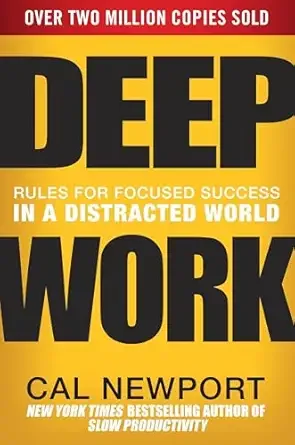
Deep Work
In Deep Work, computer science professor Cal Newport argues that the ability to focus without distraction is the defining skill of the modern economy. He divides professional activities into "deep" and "shallow" work, proving that constant connectivity actively destroys our cognitive capacity. Blending neuroscience with practical scheduling tactics, Newport provides a rigorous framework for eliminating digital noise, embracing boredom, and training your brain to produce massive value in less time.

StrengthsFinder 2.0
StrengthsFinder 2.0 by Tom Rath challenges the conventional wisdom of fixing weaknesses. Based on decades of Gallup research, it argues that the path to excellence is to identify your innate talents and invest in them to create powerful strengths. The book and its accompanying assessment reveal your top five of 34 "talent themes," providing a personalized guide to achieving higher engagement, performance, and fulfillment in your life and work.