
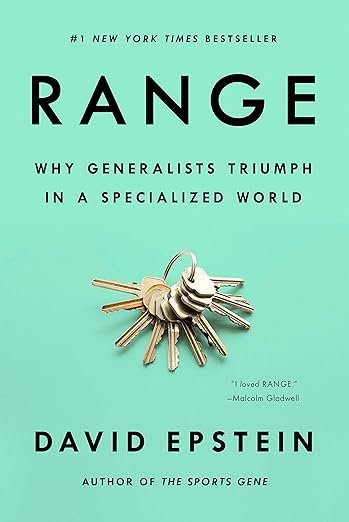
Range
Why Generalists Triumph in a Specialized World
by David Epstein
The 60-Second Take
In Range, journalist David Epstein challenges the pervasive cult of the head start. While early specialization is highly effective in predictable fields with rigid rules, the modern economy is fundamentally unpredictable. Epstein argues that generalists—professionals who sample widely, delay committing to a single path, and draw analogies across diverse disciplines—are uniquely equipped to thrive. By embracing a broad, winding path, you build the creative agility required to solve complex problems.
Why the Cult of the Head Start Has It All Wrong
We live in a culture that worships the early start. We are told that if you want to be exceptional at anything—whether that is music, sports, medicine, or business—you must pick your specialty as early as possible and begin racking up thousands of hours of deliberate practice. Parents rush to enroll toddlers in specialized sports camps, terrified they will fall behind. College students feel panicked if they have not mapped out a rigid thirty-year career plan by their sophomore year. The overarching societal narrative insists that any time spent exploring is time wasted.
In Range, David Epstein argues that this intense drive toward hyper-specialization is fundamentally misguided. Drawing on deep research from cognitive psychology, economics, and biology, Epstein demonstrates that while early specialization works perfectly for a few specific domains, it is a terrible strategy for navigating the messy, unpredictable reality of the rest of the world. He proves that the most effective, innovative, and resilient professionals are actually generalists. They are the people who stumble through diverse experiences, delay their final career choices, and build a wide array of mental models. This summary breaks down why breadth often beats depth, and why your wandering path is actually a strategic advantage.
What You'll Learn
Why the famous "10,000-hour rule" only applies to very specific, highly predictable activities
The critical difference between "kind" and "wicked" learning environments
Why quitting is often a highly strategic move to improve your career trajectory
How to solve complex problems by borrowing ideas from outside your industry
The danger of functional fixedness and why experts often make the worst forecasters
The Cult of the Head Start: Tiger Versus Roger
To illustrate the flaw in how we think about success, Epstein contrasts two of the greatest athletes in modern history: Tiger Woods and Roger Federer. Tiger Woods is the absolute poster child for the early start. His father gave him a putter at seven months old. He was beating adults on the golf course before he could read. He specialized immediately, engaged in relentless deliberate practice, and became a legend. This is the model society tells us to follow. We are conditioned to believe that if you want to win, you have to be Tiger.
Roger Federer’s path was entirely different. His mother was a tennis coach, but she explicitly refused to coach him because he wouldn't return the ball normally. As a child, Federer played squash, skiing, wrestling, swimming, skateboarding, and basketball. He did not focus entirely on tennis until his late teens. He sampled a wide variety of sports, which developed his general athleticism, hand-eye coordination, and tactical thinking. He didn't get a head start; he took a long, winding detour.
We are taught that Tiger's path is the only way to reach the top. But Epstein’s research reveals that Federer’s path is actually the statistical norm. In almost every complex domain, elite performers do not specialize early. They undergo a "sampling period" where they try many different things, gain a broad range of physical and mental skills, and discover their own preferences and aptitudes before they finally commit.
Kind Versus Wicked Learning Environments
The reason Tiger Woods's method works flawlessly for golf but fails for most careers comes down to the structure of the environment. Epstein relies on the work of psychologist Robin Hogarth to divide the world into two types of learning environments: kind and wicked.
A "kind" learning environment is one where the rules are clear, all the necessary information is available, patterns repeat, and feedback is immediate and perfectly accurate. Golf is a kind environment. Chess is a kind environment. In these domains, if you make a move, you immediately see the consequence. You can adjust and try again. In kind environments, the 10,000-hour rule of deliberate practice works perfectly because the activity is essentially a closed system of pattern recognition. Artificial intelligence excels here.
Most of human life, however, is a "wicked" learning environment. In a wicked environment, the rules are unclear, incomplete, or constantly changing. You rarely have all the information. Feedback is often delayed, inaccurate, or nonexistent. Management, investing, entrepreneurship, and medical diagnostics are wicked environments. What worked yesterday might not work today because human behavior and market forces shift unpredictably.
In a wicked environment, hyper-specialization is actually a massive liability. If you only have a hammer, you are paralyzed when the rules change and you suddenly need a wrench. Generalists thrive in wicked environments because they can adapt, draw on diverse experiences, and approach entirely novel problems with a flexible mindset.
Match Quality and the Strategic Power of Quitting
One of the most persistent myths in the business world is that grit—the stubborn refusal to quit—is always a virtue. Epstein challenges this by introducing the economic concept of "match quality." Match quality is the degree of fit between the work someone does and their inherent traits, abilities, and interests.
When you force someone to specialize early, you are forcing them to make a permanent career decision before they have any real idea who they are or what the work actually entails. Epstein highlights research by Northwestern University economist Ofer Malamud, who studied students in the rigid English higher education system (where students must specialize early) versus the flexible Scottish system (where students sample diverse classes before declaring a major). The data shows that early specializers often get a jump start on earnings right out of college. However, the late specializers—those who spend their early years trying different subjects and exploring—eventually catch up and completely surpass the early specializers in income and job satisfaction.
The late specializers take longer to settle down, but because they sampled so many options, they eventually find a career with extremely high match quality. The early specializers, meanwhile, frequently end up trapped in careers they hate, but they refuse to leave because they have already invested so much time. This means that quitting is not necessarily a failure of grit. Quitting a path that is a poor fit is a highly strategic move that frees you up to find a better match. The generalist's winding path is not a series of mistakes; it is an efficient mechanism for discovering where you can deliver the most value.
Lateral Thinking and Withered Technology
Hyper-specialization inevitably breeds functional fixedness. When you spend your entire life studying one narrow discipline, you tend to view every problem through that exact lens. Generalists excel at lateral thinking—they solve complex problems by taking a concept from one domain and applying it to an entirely different one.
Epstein highlights the story of Gunpei Yokoi, a legendary creator at Nintendo. Yokoi was not a brilliant, cutting-edge engineer. He was a generalist who tinkered with odd hobbies and possessed a broad, shallow understanding of many different fields. His philosophy was "lateral thinking with withered technology." Instead of trying to invent brand-new, highly expensive tech, Yokoi took cheap, well-understood, outdated technology (like the simple LCD screens used in pocket calculators) and combined them in novel ways. This lateral thinking resulted in the creation of the Game Boy, one of the most successful products in consumer history.
Similarly, platforms like InnoCentive prove the undeniable value of the outsider. When a corporate R&D department gets stuck on a chemistry problem for years, they post it online. Very often, the person who solves it is not a chemist at all, but a biologist, a physicist, or a lawyer who recognizes a structural parallel from their own field. Deep specialists dig the trenches, but generalists are the ones who can stand on the edge, look across the battlefield, and connect the trenches together.
Dropping Your Familiar Tools
The book closes with a stark warning about the dangers of expertise. As people become more specialized, they often become worse at predicting outcomes and adapting to new situations. They become so reliant on their specialized tools that they will literally die before dropping them.
Epstein uses the tragic metaphor of wildland firefighters. In several famous historical fires, highly trained elite firefighters perished because they refused to drop their heavy chainsaws and gear while running from a sudden blaze. Their tools were so tied to their identity as experts that dropping them felt unnatural, even when doing so would have saved their lives.
This happens cognitively in the business world all the time. When faced with a completely novel crisis, experts will cling to their familiar quantitative models, specialized frameworks, and standard operating procedures, even when the situation clearly demands a new approach. Epstein points to the NASA Challenger disaster as a prime example of managers relying entirely on strict quantitative data tools when a broader, generalist sense of reasoning was required. To survive in a wicked world, professionals must be willing to drop their familiar tools and look at problems through an entirely new lens.
Range at a Glance
Kind vs. wicked. Kind environments have clear rules and perfect feedback (chess, golf). Wicked environments have unclear rules and delayed feedback (business, investing).
The sampling period. Elite performers usually go through a period of broad, unstructured exploration before committing to a specialty.
Match quality. Finding a high degree of fit between your inherent skills and your job is far more important than getting a head start in the wrong field.
Strategic quitting. Abandoning a path that lacks match quality is a required step toward finding a better trajectory, not a lack of grit.
Functional fixedness. Deep specialists struggle to adapt to new problems because they only view the world through their specific training.
Lateral thinking. Breakthrough innovation usually happens by combining old, well-understood ideas from completely different industries.
A Quick Start Guide to Embracing Range
Run cheap experiments. If you want to change careers or learn a new skill, do not commit immediately. Find a low-risk, short-term way to sample the work before changing your whole life.
Read wildly outside your field. If you work in marketing, read about biology, architecture, or history. Exposing yourself to diverse mental models feeds your ability to think laterally.
Reframe your quitting. If you are sticking with a project solely because of the time you have already invested (sunk cost), recognize that quitting to pursue a better fit is a highly productive decision.
Hire for cognitive diversity. When building a team, do not just look for people who have done the exact same job for ten years. Look for smart outsiders who bring a completely different perspective to the table.
Drop your familiar tools. When facing a stubborn problem, intentionally force yourself to stop using the software, framework, or methodology you rely on every day to break your functional fixedness.
Who Should Read Range (and Who Can Skip It)
Read it if you have a varied, winding resume and you want to understand how to articulate your diverse background as a strategic advantage rather than a lack of focus.
Read it if you are a manager or executive trying to build an agile organization capable of solving unprecedented, complex problems in a rapidly changing market.
Read it if you are a parent feeling immense pressure to force your kids into year-round specialization in a single sport or musical instrument.
Skip it if your sole ambition is to become a competitive chess grandmaster or an elite classical musician, where a kind learning environment actually demands immediate and ruthless specialization.
Skip it if you are looking for a day-to-day productivity manual or a time management system. This book is about long-term career strategy and cognitive flexibility.
Final Reflections
Range is an incredibly liberating book for anyone who has ever felt like they were falling behind because they didn't know exactly what they wanted to do at age twenty-two. David Epstein does a masterful job of dismantling the anxiety-inducing narrative that success requires a singular, lifelong obsession. His research is rigorous, and his ability to translate academic studies into compelling, human stories keeps the narrative moving briskly. Most importantly, he provides a rigorous defense of curiosity. The book proves that in a world racing toward automation, the most valuable human skill is not the ability to execute a narrow task perfectly, but the ability to connect disparate ideas and adapt to whatever comes next.
The Bottom Line
The modern world is too complex and unpredictable for rigid hyper-specialization, so the greatest advantage you can build is a broad, varied toolkit that allows you to adapt when the rules suddenly change.
Frequently Asked Questions
What is the main idea of Range?
The main idea is that generalists—people who sample various interests, delay specialization, and build a broad range of skills—are far better equipped to succeed in our unpredictable modern world than those who specialize early.
Does Range disprove the 10,000-hour rule?
It reframes it. Epstein argues that the 10,000-hour rule of deliberate practice only works in "kind" learning environments with fixed rules and immediate feedback, like golf or classical music. It does not apply to "wicked" environments like business or innovation, where adaptability is more important than repetitive practice.
What is a "wicked" learning environment?
A wicked learning environment is a situation where the rules are unclear, patterns do not neatly repeat, and feedback is delayed or inaccurate. Most professional careers and leadership roles operate in wicked environments, requiring cognitive flexibility over narrow expertise.
Business Floss is reader-supported. When you use our links we may earn an affiliate commission that helps us keep the site running. Thank you for your support!


