
Creativity, Inc.
Good to Great
Building a Second Brand
The Lean Startup
Blue Ocean Strategy
Leaders Eat Last
The Innovator's Dilemma
Thinking, Fast and Slow
Lean In
The Power of Habit
Four Thousand Weeks
The 5AM Club
Crucial Conversations
The Infinite Game
Never Split the Difference
The First 90 Days
Creativity, Inc. Good to Great Building a Second Brand The Lean Startup Blue Ocean Strategy Leaders Eat Last The Innovator's Dilemma Thinking, Fast and Slow Lean In The Power of Habit Four Thousand Weeks The 5AM Club Crucial Conversations The Infinite Game Never Split the Difference The First 90 Days
Keep your mind fresh with summaries of the best business books
Losing The Signal
Losing the Signal is Jacquie McNish and Sean Silcoff's inside account of Research In Motion, the Waterloo company that turned a pocket email device into the tool of choice for presidents and CEOs, then watched its grip on the U.S. smartphone market slip from half to almost nothing. Drawing on interviews with executives, directors, and rivals, the two Globe and Mail journalists trace the partnership between engineer Mike Lazaridis and dealmaker Jim Balsillie, the carrier relationships that made BlackBerry thrive, and the distractions, rushed products, and leadership rifts that left it unprepared when Apple and Google rewrote the rules.
The 22 Immutable Laws of Marketing
The 22 Immutable Laws of Marketing is Al Ries and Jack Trout's compressed statement of the positioning philosophy they spent careers developing. Its foundational claim is that marketing is a battle of perceptions rather than products, and that the mind's limited capacity for categories determines almost everything. The laws run from leadership and category creation through owning a single word, the perils of line extension, and the discipline of sacrifice. Written in 1993 and unapologetically absolute, it remains one of the sharpest things written on positioning.
The Coming Wave
In The Coming Wave, DeepMind co-founder Mustafa Suleyman warns that converging technologies including AI, synthetic biology, and quantum computing will reshape society on a scale humanity has not previously contained. The book explores the "containment problem" of preventing catastrophe while still capturing the benefits. A sobering and serious treatment of where the technology curve actually leads.
Storytelling With Data
Storytelling with Data is Cole Nussbaumer Knaflic's practical guide to communicating with charts, drawn from her time at Google and in consulting. Its argument is that showing data and making a point are different tasks, and most business visuals default to the first. She organizes the work into six lessons covering context, chart selection, decluttering, directing attention, design thinking, and narrative, grounded in how visual perception actually operates. The book is software-agnostic and heavily worked through before-and-after examples rather than theory.
The Everything War
In The Everything War, Wall Street Journal reporter Dana Mattioli investigates Amazon's transformation from an online bookstore into an aggressive corporate titan. Drawing on hundreds of insider interviews, she exposes how the company leverages its massive data advantage, secret algorithms like Project Nessie, and espionage tactics through the Alexa Fund to crush competitors and copy third-party sellers. It is a sobering look at how monopolistic power reshapes global retail.
Building a StoryBrand
In Building a StoryBrand, Donald Miller shows that customers respond to clear stories, not clever marketing. His seven-part framework casts the customer as the hero and your brand as the guide who offers a plan and a call to action. By clarifying your message around what the customer wants and the problem you solve, you cut through the noise. The rule is simple: if you confuse, you lose.
First, Break All The Rules
First, Break All the Rules distills decades of Gallup research, drawing on interviews with over a million employees and eighty thousand managers, into an account of what the best managers actually do. Its central instrument is the Q12, twelve questions whose answers vary more between teams than between companies, which locates engagement with the immediate manager. Its central argument is four keys: select for talent rather than experience, define outcomes rather than steps, build on strengths rather than fixing weaknesses, and find the right fit rather than the next promotion.
Inspired
Inspired is Marty Cagan's account of how strong product organizations actually operate, drawn from decades at eBay, HP, and Netscape and years advising companies through the Silicon Valley Product Group. Its central distinction is between feature teams that receive specifications and empowered teams that receive problems. The book covers the four risks discovery exists to eliminate, why discovery and delivery run in parallel rather than in sequence, the case against feature roadmaps, and what the product manager, designer, and engineering lead each actually contribute.

$100M Offers
$100M Offers is Alex Hormozi's manual for constructing what he calls a Grand Slam Offer: a bundled proposition valuable enough that price comparison with competitors becomes impossible. Built from his experience scaling gyms and later a portfolio of companies, it argues most businesses fail not because their product is poor but because their offer is weak and commoditized. The book supplies a value equation with four levers, a five-step process for building an offer around customer obstacles, and five enhancers covering scarcity, urgency, bonuses, guarantees, and naming.

The Box
The Box is Marc Levinson's history of the shipping container and the economic transformation it produced. Its central argument is that the container was not an invention so much as a system: standardized dimensions, purpose-built ships, redesigned ports, compatible trucks and rail, and labor agreements, all of which had to arrive together before any of it worked. Levinson traces Malcom McLean's role, the standardization fights, the union negotiations, the Vietnam logistics contract that proved the concept, and the resulting collapse of historic port cities alongside the rise of global supply chains.
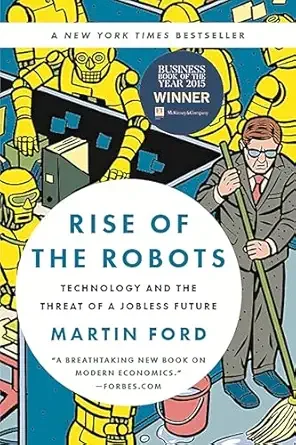
Rise of the Robots
Rise of the Robots is Martin Ford's argument that this wave of automation differs from previous ones in ways that matter economically. A software entrepreneur, Ford contends that information technology functions as a general-purpose capability rather than a task-specific tool, that it increasingly targets educated white-collar work rather than only routine manual labor, and that seven observable economic trends already show the strain. He argues more education won't solve it, that mass automation eventually undermines the consumer demand it depends on, and that a guaranteed basic income deserves serious consideration.
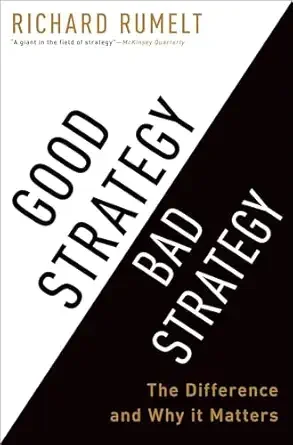
Good Strategy Bad Strategy
In Good Strategy Bad Strategy, UCLA professor Richard Rumelt takes one of business's most abused words and gives it a spine. Most of what organizations call strategy, he argues, is ambition in disguise: goals, slogans, and template mission statements that never name the actual obstacle. Real strategy has a structure he calls the kernel, built from an honest diagnosis, a guiding policy, and coherent actions that reinforce one another. Drawing on Sam Walton, Nvidia, Apple's 1997 turnaround, and Desert Storm, Rumelt shows why focus beats ambition and why the hardest part of strategy is deciding what not to do.
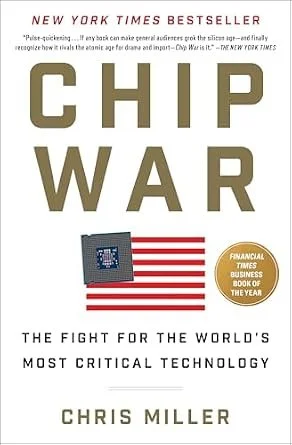
Chip War
In Chip War, economic historian Chris Miller traces how a sliver of silicon became the resource that determines who holds power. From Bell Labs and Cold War missile guidance to Morris Chang's foundry model and ASML's lithography monopoly, he shows how a globe-spanning supply chain quietly concentrated into a few irreplaceable chokepoints, and why Taiwan now sits at the center of the rivalry between Washington and Beijing.
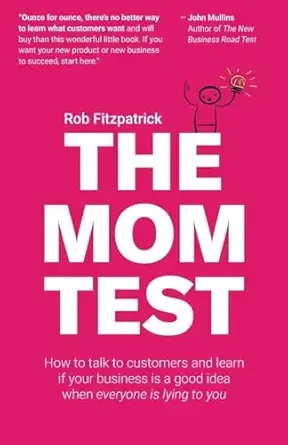
The Mom Test
In The Mom Test, Rob Fitzpatrick offers a deceptively simple guide to customer conversations that actually reveal the truth. Because friends and family will tell you what you want to hear, he provides rules for asking questions so good that even your mom can't lie: talk about their life, not your idea; ask about specific past behavior, not hypotheticals; and listen more than you pitch. It is an essential, practical book for any founder validating an idea.
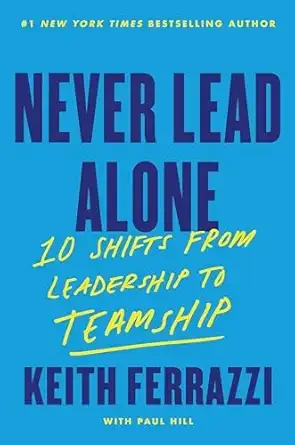
Never Lead Alone
In Never Lead Alone, executive coach Keith Ferrazzi argues that the era of the individual hero leader is dead. Drawing from decades of research, he outlines a transformational shift from traditional top-down management to "teamship." By embracing co-elevation, peer-to-peer accountability, and structured candor, organizations can dismantle the silos and conflict avoidance that destroy value. Master these shifts to build a deeply resilient, high-performing, and unified team.

Supremacy
In Supremacy, technology journalist Parmy Olson chronicles the high-stakes rivalry between OpenAI and DeepMind. She reveals how the noble quest to build artificial general intelligence devolved into a cutthroat proxy war between tech monopolies. By tracing the paths of Sam Altman and Demis Hassabis, Olson exposes how massive computing costs forced idealistic founders to compromise their safety principles, prioritizing rapid commercialization over the public good.
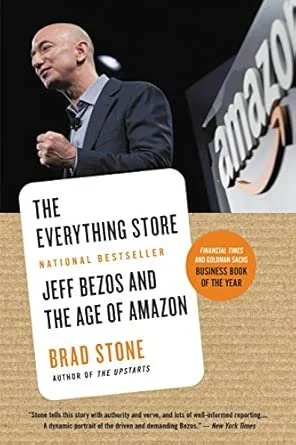
The Everything Store
In The Everything Store, Brad Stone provides the definitive, unvarnished history of Amazon and its relentless founder, Jeff Bezos. Stone reveals how Amazon grew from a scrappy online bookstore into a global juggernaut by relying on a deeply contrarian playbook. By prioritizing extreme customer obsession, decades-long strategic thinking, and a famously ruthless corporate culture, Bezos proved that prioritizing long-term market dominance over short-term profits is the ultimate competitive advantage.
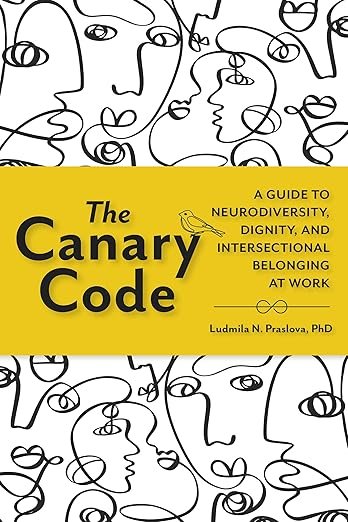
The Canary Code
In The Canary Code, organizational psychologist and autistic community member Ludmila N. Praslova provides a comprehensive framework for neuroinclusion at work. She argues that neurodivergent employees are like canaries in a coal mine, sensing toxic environments and broken workflows first. By shifting from a deficit model to a dignity-based approach built on six core principles, organizations can create flexible, transparent systems where all talent thrives.
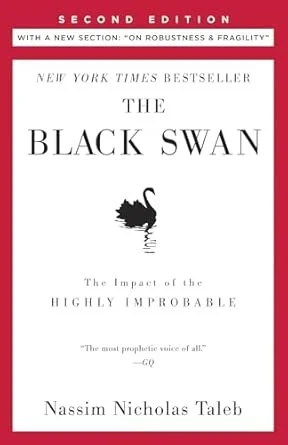
The Black Swan
In The Black Swan, former options trader and philosopher Nassim Nicholas Taleb exposes the severe limitations of human prediction. He argues that history is driven not by predictable trends, but by highly improbable, high-impact events he calls Black Swans. By abandoning flawed bell-curve risk models and adopting a robust "barbell" strategy, professionals can stop acting like the Thanksgiving turkey and learn to survive in an inherently unpredictable world.
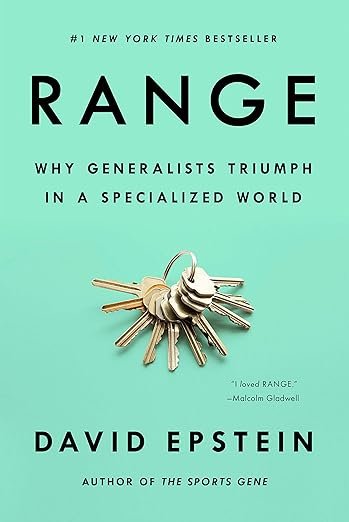
Range
In Range, journalist David Epstein challenges the pervasive cult of the head start. While early specialization is highly effective in predictable fields with rigid rules, the modern economy is fundamentally unpredictable. Epstein argues that generalists—professionals who sample widely, delay committing to a single path, and draw analogies across diverse disciplines—are uniquely equipped to thrive. By embracing a broad, winding path, you build the creative agility required to solve complex problems.