
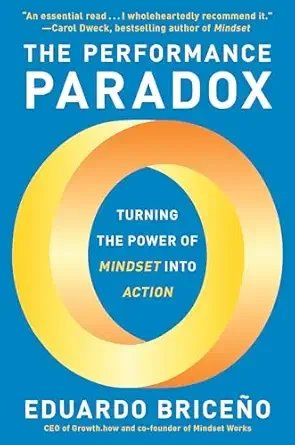
The Performance Paradox
by Eduardo Briceño
The 60-Second Take
In The Performance Paradox, executive coach Eduardo Briceño exposes why high performers eventually plateau: they spend all their effort executing and none of it improving. His remedy is a deliberate split between the Performance Zone, where you do what you know, and the Learning Zone, where you build what you don't. Master the rhythm between them and growth stops being accidental.
The Performance Paradox: Why Your Best Effort Might Be Holding You Back
There's a quiet frustration that hits most ambitious professionals somewhere around year five or seven of their career. You're working hard. You're delivering. Your calendar is packed. And yet... you sense you've stopped getting better. The promotions slow down. The skills you'd planned to build never quite arrive. You feel busy, useful, and oddly stuck all at once.
Eduardo Briceño, executive coach and co-founder of Mindset Works alongside Carol Dweck, calls this the Performance Paradox. His central claim in the book is both simple and uncomfortable: the more time we spend trying to perform well, the less we actually improve. And without improvement, performance eventually flattens. Briceño's solution isn't to work less, hustle less, or care less. It's to deliberately split your time between two distinct modes of operating, and to recognize that most of us have been stuck in one of them for years.
What You'll Learn
Why being "always on" can silently cap your career growth
The difference between the Performance Zone and the Learning Zone, and how to move between them
Which kinds of mistakes are worth celebrating and which to root out
A weekly routine that protects time for genuine improvement
How to lead teams that get better, not just busier
The Chronic Performance Trap
Briceño argues that most of us live in what he calls Chronic Performance: a state where every working hour is spent executing known tasks, optimizing output, and avoiding errors. It feels productive because, well, things are getting done. But chronic performance has a hidden cost. When you only do what you already know how to do, you never practice the awkward, uncertain motions that lead to new capability.
Think of a customer service rep who has answered the same five complaint types for three years. She's fast. She's praised. Her metrics are excellent. But the day her company introduces a new product line, she's no more equipped to learn it than someone hired yesterday. She performed her way into a corner.
The Performance Paradox is essentially this: high performers who never step outside performance mode eventually lose the very edge that made them high performers.
The Two Zones That Change Everything
Briceño's core framework divides effortful activity into two distinct zones, and the book argues that both are necessary.
The Performance Zone is where you execute. The goal is to do what you already know, as well as you can, with minimal mistakes. This is your client meeting, your live presentation, your closing pitch.
The Learning Zone is where you improve. The goal is to expand what you can do. Mistakes are not just acceptable here, they're the point. This is deliberate practice, reflection, experimentation, and feedback-seeking.
The trick is that these zones look almost identical to an outside observer. A pianist running scales and a pianist performing a recital both appear to be playing the piano. The difference is internal: one is trying to expand a skill, the other is trying to express it flawlessly.
The Two Zones at a Glance
Performance Zone: Execute known skills. Minimize mistakes. Goal is the result.
Learning Zone: Expand new skills. Embrace mistakes. Goal is the improvement.
Chronic Performance: Living only in the Performance Zone. Feels productive but causes long-term stagnation.
The Integration: High performers alternate intentionally between zones, often within the same day or week.
Not All Mistakes Are Created Equal
One of the most useful contributions in the book is Briceño's taxonomy of mistakes. He pushes back hard on the corporate slogan of "fail fast," noting that not every failure is educational. He breaks them into four buckets.
Stretch mistakes happen when you try something just beyond your current capability. These are the engine of growth. A new manager fumbling her first tough conversation is making a stretch mistake.
Aha-moment mistakes occur when you discover a hidden assumption you didn't know you were holding. These often spark the biggest breakthroughs.
Sloppy mistakes are errors on tasks you already know how to do. These are worth eliminating, not celebrating.
High-stakes mistakes happen when the cost of failure is severe. These should be avoided through rehearsal and Learning Zone work before the high-stakes moment arrives.
The implication is liberating. You don't have to feel guilty about every misstep, and you don't have to romanticize every failure either. The question is which kind of mistake you just made, and what it's telling you.
Designing Your Personal Learning Zone
The book gets practical about how to actually build Learning Zone time into a working week that already feels overstuffed. A few of the most useful tactics:
Schedule it. If Learning Zone work isn't on the calendar, it loses every battle with Performance Zone urgencies. Block 30 to 60 minutes, two or three times a week.
Ask better feedback questions. Instead of "How did I do?" (which invites polite affirmation), try "What's one thing I could have done differently?" or "Where did I lose you?"
Practice deliberately. Pick a specific subskill, work on it in low-stakes conditions, and get rapid feedback. A consultant who wants to improve executive communication might rehearse the first 90 seconds of a board presentation a dozen times before doing it live.
Reflect with intent. A five-minute weekly review of what you learned beats an hour of vague journaling. Briceño cites research showing that brief, structured reflection meaningfully improves performance on the next round.
A salary negotiation example from the book sticks with you. A coachee, instead of winging her annual review, spent two weeks rehearsing the conversation with a friend, predicting objections, refining responses. The actual conversation lasted twenty minutes. She walked out with a raise nearly double what she'd planned to ask for. Pure Learning Zone investment paying off in a Performance Zone moment.
Building a Team That Actually Improves
For leaders, the Performance Paradox becomes an organizational problem. Teams that punish mistakes, reward only output, and frame every meeting as a status update will produce chronic performers at scale.
Briceño's prescription for leaders includes:
Modeling Learning Zone behavior openly (sharing what you're working on improving)
Distinguishing publicly between stretch mistakes and sloppy mistakes
Creating psychological safety so people will admit uncertainty
Building learning rituals into the team's calendar (retros, skill swaps, post-mortems that don't devolve into blame)
The leaders he profiles tend to share a habit: they ask "What did we learn?" with the same regularity that most managers ask "Did we hit the number?"
Quick Start Guide: Your First 14 Days
Days 1-2: Diagnose. Track where your hours go. Label each block as Performance Zone, Learning Zone, or neither. Most people are shocked at the ratio.
Days 3-5: Pick one skill. Choose a single capability you want to grow. Make it specific. Not "be a better communicator" but "open meetings more crisply."
Days 6-10: Schedule three Learning Zone blocks. Thirty minutes each. Practice the chosen skill in low-stakes conditions. Solicit feedback.
Days 11-12: Audit your mistakes. Categorize the last week's slip-ups into Briceño's four buckets. Which ones taught you something? Which are worth eliminating?
Days 13-14: Reflect and reset. Spend ten minutes capturing what worked. Then plan next week's Learning Zone blocks before the calendar fills.
Final Reflections
The Performance Paradox is a quiet rebuke to hustle culture and a thoughtful corrective to the "fail fast" cliché. Briceño's argument is that the dichotomy of working hard versus working smart misses the real question, which is whether you're working to execute or working to improve. Both matter. The professionals and teams that compound over decades are the ones who stop treating learning as something that happens accidentally, and start treating it as a discipline as deliberate as performance itself. Pick a skill, build the time, welcome the right kinds of mistakes, and the paradox dissolves.
Business Floss is reader-supported. When you use our links we may earn an affiliate commission that helps us keep the site running. Thank you for your support!


