
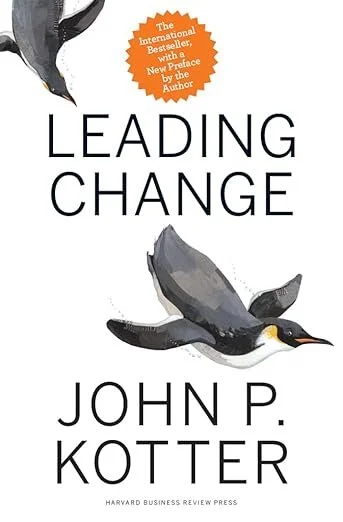
Leading Change
by John P. Kotter
The 60-Second Take
In Leading Change, Harvard professor John P. Kotter lays out the eight-step framework that has defined modern change management. Drawing on decades of research across hundreds of organizations, he reveals why most transformation efforts fail and exactly what leaders must do to beat those odds. From building urgency to anchoring new behaviors in culture, this book remains the go-to guide for anyone leading meaningful change.
Why 70% of Change Efforts Fail (and How to Beat the Odds)
Almost every leader has lived through it. The all-hands meeting where the new strategy gets unveiled with great fanfare, the slide deck that promises a bold new direction, the launch that quietly fizzles by Q3 as everyone returns to the way things have always been done. After studying hundreds of organizations attempting major change, Harvard Business School professor John P. Kotter found a brutal pattern: most transformation efforts fall short, and the reasons are remarkably predictable.
In Leading Change, Kotter delivers what has become the most influential framework in organizational change management. First published in 1996 and refreshed for the modern era, the book breaks down why companies stumble when they try to transform themselves and provides an eight-step roadmap for leaders who want to actually pull it off. Whether you're rolling out new technology, reshaping a culture, or steering through a merger, Kotter's playbook gives you a clear sequence to follow when the stakes are high and the resistance is real.
What You'll Learn
The eight common mistakes that doom most change efforts before they begin
Kotter's eight-step framework for leading transformation that actually sticks
The crucial difference between management and leadership, and why both are needed
How to build urgency without creating panic
Why short-term wins are non-negotiable for keeping momentum alive
The Eight Errors That Sink Transformations
Before laying out his solution, Kotter dissects the failure modes. He identifies eight errors he saw repeated across companies in industries ranging from retail to manufacturing to financial services.
Common pitfalls include allowing too much complacency, failing to assemble a powerful enough coalition of leaders, underestimating how compelling a vision must be, and undercommunicating that vision by a factor of ten or more. Other deal-breakers: tolerating obstacles that block progress, declaring victory before the change has truly taken root, and forgetting to weave new behaviors into the culture so they survive the next leadership change.
Each of these mistakes traces back to a single root cause: leaders treat change as a logistical exercise rather than a deeply human one. Spreadsheets and Gantt charts are necessary, but they don't move people. Hearts do.
Step One: Manufacture a Sense of Urgency
Most change efforts begin too gently. Leaders schedule an offsite, draft a memo, and assume the message will trickle down. It rarely does. Kotter argues the first job of any transformation leader is to crank up the urgency level so high that complacency becomes uncomfortable.
This isn't about manufacturing a crisis or screaming about the burning platform. It's about confronting people with hard data: shrinking margins, customer defections, competitive threats, or market shifts they may have been quietly avoiding. One executive at a struggling industrial company stopped softening the bad news in his quarterly updates and started showing the raw numbers, including which customers had recently left and why. Within a quarter, the conversations across the company shifted from defending past decisions to figuring out what to do next.
Step Two: Build a Guiding Coalition
A single executive, no matter how charismatic, cannot drive change alone. Kotter insists transformation requires a coalition of people with the right mix of position power, expertise, credibility, and leadership instincts. The team needs enough authority to move the organization and enough trust from rank-and-file employees that the message actually lands.
Crucially, this coalition must work as a team. That means meeting often, building genuine trust with one another, and aligning around a shared view of what needs to happen. Without that internal cohesion, the broader effort fractures the moment serious resistance shows up.
Step Three: Develop a Vision That Actually Inspires
A vision is not a mission statement, and it's certainly not a list of financial targets. Kotter offers a useful test: a strong vision should be communicable in five minutes and produce a reaction of understanding and interest. If it takes a thirty-page memo to explain, it isn't a vision; it's a plan.
Effective change visions paint a clear picture of the future, appeal to the long-term interests of employees and customers, and stay flexible enough to adapt as circumstances shift. They give people a reason to care.
Step Four: Communicate Until You're Sick of Hearing Yourself
Here Kotter delivers one of his most quoted lines: most leaders undercommunicate the vision by a factor of ten, a hundred, or even a thousand. A single town hall is not enough. Neither is one email blast. The vision needs to show up in every speech, every team meeting, every performance review, and every casual hallway conversation.
Even more important, leaders must walk the talk. Nothing kills a change vision faster than a CEO who preaches collaboration in public and rewards turf-protectors in private.
Step Five: Empower People to Knock Down Walls
Once the vision is clear, the real friction begins. Old structures, outdated systems, and middle managers who feel threatened can quietly grind progress to a halt. Kotter urges leaders to actively remove barriers: rewriting job descriptions, retraining employees, updating IT systems, and confronting managers who undermine the effort.
Empowerment means more than a motivational speech. It means giving people the resources and authority to act, then getting out of their way.
Step Six: Stack Up Short-Term Wins
Transformation is a marathon, but humans need proof of progress along the way. Kotter recommends planning for visible wins within the first six to eighteen months. These might be a successful pilot in one region, a new product launch that beats expectations, or a significant cost reduction in a single business unit.
Short-term wins do double duty. They reward the people doing the work, and they shut down the skeptics who are quietly waiting for the whole thing to collapse.
Step Seven: Don't Declare Victory Too Early
The biggest trap is celebrating too soon. After the first wave of wins, leaders often relax, declare success, and turn their attention elsewhere. Kotter warns this is exactly when change tends to unravel. New behaviors haven't yet become habits, and old ways of working are still lurking just beneath the surface.
Instead, use the credibility of early wins to take on bigger challenges. Tackle the systems and structures that resisted the first round. Bring in new people. Keep pushing.
Step Eight: Anchor Change in the Culture
Change only sticks when it becomes "the way we do things around here." That means weaving new behaviors into hiring practices, promotion decisions, training programs, and the stories leaders tell. When the next generation of leaders rises through the ranks already living the new values, the transformation is complete.
Core Concepts at a Glance
Sense of Urgency: The fuel for change. Without it, complacency wins.
Guiding Coalition: A team of credible leaders driving the effort together.
Change Vision: A clear, inspiring picture of the future that fits on one page.
Short-Term Wins: Proof points that build momentum and silence skeptics.
Cultural Anchor: The final mile, where new behaviors become unwritten norms.
Management vs. Leadership: Why Both Matter
A theme running beneath all eight steps is Kotter's distinction between management and leadership. Management is about planning, budgeting, organizing, and problem-solving. It produces predictability and order. Leadership is about establishing direction, aligning people, and motivating them to push through obstacles. It produces meaningful change.
Kotter's point isn't that one beats the other. Most organizations have plenty of management and not nearly enough leadership. Transformation requires a heavy dose of leadership at every level, not just at the top.
Quick Start Guide: Launching a Change Effort This Quarter
Audit complacency. Walk the floor and listen. Are people too comfortable? What facts would shake them?
Recruit your coalition. Identify five to ten leaders with credibility and clout. Build trust through working sessions, not just status updates.
Draft a one-page vision. Test it on a frontline employee. If they can't repeat the gist back to you, rewrite it.
Build a communication cadence. Calendar weekly touchpoints where the vision shows up in meetings, emails, and storytelling.
Identify your first short-term win. Pick something achievable within ninety days that will be impossible to ignore.
Map the obstacles. List structural, systemic, and human barriers. Assign owners to remove them.
Plan the culture work early. Decide now what new behaviors will be hired for, promoted, and celebrated.
Final Reflections
Leading Change endures because it gets the human reality of transformation right. Kotter's eight-step framework is not a rigid checklist but a sequence of conditions that must hold for change to take root: urgency, coalition, vision, communication, empowerment, wins, persistence, and cultural integration. Skip a step or rush the timeline and the effort tends to collapse on itself. The harder lesson is that real transformation is less about strategy decks and more about leadership behavior sustained over years against constant resistance. For any leader trying to move an organization from where it is to where it needs to be, this book remains the foundational playbook.
Business Floss is reader-supported. When you use our links we may earn an affiliate commission that helps us keep the site running. Thank you for your support!


