
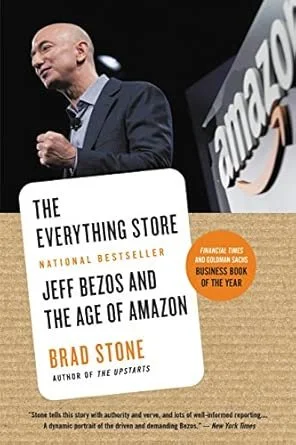
The Everything Store
Jeff Bezos and The Age of Amazon
by Brad Stone
The 60-Second Take
In The Everything Store, Brad Stone provides the definitive, unvarnished history of Amazon and its relentless founder, Jeff Bezos. Stone reveals how Amazon grew from a scrappy online bookstore into a global juggernaut by relying on a deeply contrarian playbook. By prioritizing extreme customer obsession, decades-long strategic thinking, and a famously ruthless corporate culture, Bezos proved that prioritizing long-term market dominance over short-term profits is the ultimate competitive advantage.
Why Worrying About Your Competitors Will Bankrupt You
The corporate graveyard is filled with companies that tried to win by watching their rivals. They tracked what their competitors were building, matched their pricing, and copied their marketing. In The Everything Store: Jeff Bezos and the Age of Amazon, Brad Stone explains why this mindset guarantees mediocrity. When you focus on your competitors, you are fighting over the status quo. Jeff Bezos built the most powerful retail empire in human history by demanding his team ignore the competition entirely and obsess exclusively over the customer.
Stone’s book is not a sanitized, corporate-approved history. It is a gritty, highly researched look at the mechanical strategies and intense human sacrifices that forged Amazon. From his early days working at a Wall Street hedge fund to becoming the richest man on the planet, Bezos utilized a specific set of mental models that allowed him to make massive, highly unpopular bets. This summary extracts the operational playbook that Amazon used to survive the dot-com crash and systematically conquer global commerce.
What You'll Learn
The "Regret Minimization Framework" Bezos used to leave a lucrative Wall Street job
Why true customer obsession requires actively cannibalizing your own business
How the "two-pizza team" structure enables rapid, decentralized innovation
Why Amazon views inter-departmental communication as a structural defect
The strategy of ignoring short-term Wall Street pressure to build unassailable scale
The Regret Minimization Framework
In 1994, Jeff Bezos had a highly secure, extremely lucrative job at the quantitative hedge fund D.E. Shaw & Co. He had stumbled upon a staggering statistic: internet usage was growing at 2,300 percent a year. He realized that a massive digital marketplace was inevitable, and he wanted to build an "everything store".
Walking away from a massive mid-year Wall Street bonus to sell books out of a garage seemed completely irrational to his peers. To make the decision, Bezos employed a mental model he called the Regret Minimization Framework. He projected himself forward to age eighty. He reasoned that at eighty years old, he would never regret walking away from a Wall Street bonus. He would, however, be haunted by the regret of never trying to participate in the birth of the internet. By viewing the decision through the lens of long-term regret rather than short-term fear, the choice became remarkably easy.
This framework became the psychological foundation of Amazon. It empowered Bezos to consistently make bold, highly contrarian decisions that prioritized long-term upside over immediate, short-term safety.
Customer Obsession and the Flywheel
Virtually every company claims to put the customer first. At Amazon, customer obsession is enforced with a ruthless, almost terrifying intensity. Bezos frequently reminded his employees that they should wake up every morning terrified—not of their competitors, but of their customers. Competitors will never send you money, but customers are intensely loyal right up until the moment someone else offers them a better service.
This obsession birthed the Amazon Flywheel. The logic is simple but devastatingly effective. Amazon focused on offering the lowest possible prices, which naturally attracted more customers. This massive volume of customer traffic attracted third-party sellers to the platform. More sellers meant greater product selection, which further improved the customer experience. This scale allowed Amazon to lower its fixed costs, and Bezos insisted that those savings be passed directly back to the consumer in the form of even lower prices, spinning the flywheel faster.
True customer obsession requires making decisions that look foolish on a quarterly balance sheet. For example, Amazon eventually allowed third-party sellers to advertise their products directly on Amazon’s own product pages, even if the third party was selling the item cheaper than Amazon. Short-term, this cannibalized Amazon’s direct sales. Long-term, it guaranteed that the customer always got the best price without leaving the site, cementing absolute trust in the platform.
Two-Pizza Teams and Decentralized Speed
As startups scale into massive corporations, they inevitably slow down. Bureaucracy sets in, and launching a new product requires the approval of five different committees. When Amazon began facing these growing pains, a group of junior executives suggested that the company needed more meetings to fix their internal disjointedness.
Bezos immediately shut the idea down, declaring that "communication is a sign of dysfunction". He argued that if teams constantly have to communicate with each other to get their work done, the organizational structure is broken. Heavy communication implies that teams are dependent on one another, creating massive bottlenecks.
To solve this, Bezos decentralized the company using the "two-pizza team" rule. He mandated that no team should be larger than what two pizzas could feed (roughly six to ten people). These small, autonomous units were given absolute ownership over specific metrics and functions. They did not need to coordinate with the rest of the company or ask for permission to innovate. By treating forced communication as a defect, Amazon maintained the agility of a startup even as it grew to hundreds of thousands of employees.
The Everything Store at a Glance
Regret Minimization. Project yourself to age eighty to make high-stakes decisions based on avoiding lifelong regrets rather than short-term fears.
Customer Obsession. Ignore competitors and focus entirely on building a superior, frictionless customer experience.
The Amazon Flywheel. Lower prices drive volume, volume drives scale, and scale drives lower costs, allowing for even lower prices.
Two-Pizza Teams. Keep operational groups small and autonomous to maintain speed and eliminate bureaucratic communication.
Long-Term Thinking. Willingly accept massive short-term financial losses to secure unassailable long-term market dominance.
A Quick Start Guide to the Amazon Playbook
Apply the Regret Framework. Before making a major career move or launching a new product, ask yourself if your eighty-year-old self will regret passing on the opportunity.
Cannibalize your own products. If there is a cheaper, faster way to serve your customer, build it—even if it directly threatens your current highest-margin product.
Shrink your meetings. If the group working on a specific project cannot be fed with two pizzas, the team is too large and will struggle to execute quickly.
Stop looking at competitors. Redirect the energy you spend tracking your rivals into figuring out what your customers actually hate about your industry.
Treat communication as a defect. Redesign your workflows so that individuals have the autonomy to execute their tasks without waiting for permission from three other departments.
Who Should Read The Everything Store (and Who Can Skip It)
Read it if you are a founder trying to understand the actual mechanics of scaling a startup into a massive enterprise without losing your agility.
Read it if you want a masterclass in long-term strategic thinking and are willing to sacrifice short-term optics for absolute market dominance.
Read it if you are interested in the unvarnished, often ruthless reality of what it takes to build a generational monopoly.
Skip it if you are looking for a warm, feel-good book on empathetic leadership and work-life balance; Bezos's management style is notoriously demanding and unsentimental.
Skip it if you just want a tactical guide on how to sell products via Amazon FBA today. This is an operational history of the company, not an e-commerce tutorial.
Final Reflections
Brad Stone's biography is both an awe-inspiring business manual and a sobering cautionary tale. The sheer strategic brilliance of Jeff Bezos is undeniable. The relentless focus on the customer, the willingness to look foolish to Wall Street for years, and the structural innovations like AWS and Prime redefined global commerce. However, the book does not shy away from the human cost of this ambition. The culture of severe "frugality" and the absolute intolerance for work-life balance serve as a stark reminder that building a historic empire requires extreme, often painful, sacrifices. It is a mandatory read for anyone who wants to understand the brutal realities of the modern digital economy.
The Bottom Line
Building a generational business requires ignoring the short-term demands of competitors and markets, and instead obsessing entirely over delivering extreme long-term value to the customer.
Frequently Asked Questions
What is the main idea of The Everything Store?
Brad Stone chronicles the rapid rise of Amazon, arguing that its unparalleled success comes from Jeff Bezos's relentless long-term thinking, a notoriously demanding corporate culture, and an absolute obsession with customer satisfaction over short-term profits.
What is the Regret Minimization Framework?
It is a mental model Bezos used to decide to leave his comfortable Wall Street job to start Amazon. When faced with a risky decision, he projected himself to age eighty and asked if he would regret not trying it, prioritizing bold action over the safety of the status quo.
Why did Bezos say "communication is a defect"?
In large organizations, heavy communication usually means teams are overly dependent on each other, causing massive bureaucratic bottlenecks. Bezos believed teams should be small, self-sufficient "two-pizza teams" that can execute their goals without needing to coordinate with the rest of the company.
Bonus Content
Business Floss is reader-supported. When you use our links we may earn an affiliate commission that helps us keep the site running. Thank you for your support!


