
Creativity, Inc.
Good to Great
Building a Second Brand
The Lean Startup
Blue Ocean Strategy
Leaders Eat Last
The Innovator's Dilemma
Thinking, Fast and Slow
Lean In
The Power of Habit
Four Thousand Weeks
The 5AM Club
Crucial Conversations
The Infinite Game
Never Split the Difference
The First 90 Days
Creativity, Inc. Good to Great Building a Second Brand The Lean Startup Blue Ocean Strategy Leaders Eat Last The Innovator's Dilemma Thinking, Fast and Slow Lean In The Power of Habit Four Thousand Weeks The 5AM Club Crucial Conversations The Infinite Game Never Split the Difference The First 90 Days
Keep your mind fresh with summaries of the best business books
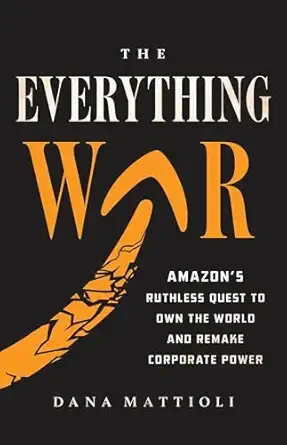
The Everything War
In The Everything War, Wall Street Journal reporter Dana Mattioli investigates Amazon's transformation from an online bookstore into an aggressive corporate titan. Drawing on hundreds of insider interviews, she exposes how the company leverages its massive data advantage, secret algorithms like Project Nessie, and espionage tactics through the Alexa Fund to crush competitors and copy third-party sellers. It is a sobering look at how monopolistic power reshapes global retail.
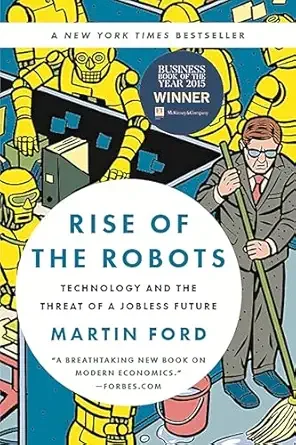
Rise of the Robots
Rise of the Robots is Martin Ford's argument that this wave of automation differs from previous ones in ways that matter economically. A software entrepreneur, Ford contends that information technology functions as a general-purpose capability rather than a task-specific tool, that it increasingly targets educated white-collar work rather than only routine manual labor, and that seven observable economic trends already show the strain. He argues more education won't solve it, that mass automation eventually undermines the consumer demand it depends on, and that a guaranteed basic income deserves serious consideration.
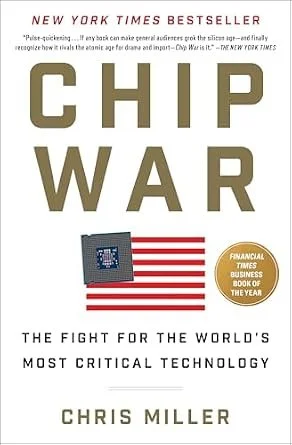
Chip War
In Chip War, economic historian Chris Miller traces how a sliver of silicon became the resource that determines who holds power. From Bell Labs and Cold War missile guidance to Morris Chang's foundry model and ASML's lithography monopoly, he shows how a globe-spanning supply chain quietly concentrated into a few irreplaceable chokepoints, and why Taiwan now sits at the center of the rivalry between Washington and Beijing.
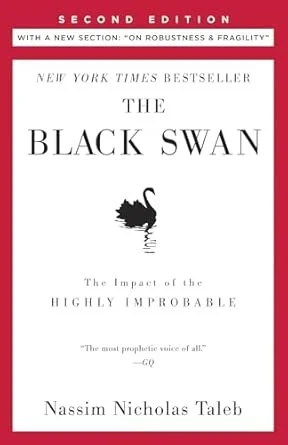
The Black Swan
In The Black Swan, former options trader and philosopher Nassim Nicholas Taleb exposes the severe limitations of human prediction. He argues that history is driven not by predictable trends, but by highly improbable, high-impact events he calls Black Swans. By abandoning flawed bell-curve risk models and adopting a robust "barbell" strategy, professionals can stop acting like the Thanksgiving turkey and learn to survive in an inherently unpredictable world.
The Second Machine Age
In The Second Machine Age, MIT researchers Erik Brynjolfsson and Andrew McAfee explain how digital technologies are doing for human brainpower what the steam engine did for muscle power. While this era promises unprecedented abundance, it also creates severe economic inequality by hollowing out routine jobs. To thrive, professionals must stop competing against computers and learn to race alongside them by mastering ideation, complex communication, and large-frame pattern recognition.
The Big Short
In The Big Short, journalist Michael Lewis tells the story of a handful of investors who saw the 2008 housing crisis coming and bet against the mortgage bond market. The book uses their stories to explain how subprime lending, credit default swaps, and rating agency failures produced the financial crisis. Useful reading for any finance professional trying to understand how markets get things spectacularly wrong.

The Power of Resilience
In The Power of Resilience, MIT supply chain expert Yossi Sheffi explores how globalization and lean manufacturing have made modern businesses dangerously fragile. Drawing on high-stakes corporate crises, Sheffi provides a comprehensive framework for managing risk. He argues that companies must move beyond costly redundancy and build inherent flexibility—mapping deep-tier suppliers, standardizing components, and fostering a culture of rapid detection—to survive and thrive during unexpected disruptions.

Global Vision
In Global Vision, NYU Stern professor Robert Salomon dismantles the myth that the modern business world is flat and borderless. He introduces the concept of Institutional Distance, demonstrating how political, economic, and cultural differences create a dangerous "liability of foreignness" for expanding companies. By teaching leaders to mathematically price global risk, the book provides a rigorous toolkit for avoiding the costly pitfalls of international expansion.

The Personal MBA
In The Personal MBA, Josh Kaufman demystifies the corporate world by arguing that you do not need expensive graduate school to master business. He distills the entirety of business practice into five interdependent processes: Value Creation, Marketing, Sales, Value Delivery, and Finance. By understanding these core mechanics, alongside fundamental human psychology and systems thinking, anyone can build a profitable enterprise and make highly effective, real-world business decisions.

Age of Discovery
In Age of Discovery, Ian Goldin and Chris Kutarna argue that our current era of globalization and technological explosion represents a Second Renaissance. Just as Gutenberg’s press and global exploration birthed immense genius and devastating upheaval five centuries ago, today's hyper-connected world brings both unprecedented prosperity and fragile systemic risks. To survive, leaders must embrace bold innovation while managing the inevitable social backlash of rapid change.

Freakonomics
Freakonomics by Steven D. Levitt and Stephen J. Dubner is a mind-bending exploration of the hidden side of everything. Using the tools of economics, the book argues that incentives are the key to understanding human behavior, from cheating sumo wrestlers to real-estate agents. It debunks conventional wisdom with data-driven analysis on topics like crime rates and parenting, teaching readers a new, skeptical, and powerfully insightful way to look at the world and its complexities.

Thinking, Fast and Slow
In Thinking, Fast and Slow, Nobel laureate Daniel Kahneman provides a masterclass in human irrationality. He reveals that our minds operate on two systems: one fast, intuitive, and prone to hidden biases, the other slow, logical, and incredibly lazy. By exposing the predictable mental shortcuts we take, Kahneman offers a profound framework for making better decisions in business and life while recognizing the limits of our own objectivity.

How Soccer Explains the World
In How Soccer Explains the World, journalist Franklin Foer uses humanity's most popular sport to test the optimistic promises of globalization. Traveling from the violent terraces of Serbia to the suburban fields of America, he reveals how global capitalism failed to erase tribalism, nationalism, and corruption. Instead, the beautiful game exposes how fiercely people cling to local identities and sectarian divides in a rapidly integrating world.