
Chip War
The Fight for the World’s Most Critical Technology
by Chris Miller
The 60-Second Take
In Chip War, economic historian Chris Miller traces how a sliver of silicon became the resource that determines who holds power. From Bell Labs and Cold War missile guidance to Morris Chang's foundry model and ASML's lithography monopoly, he shows how a globe-spanning supply chain quietly concentrated into a few irreplaceable chokepoints, and why Taiwan now sits at the center of the rivalry between Washington and Beijing.
Everything You Own Depends on a Few Factories You've Never Heard Of
Oil built the twentieth century, and everyone knew it. Wars were fought over it, cartels formed around it, and presidents lost elections when its price spiked. The equivalent resource of the twenty-first century is a patterned wafer of silicon, and almost nobody outside the industry paid attention until the pandemic emptied car dealerships because a few plants in Asia couldn't ship enough parts costing a dollar each.
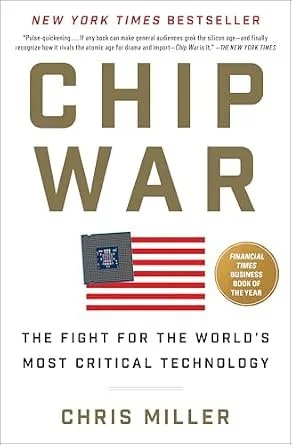
Chip War: The Fight for the World's Most Critical Technology is Chris Miller's account of how that happened. Miller teaches international history at Tufts and previously wrote about the Soviet economy, which turns out to be excellent preparation: this is a book about how technological capability becomes military and economic power, and about a state that tried to build that capability by decree and failed. It won the Financial Times Business Book of the Year in 2022 and landed in bookstores the same week Washington imposed the most aggressive semiconductor export controls in decades. Below is what the book actually argues, and where its argument has held up.
What You'll Learn
Why the chip industry's structure was set by cost curves and Moore's Law, not by any government plan
How the Soviet Union's "copy it" strategy guaranteed permanent technological backwardness
Why Morris Chang's foundry model split chip design from chip manufacturing, and what that split concentrated
What a chokepoint is in practice, and why ASML's lithography monopoly is the sharpest one
How to think about Taiwan's "silicon shield" without buying either the optimistic or catastrophic version of it
Where Miller's framing is strongest, and where a reader should push back
From Steel to Silicon: How Chips Became the New Oil
The story starts with a switch. Vacuum tubes worked, but they were bulky, hot, and unreliable, which is a problem when the calculation you need is the trajectory of a shell. The transistor arrived at Bell Labs in the late 1940s, courtesy of William Shockley, John Bardeen, and Walter Brattain. A decade later, Jack Kilby at Texas Instruments and Robert Noyce at Fairchild independently figured out how to put multiple components on a single piece of semiconductor material. The integrated circuit was born.
What made it an industry was a customer willing to pay absurd prices for very small, very light computing: the American military and the space program. Early chips went into missile guidance and Apollo, where cost mattered far less than weight. Government demand funded the first production runs, and production runs drove the cost down, which opened commercial markets, which funded more production. Gordon Moore's 1965 observation that transistor counts would keep doubling was less a law of physics than a description of that flywheel.
Two consequences shaped everything after. First, an industry whose costs fall with volume rewards whoever ships the most units, which pushes relentlessly toward consolidation. Second, assembly was labor-intensive and could be moved, so American firms moved it, starting with Fairchild's plant in Hong Kong in the early 1960s. Miller is careful here: offshoring was not a betrayal or a policy failure. It was arithmetic. Cheaper assembly in Asia made American chips competitive, and it seeded the Asian electronics ecosystem that would later host the whole supply chain.
Copy It: Why the Soviet Union Lost the First Chip War
Moscow understood the stakes early. The Soviets built Zelenograd, a planned city for microelectronics, staffed it with capable scientists, and pointed the KGB's Directorate T at Western technology. The strategy, pushed by the minister in charge, was blunt: obtain American designs and reproduce them exactly.
It could not have worked, and the reason is elegant. Copying takes time. Under Moore's Law, the target moves every eighteen to twenty-four months. A perfect copy of a chip you acquired two years ago is a two-year-old chip, and you will still be two years behind on the next one. Worse, copying only delivered the design, not the manufacturing know-how, the equipment supply base, or the feedback loop of demanding commercial customers that made American fabs improve. The USSR ended up with a secretive strategic industry whose technological direction was set entirely by companies in California.
The payoff came in the Gulf. Bill Perry and other defense planners had bet on an "offset strategy" from the mid-1970s: rather than match Soviet tank and troop numbers, use guidance and computing to make each American munition hit. Operation Desert Storm in 1991 put that bet on television. Soviet generals watched an army equipped with their doctrine and their hardware get dismantled, and drew the obvious conclusion about where military power now came from. It is the single most persuasive passage in the book, and the foundation for everything Miller says about China later.
Morris Chang and the Foundry Model That Split the Industry
For decades, a chip company designed and manufactured its own chips. Building a fab was the price of entry, and Jerry Sanders of AMD summed up the prevailing view with the line about real men having fabs.
Morris Chang broke that assumption. Chang had spent twenty-five years at Texas Instruments, rising to run its semiconductor business, and had sketched the logic of a manufacturing-only business as early as the mid-1970s. TI wasn't interested. Passed over for the top job, he eventually left, and when Taiwan's government came looking for someone to build a domestic industry, he took the offer. TSMC was founded in 1987, backed by the Taiwanese state and Philips, with a proposition that sounded modest and was radical: we will manufacture your chips and never compete with you by designing our own.
The effect was to split the industry in two. Design became a business you could enter with engineers and software rather than billions in capital equipment, which is how Nvidia, Qualcomm, and eventually Apple's silicon team came to exist. Manufacturing became a business of extreme capital intensity and accumulated process knowledge, where each generation of fab costs more than the last and only the highest-volume player can afford the next one.
That second half is the part with geopolitical consequences. Specialization plus escalating capital costs plus learning curves is a recipe for concentration, and the industry concentrated. By the time Miller was writing, TSMC was producing roughly 90 percent of the world's most advanced processor chips, on an island 100 miles off the Chinese coast. Nobody planned that. Everyone optimizing locally produced it.
ASML, EUV Lithography, and the Chokepoint Problem
If TSMC is the most concentrated point in manufacturing, ASML is the most concentrated point in equipment, and the story of how it got there is the best engineering writing in the book.
Printing features a few nanometers wide requires light with an extremely short wavelength. Extreme ultraviolet light at 13.5 nanometers is absorbed by glass and by air, so lenses are useless and the whole system must run in a vacuum using mirrors. Generating the light involves firing droplets of molten tin into a chamber and hitting each one with a laser twice, tens of thousands of times per second, to create a plasma that emits EUV. The lasers come from Trumpf in Germany. The mirrors come from Zeiss, polished to a smoothness that would be measured in fractions of a millimeter if you scaled a mirror up to the size of a country. The light source technology came out of Cymer in California. ASML in the Netherlands integrates all of it into a machine the size of a bus, containing hundreds of thousands of parts, and it is the only company in the world that can.
This is what Miller means by a chokepoint. The supply chain looks global and therefore resilient, and it is neither. It is a series of single points of failure distributed across friendly countries. That distribution is exactly what gives Washington leverage: an American rule can reach a Dutch machine or a Taiwanese fab because both depend on American design software, American equipment, or American intellectual property somewhere in the stack.
The Silicon Shield: Taiwan, China, and the New Chip War
China spends more on importing semiconductors than on importing oil, a statistic that captures the strategic problem Beijing has been throwing money at for a decade through initiatives like Made in China 2025 and its state-backed investment funds. Progress has been real in some segments and slow at the leading edge, where the barriers are less about capital than about equipment access and process knowledge that cannot be bought or stolen wholesale. The Soviet lesson applies.
Washington's response has escalated from targeting individual firms like Huawei to broad controls on advanced chips and the tools that make them, paired with $52 billion in domestic manufacturing subsidies under the CHIPS Act. Miller's framing is that the United States is doing something it has done before: using its position in the supply chain to deny a rival the computing power that modern military capability rests on.
Taiwan sits in the middle, protected in theory by a "silicon shield." The argument is that TSMC's importance makes invasion unthinkable, since the fabs would not survive it and the world economy would seize. Miller treats this with appropriate skepticism. A shield that depends on your adversary's cost-benefit calculation is only as reliable as that calculation, and it can cut the other way: an asset that valuable is also worth taking, and its concentration guarantees that any conflict becomes everyone's problem. He is honest that nobody knows how this ends, which is the correct posture and also, for a reader wanting predictions, a slightly unsatisfying one.
The Chip War at a Glance
Moore's Law. The doubling of transistor density roughly every two years, which functions less as physics than as an industry pacing mechanism that punishes anyone who falls behind.
The offset strategy. The US decision in the 1970s to counter Soviet numerical advantage with guidance and computing rather than matching tanks.
The foundry model. Manufacturing chips designed by other companies, pioneered by TSMC, which enabled the fabless design industry.
Fabless. A chip company that designs but does not manufacture, such as Nvidia, Qualcomm, or Apple.
EUV lithography. Extreme ultraviolet patterning at 13.5nm, made only by ASML, and required for every leading-edge logic chip.
Chokepoint. A step in the supply chain controlled by so few suppliers that restricting it halts everything downstream.
Silicon shield. The contested claim that Taiwan's chip dominance deters Chinese military action.
A Quick Start Guide to Reading the Chip Supply Chain
Find the chokepoint, not the country. Ask which single supplier a process depends on. Geography matters mainly because chokepoints happen to sit somewhere.
Separate design from fabrication. They have opposite economics: one is people-intensive and mobile, the other is capital-intensive and immobile. Conflating them produces bad analysis and bad policy.
Assume capability lags capital. Money buys fabs. It does not buy yield, and process knowledge accumulates through production, not investment.
Treat efficiency and resilience as a real trade-off. Concentration was the rational outcome of decades of cost optimization. Reversing it costs money that someone has to be willing to spend.
Apply the same map to your own business. Most supply chains have a Zeiss somewhere in them: a supplier three tiers down with no substitute. Find yours before an export rule or an earthquake finds it for you.
Who Should Read Chip War (and Who Can Skip It)
Read it if you want to understand why semiconductors dominate trade policy and defense strategy, explained through history rather than punditry.
Read it if you work in supply chain, procurement, or risk, and want a well-documented case study in how efficiency quietly builds fragility.
Read it if you invest in or around technology and want context for TSMC, ASML, Nvidia, and Intel that goes beyond the last earnings call.
Read it if you like business history with real characters. Chang, Noyce, Grove, and Morita are drawn as people, not case studies.
Skip it if you want a technical education in semiconductor physics or fabrication. Miller explains just enough to make the geopolitics legible.
Skip it if you need current analysis of the AI chip race. The book closes as the export-control era begins, so Nvidia's rise and everything after 2022 sits outside its frame. Pair it with newer reporting.
Final Reflections
The great strength of Chip War is that it refuses to treat the supply chain as an accident or a conspiracy. Every link was placed by someone making a defensible decision: Fairchild moving assembly to Hong Kong to survive on price, Chang building in Taiwan because TI wouldn't build with him, ASML's customers funding EUV because no one else would. The concentration everyone now worries about is the accumulated residue of rational choices, which is precisely why it is so difficult to undo.
There are fair criticisms. The military framing occasionally crowds out the commercial story, and readers primarily interested in the business dynamics may want more on demand-side economics than they get. The narrative is US-centric by design, with Japan, Korea, and Europe appearing mostly as they intersect with American fortunes. And Miller's core question, whether interdependence deters conflict or invites it, is posed more sharply than it is answered. None of that undermines the book. It is the clearest available explanation of why a category of component most people never think about now shapes trade law, industrial policy, and the probability of great-power conflict.
The Bottom Line
Computing power is the raw material of modern military and economic strength, and the world lets a handful of irreplaceable companies produce it in a handful of places. That concentration was nobody's plan and is now everybody's problem.
Frequently Asked Questions
What is the main idea of Chip War?
That semiconductors have replaced oil as the resource on which military and economic power depends, and that the industry making them has concentrated into a few chokepoints controlled by a few firms. Miller argues this concentration decided the Cold War and now defines the competition between the United States and China.
Is Chip War still relevant?
Yes, though it stops short of the AI boom. It was published in October 2022, days before the first sweeping US export controls, so the history and the structural analysis remain the best available foundation. For events after 2022, read it alongside current coverage.
Do I need a technical background to read it?
No. Miller writes for a general audience and explains the technology only as far as the geopolitics requires. If anything, the engineering sections on lithography are among the most enjoyable parts of the book.
Business Floss is reader-supported. When you use our links we may earn an affiliate commission that helps us keep the site running. Thank you for your support!


