
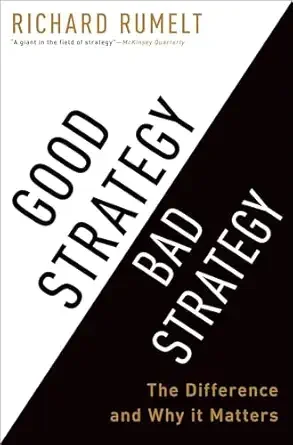
Good Strategy Bad Strategy
The Difference and Why It Matters
by Richard Rumelt
The 60-Second Take
In Good Strategy Bad Strategy, UCLA professor Richard Rumelt takes one of business's most abused words and gives it a spine. Most of what organizations call strategy, he argues, is ambition in disguise: goals, slogans, and template mission statements that never name the actual obstacle. Real strategy has a structure he calls the kernel, built from an honest diagnosis, a guiding policy, and coherent actions that reinforce one another. Drawing on Sam Walton, Nvidia, Apple's 1997 turnaround, and Desert Storm, Rumelt shows why focus beats ambition and why the hardest part of strategy is deciding what not to do.
Why Most Corporate Strategy Is Just Ambition in a Nicer Font
Ask ten executives to describe their strategy and you'll mostly get adjectives. Be the market leader. Drive customer-centric innovation. Grow twenty percent a year. Richard Rumelt, who spent decades teaching strategy at UCLA Anderson, built a career on pointing out the uncomfortable thing buried in answers like those: none of them is a strategy. They're wishes. They leave the hard question completely untouched, which is what you're actually going to do about the thing standing in your way.
Good Strategy Bad Strategy, published in 2011, is his attempt to rescue the word. It's part autopsy of why so much corporate planning comes out empty, part instruction manual for producing something better. Rumelt pulls examples from everywhere: Sam Walton reinventing what a store even was, Steve Jobs cutting Apple back to a survivable core, General Schwarzkopf's flanking maneuver in Desert Storm, and a then-small graphics chip company called Nvidia. This summary covers the structure he calls the kernel, the four warning signs of bad strategy, why bad strategy keeps getting written anyway, and the sources of power good strategies draw on.
What You'll Learn
What the kernel of a good strategy contains, and why diagnosis has to come first
The four hallmarks of bad strategy, and how to spot them in a real planning document
Why goals, visions, and mission statements aren't strategy, no matter how well written
The three reasons bad strategy keeps getting produced by smart people
How leverage, proximate objectives, and chain-link systems create durable advantage
The Kernel of Good Strategy: Diagnosis, Guiding Policy, Coherent Action
Rumelt's central contribution is a structure he calls the kernel. Strip away the frameworks, matrices, and off-site retreats, and every good strategy contains these three things.
Diagnosis. What is actually going on here? This is the part almost everyone skips, and Rumelt treats it as the real work. A diagnosis simplifies a messy situation by declaring some parts critical and the rest secondary. It names the obstacle. "Our sales are down" isn't a diagnosis; it's a result. The diagnosis is the theory of why they're down, and it has to be specific enough to be wrong. Without one, you don't have a strategy. You have a budget and some hope.
Guiding policy. This is the overall approach you'll take to deal with the obstacle you just named. Rumelt compares it to guardrails on a highway: it directs and constrains action without spelling out every turn. A guiding policy rules things out. If yours doesn't eliminate any options, it isn't doing its job.
Coherent actions. These are the concrete steps, resource commitments, and policies that carry out the guiding policy, and the key word is coherent. They have to support one another rather than pull in separate directions. Most organizations have plenty of initiatives. What they lack is initiatives that add up to something.
Rumelt points to Nvidia as a case where you can watch the entire kernel operate at once: a bet on where 3D graphics was heading, a guiding policy that cut complexity out of the product line, a coordinated release cadence, and rivals too tangled up in their own inertia to respond. None of the individual pieces looks like genius. Together they compound.
The Four Hallmarks of Bad Strategy
Bad strategy isn't just weak strategy, Rumelt insists. It has its own recognizable anatomy, and once you know the four hallmarks you can diagnose a strategy document in about ten minutes.
Fluff. Restatements of the obvious dressed in expensive vocabulary. Rumelt's favorite specimen came from a bank that described its fundamental strategy as customer-centric intermediation. Translated: we take deposits and lend them out. Fluff is a tell, because inflated language is usually covering for the absence of any thought underneath.
Failure to face the challenge. If a strategy never defines the difficulty it's meant to overcome, nobody can evaluate it. You can't reject it, and you can't improve it either. Plenty of strategic plans read like a list of good things that will happen, with the obstacles politely left out.
Mistaking goals for strategy. Rumelt describes a client who arrived with a "20/20 plan," twenty percent sales growth and twenty percent margins every year, and wanted help firing up the troops. When Rumelt asked how the company would actually get there, the answer came back as a lecture on the will to win. Ambition isn't a plan. Deciding you'll be the best doesn't tell anyone what to do differently tomorrow.
Bad strategic objectives. Objectives are supposed to be a bridge between the challenge and the action. They go wrong in two recognizable ways. The dog's dinner is a sprawling list of things to do, usually the residue of a meeting where everyone's pet project got added so nobody's feelings got hurt. The blue-sky objective simply restates the desired outcome ("become the preferred provider") while skipping the awkward detail that nobody has any idea how to get there.
Why Bad Strategy Is So Common: Nobody Wants to Choose
If bad strategy is this easy to identify, why does it keep getting written by intelligent, experienced people? Rumelt's answer is that bad strategy isn't miscalculation. It's avoidance. And he traces it down three pathways.
The first and most damaging is the unwillingness to choose. Strategy means concentrating resources on one thing, which means starving other things, which means telling colleagues no. When leaders won't or can't make that call among competing interests, what emerges is a document that tries to cover everything and therefore commits to nothing. Rumelt notes that when a strategy succeeds we remember what was accomplished and forget the options that were painfully set aside. Those discarded options were the strategy.
The second is template-style strategy: fill in the vision, add a mission, list some values, append a few "strategies," and you have a deliverable. It's popular precisely because it substitutes a form for analysis, and because it's phrased entirely in positives, nobody in the room gets uncomfortable.
The third is what he calls New Thought, the imported belief that a positive mental attitude is the active ingredient in success. It sounds harmless until you notice its practical effect: analyzing obstacles starts to feel like negativity, so the obstacles go undiscussed. Which is a fairly efficient way to guarantee they never get solved.
Sources of Power: Leverage, Proximate Objectives, and Chain-Link Systems
The middle section of the book catalogs where strategic advantage actually comes from. Rumelt's list runs to leverage, proximate objectives, chain-link systems, design, focus, growth, advantage, dynamics, inertia, and entropy. A few are worth pulling out.
Leverage is finding the pivot point: some place where a concentrated push produces a cascade of results out of proportion to the effort. It usually combines anticipation (a read on how customers or competitors will predictably behave), insight into where the pivot actually sits, and the discipline to concentrate resources there rather than spreading them thin. David beat Goliath by identifying an exposed forehead and owning a weapon that could reach it. Armor would have killed him.
Proximate objectives are goals close enough to be achievable, which is a leader's job to define. Rumelt uses Kennedy's moon landing as the model. It sounds audacious, but the underlying technologies existed; what the objective did was resolve ambiguity and give a huge organization a problem it could actually attack. He adds a counterintuitive corollary: the more turbulent your environment, the more proximate your objectives should be, because your foresight gets worse as uncertainty rises, not better.
Chain-link systems are the ones where overall performance is capped by the weakest link. Here the usual management instinct backfires, because strengthening any other link produces nothing at all. That's why some organizations stay stuck for years despite real effort in many places. The flip side is the good news: a company that has gotten every link right, like IKEA, becomes almost impossible to copy. A rival can't imitate one piece. They'd have to imitate all of it simultaneously.
The Wal-Mart story ties these together. Conventional wisdom said discount stores needed a population base of at least 100,000. Walton built them in small towns anyway, because he'd stopped thinking of a store as the basic unit. The network was the unit: a regional cluster of stores fed by shared distribution and centralized purchasing, serving millions in aggregate. Kmart couldn't copy it piecemeal, and its own inertia did the rest.
Treat Your Strategy Like a Hypothesis
The final part of the book is about the strategist's own thinking, and its most useful idea is a reframe. A new strategy is a hypothesis, and implementing it is an experiment. That framing lowers the stakes on being right up front while raising them on paying attention afterward. You commit, you watch what happens, you adjust based on evidence rather than on who argued loudest.
Rumelt also recommends actively trying to demolish your own ideas before the market does it for you: imagine a panel of skeptical experts picking apart your proposal and see what survives. It's an unglamorous habit, and it's the difference between a strategy and a story you've told yourself.
Strategy at a Glance
The kernel. The structure underneath every good strategy: diagnosis, guiding policy, coherent action.
Diagnosis. A working theory of what's actually going on, naming which factors are critical and which are noise.
Guiding policy. The overall approach for handling the diagnosed obstacle, which constrains action without scripting it.
Fluff. Buzzword-heavy language that restates the obvious and masks an absence of thinking.
Dog's dinner objectives. A long, unranked list of everyone's priorities mislabeled as a strategic plan.
Proximate objective. A goal close enough to current capabilities to be genuinely achievable.
Chain-link system. A system limited by its weakest link, where improving the other links changes nothing.
A Quick Start Guide to Writing a Real Strategy
Write the diagnosis first. State the single central obstacle in one paragraph, in plain language, before proposing anything.
Delete every goal masquerading as a strategy. If a line names a desired outcome without an approach, it's a target, not a plan.
Make the guiding policy exclude something. If it rules nothing out, rewrite it until it does.
Audit your initiative list for coherence. Ask which items reinforce each other and which are quietly competing for the same people and budget.
Find the weakest link before funding the strong ones. In a chain-link system, effort spent anywhere else is effort wasted.
Who Should Read Good Strategy Bad Strategy (and Who Can Skip It)
Read it if you're about to run or sit through a strategic planning cycle and suspect the output will be a list of goals nobody can act on.
Read it if you're a founder or operator writing your first real strategy, before you touch a vision-and-values template.
Read it if you've read Playing to Win or 7 Powers and want the diagnostic counterpart. Rumelt is stronger on why most strategies fail than on how to pick a winning market position.
Skip it if you want a step-by-step planning process with worksheets. Rumelt teaches by case and argument, and deliberately refuses to hand you a template.
Skip it if you're mainly focused on execution and team performance. This book is about deciding what to do, not about getting an organization to do it.
Skip it if you've already read Rumelt's 2022 follow-up The Crux, which reworks much of the same territory around the idea of the pivotal challenge.
Final Reflections
Good Strategy Bad Strategy has aged unusually well for a business book, partly because its target keeps regenerating. Every planning season produces a fresh crop of mission statements, stretch goals, and strategic pillars, and Rumelt's diagnostic still cuts through all of it in about ten minutes. His strongest chapters are the critical ones. The teardown of template-style strategy and New Thought is worth the price on its own.
The honest caveat is that it's easier to use this book to evaluate a strategy than to create one. Rumelt is emphatic that there's no formula, which is intellectually correct and practically frustrating: you can finish the book fully convinced your current plan is bad without being much closer to a better one. The prose also runs long in places, and a few examples feel like classroom cases that outstayed their welcome. Still, the core structure is small enough to carry around in your head, which is the real test of a strategy book.
The Bottom Line
Strategy is not what you want to happen. It's a specific, named obstacle plus a coordinated way through it, and if your plan doesn't say no to anything, you don't have one.
Frequently Asked Questions
What is the main idea of Good Strategy Bad Strategy?
That most organizations confuse ambition with strategy. Rumelt argues a genuine strategy identifies the central obstacle in the way, chooses an approach for overcoming it, and commits resources to coordinated actions that carry that approach out. Everything else, including vision statements and growth targets, is decoration.
What is the difference between a goal and a strategy?
A goal states the outcome you want; a strategy explains how you'll overcome what's currently preventing it. "Double market share" is a goal. Deciding that your distribution network is the binding constraint and redirecting spending there is the beginning of a strategy.
Is Good Strategy Bad Strategy worth reading in 2026?
Yes, particularly for anyone responsible for a planning process. The examples are dated in places, since the book came out in 2011, but the diagnostic checklist for spotting empty strategy applies to any planning document you'll encounter this quarter.
Business Floss is reader-supported. When you use our links we may earn an affiliate commission that helps us keep the site running. Thank you for your support!


