
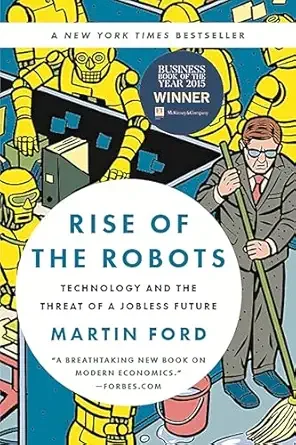
Rise of the Robots
Technology and the Threat of a Jobless Future
by Martin Ford
The 60-Second Take
Rise of the Robots is Martin Ford's argument that this wave of automation differs from previous ones in ways that matter economically. A software entrepreneur, Ford contends that information technology functions as a general-purpose capability rather than a task-specific tool, that it increasingly targets educated white-collar work rather than only routine manual labor, and that seven observable economic trends already show the strain. He argues more education won't solve it, that mass automation eventually undermines the consumer demand it depends on, and that a guaranteed basic income deserves serious consideration.
The Argument That Kept Being Wrong Until It Wasn't
Every generation produces someone warning that machines will eliminate work, and every generation so far they've been mistaken. Agriculture went from employing most of the population to a small fraction, manufacturing automated heavily, and employment recovered each time as new categories of work appeared. Economists have a name for the error of assuming otherwise, and pointing at the historical record is usually enough to end the conversation.
Martin Ford, a software entrepreneur, wrote Rise of the Robots in 2015 to argue that the historical record may be a poor guide this time, and it won the Financial Times and McKinsey Business Book of the Year award for the attempt. His case rests less on speculation about future machines than on economic data already visible when he wrote, and on a structural claim about what kind of technology this is. Reading it now, a decade on, is unusually interesting, because parts of it have aged poorly and one central part has aged remarkably well. This summary covers the argument and how it has held up.
What You'll Learn
Why Ford argues information technology differs in kind from previous automation
The economic trends he treats as evidence the shift is already underway
Why he thinks more education isn't a sufficient answer
The consumer demand problem at the heart of his economic argument
What has and hasn't happened since publication
Why This Time Might Be Different
Ford's structural claim is that information technology isn't a machine for a particular job. It's closer to a general-purpose utility, like electricity, that becomes available everywhere simultaneously and improves continuously without requiring anyone to reinvent it for each application.
Previous automation waves substituted capital for labor in specific, identifiable tasks, which left adjacent work intact and created demand for people to operate, maintain, and coordinate the new machinery. Ford's argument is that software capable of pattern recognition, prediction, and language generalizes across domains, which means it doesn't leave the same adjacent territory untouched.
His most provocative analogy is the horse. Horse populations rose for centuries alongside human economic activity, then peaked and collapsed with the internal combustion engine. The horses weren't reassigned to new roles; their capabilities were simply superseded. Ford is careful that humans are not horses, since we adapt and learn. His question is whether adaptation can outpace a technology that improves faster than people can retrain.
The Seven Trends
Rather than resting on prediction, Ford assembles economic evidence he says already shows the pattern, listing a set of trends visible in US data.
Wages stagnating in real terms while productivity continued climbing, breaking a relationship that had held for decades. The share of national income going to labor declining while the share going to capital rose, contradicting what economists had long treated as a stable ratio. Labor force participation falling. Job creation slowing across successive decades, with each recovery taking longer to restore employment than the last. Income inequality rising sharply. Underemployment and declining opportunity for new graduates. And polarization of the labor market, with growth at the top and bottom and hollowing in the middle.
His argument is that these are consistent with technology capturing a growing share of the gains from productivity, and that the pattern predates any dramatic robot deployment. Whether technology is the primary cause is contested, and other explanations, including globalization, financialization, declining union power, and policy choices, are competing candidates for most of the same data. Ford acknowledges those factors and argues technology is doing more of the work than mainstream accounts allow, which is a claim rather than a demonstration.
The Education Answer Doesn't Work
The standard policy response to technological displacement is education: retrain the workforce for higher-skilled roles. Ford treats this as insufficient for two reasons.
First, the direction of the threat has changed. Earlier automation displaced routine manual work, so moving up the skill ladder was a genuine escape route. Software that handles analysis, drafting, prediction, and pattern recognition targets exactly the cognitive work that education produces. Paralegals, analysts, journalists, radiologists, and programmers are all on Ford's list of exposed occupations, which was a considerably more contentious claim in 2015 than it reads today.
Second, education can't scale as a universal answer. There are only so many positions at the top of any occupational structure, and pushing more people through higher education doesn't create the roles for them to occupy. Ford's blunt observation is that a great many people will do everything they've been told to do, acquire the credentials and the skills, and still fail to find secure footing.
He extends this to what he sees as structural problems in higher education and healthcare, where costs have risen faster than the broader economy for reasons that automation may eventually disrupt in ways that are themselves destabilizing.
The Consumer Demand Problem
Ford's most interesting economic argument is that mass automation eventually undermines itself.
Consumer spending drives the majority of economic activity in developed economies, and consumers are, overwhelmingly, workers spending wages. If automation transfers enough income from labor to capital, the purchasing power that made the automated production profitable erodes. A company that automates gains an advantage; an entire economy that automates loses its customers.
This is why Ford frames the issue as an economic problem rather than a moral one. He isn't primarily arguing that automation is unfair to workers, though he thinks it is. He's arguing it's unstable as a system, and that the beneficiaries of automation have a direct interest in whatever mechanism sustains aggregate demand.
His proposed solution is a guaranteed basic income, designed with incentives so that working still improves your position. He treats it as the least-bad available policy for decoupling income from employment, and notes its historical support from across the political spectrum. It's worth engaging with the counterarguments seriously: critics question the fiscal arithmetic, the labor supply effects, whether transfers can substitute for the meaning and structure work provides, and whether the underlying premise of permanent labour displacement is even correct. Ford addresses some of these; the debate is live and unresolved, and this summary doesn't take a position on it.
Rise of the Robots at a Glance
General-purpose technology. Information technology as a utility available everywhere rather than a machine for a specific task.
The horse analogy. A cautionary case where capabilities were superseded rather than reassigned.
The seven trends. Stagnant wages, falling labor share, declining participation, slowing job creation, rising inequality, underemployment, and polarization.
The education limit. Skills-based escape routes narrow when the technology targets cognitive work directly.
The demand problem. Automation that removes wage income eventually removes the consumer spending it depends on.
Basic income. Ford's proposed mechanism for decoupling income from employment, with incentives preserved.
A Quick Start Guide to Thinking About Your Own Exposure
Break your job into tasks. Automation targets tasks rather than occupations, so the useful question is which parts of your work are exposed.
Identify the non-routine cognitive parts. These were the safe harbor under the old analysis and are precisely what current systems target.
Look for the judgment and relationship components. Work requiring accountability, negotiation, and physical presence has held up better than work requiring analysis alone.
Assume tool fluency is table stakes. The near-term displacement documented so far tends to favor people using the tools over people ignoring them.
Follow the labor share, not the headlines. Whether the gains from productivity reach wages is the number that determines whether Ford's thesis is playing out.
Who Should Read Rise of the Robots (and Who Can Skip It)
Read it if you want the foundational text of the modern technological unemployment debate, since most current writing on AI and work builds on it explicitly or implicitly.
Read it if you're interested in the economic mechanism rather than the technology, which is where Ford is strongest.
Read it if you want a serious presentation of the basic income case from someone arguing from economics rather than ideology.
Skip it if you want current technology detail. The book predates the generative AI wave entirely, and its examples are a decade old.
Skip it if you've followed the AI and labour debate closely. The core arguments circulate widely and you'll have encountered most of them.
Skip it if you want the counterargument fairly represented. Ford is making a case, and the economists who dispute his reading of the data get comparatively little space.
Final Reflections
Reading this a decade later produces a genuinely split verdict. The near-term prediction has not been borne out: employment across developed economies remained strong for years after publication, unemployment fell rather than rose, and the mass technological displacement Ford's tone implied did not arrive on the timeline the book suggested. Anyone who reallocated their career on the strength of it in 2015 acted early.
But the specific claim that made the book contentious, that this wave would come for educated cognitive work rather than only routine manual labor, was the part most economists were least willing to accept and is the part that now reads as prescient. Ford identified the exposed categories before the technology capable of touching them existed publicly, and he did it by reasoning about what kind of technology software is rather than by extrapolating from what it could then do.
The fair criticisms remain. His attribution of the economic trends primarily to technology is contested and underdetermined by the data, since globalization, policy, and declining labor bargaining power explain much of the same evidence. The policy chapters are thinner than the diagnostic ones. And the book's confidence occasionally outruns its support. Read it as the clearest early statement of a question that is now unavoidable, rather than as a forecast whose accuracy you can score.
The Bottom Line
The historical reassurance that new jobs always appear rests on automation that replaced specific tasks. A technology that generalizes across cognitive work may not behave the same way, and the economic problem is not just displaced workers but the consumer demand those wages were funding.
Frequently Asked Questions
What is the main argument of Rise of the Robots?
That information technology is a general-purpose capability rather than a task-specific tool, which means it may not follow the historical pattern where automation destroyed some jobs and created others. Ford argues it targets educated cognitive work and that existing economic trends already show the strain.
Why does Ford say more education won't solve automation?
Because the work being automated is increasingly the cognitive work that education produces, and because there are a limited number of high-skill positions regardless of how many people are credentialed for them. He argues many people will acquire the right skills and still lack secure employment.
Have Ford's predictions come true?
Partially. The mass unemployment his tone implied did not materialize on the timeline suggested, and labor markets stayed strong for years afterward. His contested claim that white-collar cognitive work would be exposed, however, reads very differently since the arrival of generative AI.
Business Floss is reader-supported. When you use our links we may earn an affiliate commission that helps us keep the site running. Thank you for your support!


