
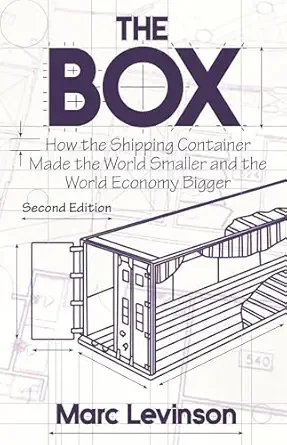
The Box
How the Shipping Container Made the World Smaller and the World Economy Bigger
by Marc Levinson
The 60-Second Take
The Box is Marc Levinson's history of the shipping container and the economic transformation it produced. Its central argument is that the container was not an invention so much as a system: standardized dimensions, purpose-built ships, redesigned ports, compatible trucks and rail, and labor agreements, all of which had to arrive together before any of it worked. Levinson traces Malcom McLean's role, the standardization fights, the union negotiations, the Vietnam logistics contract that proved the concept, and the resulting collapse of historic port cities alongside the rise of global supply chains.
The Most Important Object of the Twentieth Century Is a Corrugated Steel Box
On 26 April 1956, a converted tanker called the Ideal-X left Newark carrying 58 aluminum truck bodies and sailed to Houston. It attracted little attention. It was also the beginning of the most consequential change in the economics of trade in modern history.
To understand why, you need the world it replaced. Cargo shipping before containers was called breakbulk, and it meant that every barrel, sack, crate, and bale was handled individually: carried to the dock, stacked, inventoried, lifted into the hold, and arranged by gangs of longshoremen working essentially as their predecessors had for centuries. A ship might spend as long in port as at sea. Theft was routine. And the cost was enormous: Levinson's figures put loading loose cargo at several dollars a ton against a small fraction of that for the Ideal-X.
Marc Levinson, an economist and journalist, wrote The Box in 2006 to explain how that gap closed. His central point is one most innovation stories miss: the box wasn't the hard part. This summary covers what actually was.
What You'll Learn
Why containerization was a system problem rather than an invention
What Malcom McLean actually contributed, and what he got wrong later
Why standardization mattered more than any single company's technology
How labor negotiations and the Vietnam War determined the timeline
What the container did to port cities, manufacturing, and global trade
The Idea Was Never the Constraint
People had put cargo in boxes before. Railways used containers in various forms for decades, and multiple attempts at intermodal shipping predate McLean. None of them changed anything, and Levinson's explanation is that a container in isolation delivers almost no benefit.
To capture the savings you need: ships designed with cellular holds to stack boxes rather than general-purpose freighters; cranes capable of lifting them, which barely existed; ports with acreage for stacking and road and rail connections, which historic waterfront ports lacked; truck chassis and rail cars built to the same dimensions; and containers that any operator's equipment could handle anywhere in the world.
Every one of those required enormous capital investment, and none of them paid off unless the others existed. A port that built container facilities before ships arrived had a very expensive empty terminal. A shipping line that converted its fleet before ports could handle the boxes had nowhere to unload. This is a coordination problem, not a technical one, and it's why the gap between the first voyage and genuine global adoption ran to roughly two decades.
McLean's contribution was seeing the system rather than the box. He came from trucking, not shipping, which mattered: his frustration was watching cargo handled repeatedly as it moved between modes, and his instinct was to detach the truck body from its chassis so the same sealed unit could travel by road, sea, and rail without ever being opened. That outsider's framing let him ask why the industry organized itself as it did, a question insiders had stopped asking.
The Standards Fight
The least glamorous chapters are the most instructive. For containers to work globally, everyone had to agree on dimensions, corner fittings, and strength specifications, and each company had already invested in its own.
McLean's line used 35-foot boxes sized to trucking regulations in his region. Matson, running to Hawaii and having done considerably more analytical work, favored 24-foot boxes suited to its cargo mix. Others had their own. Each argued for its existing choice, because a standard matching someone else's equipment meant writing off your own.
The eventual settlement on the 20- and 40-foot dimensions we still use was the product of years of committee negotiation involving industry bodies, the US military, and international standards organizations. Levinson's point is that this bureaucratic process, which reads as tedious, was the single thing that made global containerization possible. Without an agreed standard, you get regional container networks that don't interoperate, and the network effect that produced the cost collapse never happens.
The labor negotiations were equally decisive and considerably more painful. Containerization eliminated the great majority of dock labor, and the unions understood this immediately. The eventual agreements involved guaranteed income and payments for workers displaced, funded from the productivity gains, in exchange for permitting mechanization. Levinson is somewhat unsympathetic to the unions, which some readers have flagged, and the underlying question of what is owed to workers whose occupation is eliminated by a technology is one the book raises more than it resolves.
Vietnam and Proof
What finally convinced the industry was a war. American military logistics in Vietnam were badly congested: shallow harbors, insufficient onshore storage, ships being used as floating warehouses, widespread theft, and a supply system pushing materiel based on assumptions rather than requests.
McLean's Sea-Land won contracts to provide container service, built terminal facilities, and demonstrated the system at a scale and under conditions that made the advantages undeniable. The commercial consequence was almost accidental: ships returning empty from Vietnam could stop in Japan and pick up cargo, which meant the transpacific trade in Japanese manufactured goods began on backhaul voyages that cost Sea-Land almost nothing.
That detail is worth pausing on, because it's where the container's economic effects become visible. Cheap reliable transport from Asia to the United States wasn't a consequence of Asian manufacturing growth. It preceded and enabled it.
It's also fair to note, as some readers have, that this was a heavily subsidized transformation: government-funded port construction, surplus vessels, and lucrative military contracts all underwrote the private innovation the book celebrates.
What the Container Did
Levinson's final sections trace consequences that reach considerably further than shipping.
Historic ports died. New York's waterfront, London's docks, and similar districts around the world had grown up around breakbulk handling, with warehouses, brokers, and manufacturers clustered nearby precisely because interrupting the flow of goods was where value was added. Containers needed space and highway access instead, so activity moved to Newark, Oakland, Felixstowe, and equivalents, taking entire local economies with it.
Manufacturing geography inverted. When transport was expensive, you built near your customers or your raw materials. When it became nearly free relative to production costs, you built wherever production was cheapest, which made globally distributed supply chains and just-in-time inventory economically rational for the first time.
And McLean's own ending is instructive. Having transformed the industry, he later over-leveraged at United States Lines, betting on large slow fuel-efficient vessels just before oil prices collapsed, and the company failed. The trait that let him rebuild an industry, an appetite for enormous bets on a single view of the future, was the same one that eventually ruined him.
The Box at a Glance
Breakbulk. Pre-container cargo handling, where every item was moved individually, making port time and labor the dominant costs.
The system, not the box. Containers only pay off with matched ships, cranes, ports, chassis, rail, and agreed dimensions.
Standardization. The committee process fixing dimensions and fittings, without which no global network was possible.
The coordination problem. Every required investment only paid off if the others were made, which is why adoption took decades.
Vietnam. The military contract that proved the concept and accidentally opened the transpacific trade via backhaul.
Economic geography. Cheap transport moved manufacturing to wherever production was cheapest and killed historic port districts.
A Quick Start Guide to the Lessons That Transfer
Ask what has to change around your innovation. The technology is rarely the constraint; the surrounding system usually is.
Look for the coordination deadlock. When everyone waits for someone else to invest first, adoption stalls regardless of the merits.
Treat standards as strategy. Interoperability creates the network effect, and the fight over whose standard wins is a commercial fight.
Expect the timeline to be decades. Genuinely infrastructural change moves at the speed of capital replacement, not software.
Plan for who loses. Displacement is a predictable consequence, and the terms on which it's handled determine whether adoption proceeds.
Who Should Read The Box (and Who Can Skip It)
Read it if you work in operations, logistics, or supply chain and want the origin story of the system you operate inside.
Read it if you think about technology adoption. The coordination problem at the book's center is the best-documented case study available.
Read it if you like economic history written accessibly. Levinson combines archival research with genuine narrative pace.
Skip it if you want a business how-to. This is history, and the lessons are inferential rather than prescribed.
Skip it if procedural detail bores you. There are substantial sections on standards committees and union negotiations, which are the most important parts and the least exciting.
Skip it if you want a balanced treatment of the labor side. Levinson's sympathies lie with the innovation, and the displaced workforce gets less consideration than the question deserves.
Final Reflections
This book endures because it corrects a bias in how we tell innovation stories. We narrate breakthroughs as moments of insight, and The Box demonstrates that the insight was the trivial part: people had thought of putting cargo in boxes for decades. What took twenty years was rebuilding ships, ports, trucks, railways, labor agreements, and international standards around it, mostly through unglamorous negotiation.
That makes it unusually useful as a template for thinking about any infrastructural change. The pattern recurs: a simple idea, an enormous surrounding system that must change for it to matter, a coordination problem where nobody wants to move first, a proving event that breaks the deadlock, and then consequences nobody predicted arriving faster than anyone expected.
Two caveats. The treatment of organized labor is one-sided, and the underlying question of obligation to displaced workers is raised more than examined. And the book's role in the subsidy story is soft-pedaled, since a transformation frequently described as entrepreneurial was substantially underwritten by public port investment and military contracts. Neither undermines the history, which is meticulous, but both are worth carrying while you read it.
The Bottom Line
The container wasn't an invention, it was a system, and the twenty years between the first voyage and global adoption went into rebuilding everything around it. That gap between an idea and the infrastructure it requires is where most transformations actually live.
Frequently Asked Questions
Who invented the shipping container?
Containers existed in various forms before, but Malcom McLean, an American trucking entrepreneur, is credited with making them work commercially. His insight was systemic rather than mechanical: detaching truck bodies from chassis so a sealed unit could move between road, sea, and rail without being opened.
Why did containerization take so long to spread?
Because it required simultaneous investment in specialized ships, cranes, port land, compatible trucks and rail cars, and agreed international dimensions, none of which paid off unless the others existed. That coordination problem, plus labor negotiations, took roughly two decades to resolve.
How did the container change the world economy?
By collapsing transport costs, it made it rational to manufacture wherever production was cheapest rather than near customers, enabling global supply chains and just-in-time inventory. It also destroyed the economies of historic port districts and shifted activity to sites with space and highway access.
Business Floss is reader-supported. When you use our links we may earn an affiliate commission that helps us keep the site running. Thank you for your support!


