
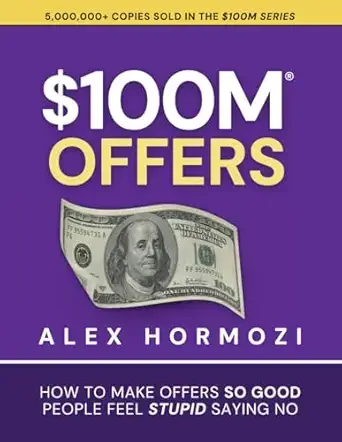
$100M Offers
How to Make Offers So Good People Feel Stupid Saying No
by Alex Hormozi
The 60-Second Take
$100M Offers is Alex Hormozi's manual for constructing what he calls a Grand Slam Offer: a bundled proposition valuable enough that price comparison with competitors becomes impossible. Built from his experience scaling gyms and later a portfolio of companies, it argues most businesses fail not because their product is poor but because their offer is weak and commoditized. The book supplies a value equation with four levers, a five-step process for building an offer around customer obstacles, and five enhancers covering scarcity, urgency, bonuses, guarantees, and naming.
How to Build an Offer People Feel Stupid Saying No To
Most struggling businesses respond to weak sales by working on the wrong layer. They rewrite the ad, hire a better closer, run more traffic, or drop the price. Alex Hormozi's argument is that all four are downstream of the thing actually causing the problem, which is that the offer itself is indistinguishable from everyone else's.
Hormozi built and sold gyms, then a gym licensing business, and now runs a holding company; $100M Offers, self-published in 2021, distills what he considers the highest-leverage skill in business. His term for the goal is a Grand Slam Offer: a proposition so strong that prospects feel foolish declining, and so distinct that comparison shopping against competitors doesn't work.
The book is short, dense, and unusually specific. This summary covers the pricing argument, the value equation at its core, the build process, and the enhancers, along with an honest read on where it applies.
What You'll Learn
Why commoditization, not product quality, is the usual cause of weak sales
The four variables in Hormozi's value equation and which two are underused
Why he argues for raising prices rather than lowering them
His five-step process for building an offer around customer obstacles
The five enhancers, and the line between using them and abusing them
Market First, Then Offer
Before anything about construction, Hormozi insists on sequence: market beats offer, and offer beats persuasion. A superb offer to a market that doesn't want it and can't pay fails, and no amount of sales skill rescues it.
His criteria for a market worth entering are blunt. There must be genuine pain, meaning the problem is urgent rather than mildly annoying. The buyers must have purchasing power. The market must be reachable, meaning you can identify and address these people specifically. And ideally it should be growing.
His phrase for the ideal condition is a starving crowd. The point is that intense unmet demand forgives a great deal of mediocrity elsewhere, while its absence punishes excellence.
From there, the commodity problem. If your product is comparable to alternatives, buyers have only one axis to compare on, and price competition drives margins toward zero. The escape is not to be marginally better but to construct something for which no direct comparison exists, which Hormozi calls a category of one.
This produces his position on pricing, which is the opposite of most instincts. Charge more. His argument runs through what he treats as a virtuous cycle: higher prices attract customers who are more committed, commitment produces better outcomes, better outcomes produce better testimonials and lower churn, and higher margins fund better delivery. Cheap prices, meanwhile, signal cheapness, attract the least committed buyers, and leave nothing to invest in quality.
The Value Equation
The analytical core is a formula for perceived value with four levers.
Value = (Dream Outcome × Perceived Likelihood of Achievement) ÷ (Time Delay × Effort and Sacrifice)
Dream outcome is what the customer actually wants, stated at the level they want it rather than the level you deliver it. Not gym access; weight loss.
Perceived likelihood of achievement is their confidence it will work for them specifically. Proof, testimonials, guarantees, and track record operate here.
Time delay is how long between paying and seeing results. Reduce it, including by delivering some visible value immediately.
Effort and sacrifice is what the customer has to do, give up, or endure. Reduce it by doing more of the work for them.
The two denominators are where Hormozi finds most of the neglected leverage. Every business talks about outcomes; comparatively few work on shortening time to first result or removing work from the customer's side. His comparison of a surgical procedure to a gym membership makes the point: identical stated outcome, entirely different position on the bottom of the equation, and the pricing follows.
The word doing the heaviest lifting is perceived. His illustration is the London Underground, where installing arrival-time displays improved rider satisfaction more than actually speeding up trains. The wait was unchanged; the uncertainty about it wasn't. That's a real finding about experience, and it's also where the framework starts inviting the manipulation question, since perception can be improved either by genuinely changing the experience or by managing impressions of it.
Building the Offer
The construction process is five steps and works better than its simplicity suggests.
Identify the dream outcome. State what the customer actually wants, in their language.
List every obstacle. Enumerate everything that could prevent them from getting there, before, during, and after purchase. Hormozi wants this list long and specific, because obstacles are the raw material for everything that follows.
Convert each obstacle into a solution. For every problem, articulate what you'd provide to eliminate it.
Choose delivery vehicles. For each solution, decide how it's delivered: one-to-one, small group, or one-to-many, and in what format and with how much customer effort. Different combinations produce very different cost and value profiles.
Trim and stack. Cut the solutions that are expensive to deliver and low in perceived value, keep and bundle the ones that are cheap to deliver and high in perceived value, and present the result as a single package.
That last step is where the economics live. The bundle should contain a set of high-perceived-value components, which anchors the price expectation well above what you then charge.
The Five Enhancers
The final section covers how to increase demand without changing what you actually deliver.
Scarcity limits quantity: a cap on total clients, on new clients per period, or on cohort size.
Urgency limits time: enrollment deadlines, cohort start dates, expiring bonuses. Hormozi notes that a large share of sales in any deadline-driven campaign arrive in the final hours.
Bonuses add components presented separately from the core offer, each with a stated value, which raises the total perceived value against an unchanged price.
Guarantees reverse risk, and he distinguishes several types, from unconditional refunds through conditional performance guarantees to arrangements where you continue working unpaid until a result is achieved. His argument is that reducing perceived risk often persuades more effectively than adding another feature.
Naming gives the offer an identity that communicates who it's for and what it delivers, so it stops being a generic service description.
The ethical line matters here, and Hormozi does address it: scarcity and urgency should reflect real constraints. A deadline that resets weekly, or a limited number that never actually limits anything, works once and destroys trust afterward. Readers should hold that caveat firmly, because these are the tools most easily misused and the ones the book's imitators most often abuse.
$100M Offers at a Glance
Grand Slam Offer. A bundled proposition strong enough that comparison shopping against competitors becomes impractical.
Market, offer, persuasion. The order of importance; a great offer to the wrong market fails.
The commodity problem. Comparable products compete only on price, driving margins toward zero.
The value equation. Dream outcome and perceived likelihood over time delay and effort.
Trim and stack. Cut costly low-value components, bundle cheap high-value ones.
The five enhancers. Scarcity, urgency, bonuses, guarantees, and naming, applied to real constraints.
A Quick Start Guide to Strengthening Your Offer
Score yourself on the four variables. Rate your current offer on each, and notice that the two denominators are probably untouched.
List every obstacle a customer faces. Write out twenty, then turn each one into something you could provide.
Shorten time to first value. Find something you can deliver in the first week that the customer can actually see.
Remove work from their side. Identify what you're currently asking the customer to do and do it for them instead.
Add a real guarantee. Reverse a specific risk you're genuinely willing to carry, since a credible one persuades more than another feature.
Who Should Read $100M Offers (and Who Can Skip It)
Read it if you sell services, coaching, courses, or anything where you control packaging and pricing, which is where the frameworks apply most directly.
Read it if you're competing on price and losing. The commodity diagnosis and the escape route are the strongest part of the book.
Read it if you want tactical density. It's short, unpadded, and almost everything in it is immediately usable.
Skip it if you sell a genuine commodity, operate in a regulated market, or run enterprise sales with procurement processes. The packaging and urgency levers don't transfer cleanly.
Skip it if aggressive persuasion tactics sit badly with you. Scarcity and urgency are legitimate when real and manipulative when manufactured, and the book's tone won't help you police the line.
Skip it if you want evidence. The claims are asserted from personal experience rather than researched, and the psychological explanations are casual.
Final Reflections
The value equation is genuinely useful, and it earns its reputation. It gives you four specific levers where most people have one vague instruction to add more value, and the observation that the denominators are underworked is correct across an enormous range of businesses.
The trim-and-stack process is the second-best content. Building an offer by enumerating customer obstacles rather than by describing your capabilities produces a different and better proposition, and it's an exercise a team can run in a morning.
Two things to hold alongside it. The book is written from and for high-margin service and information businesses, where packaging and price are entirely within the seller's control; readers in manufacturing, regulated industries, or enterprise procurement will find substantial parts inapplicable rather than merely harder. And the enhancement chapter is the one that has done the most damage in imitation, since fabricated scarcity and permanently expiring deadlines are now everywhere. Hormozi's own position is that these should reflect real constraints, and that's the version worth adopting. Take the equation and the build process, apply the enhancers honestly, and it's among the more practically useful business books of recent years.
The Bottom Line
If you're competing on price, the problem is that your offer looks like everyone else's. Build one around the obstacles your customer actually faces, shorten the time and effort on their side, and charge accordingly.
Frequently Asked Questions
What is the value equation in $100M Offers?
Value equals dream outcome multiplied by perceived likelihood of achievement, divided by time delay multiplied by effort and sacrifice. Raise the top two and lower the bottom two. Most businesses only work on the dream outcome and neglect the denominators entirely.
What is a Grand Slam Offer?
A bundled offer valuable enough that declining feels foolish and distinctive enough that direct price comparison with competitors becomes impractical. It's built by listing every obstacle a customer faces, solving each, and then trimming and stacking the components.
Are Hormozi's scarcity and urgency tactics ethical?
They are when the constraints are real: a genuine capacity limit or an actual enrollment deadline. Manufactured scarcity and deadlines that quietly reset are manipulation, work once, and damage trust. The book's position is that the constraints should be genuine.
Business Floss is reader-supported. When you use our links we may earn an affiliate commission that helps us keep the site running. Thank you for your support!