
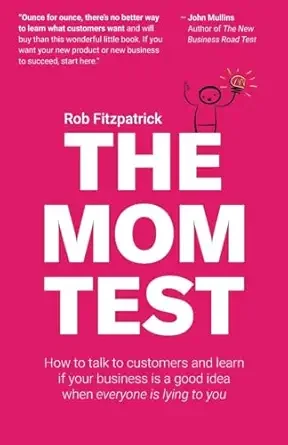
The Mom Test
How to Talk to Customers and Learn if Your Business is a Good Idea When Everyone is Lying to You
by Rob Fitzpatrick
The 60-Second Take
In The Mom Test, Rob Fitzpatrick offers a deceptively simple guide to customer conversations that actually reveal the truth. Because friends and family will tell you what you want to hear, he provides rules for asking questions so good that even your mom can't lie: talk about their life, not your idea; ask about specific past behavior, not hypotheticals; and listen more than you pitch. It is an essential, practical book for any founder validating an idea.
The Most Expensive Mistake Is Building the Wrong Product
For an entrepreneur, there is a specific kind of pain that only comes from launching a product to absolute silence. You spent months building it. You told everyone about it. Before you wrote a single line of code or spent a dollar on inventory, you asked dozens of people what they thought, and they all said it was a brilliant idea. Yet, when you finally ask them to pull out their credit cards, they vanish.
Rob Fitzpatrick knows this pain intimately, and he wrote The Mom Test to help founders avoid it. The premise of the book is rooted in a universal truth: when you pitch someone a business idea, their natural instinct is to protect your feelings. People lie. They do not do it maliciously, they do it out of basic social politeness. If you treat those polite lies as market validation, you will inevitably build something nobody actually wants to buy. Fitzpatrick offers a tactical framework for talking to customers in a way that forces the truth to the surface, proving that if you ask the right questions, even your own mother cannot give you a misleading answer.
What You'll Learn
The three cardinal rules for conducting a useful customer interview
Why you should almost never mention your specific product idea
How to identify and neutralize polite compliments and hypothetical fluff
The critical difference between verbal interest and an actual commitment
How to keep discovery conversations casual, short, and highly effective
The Three Rules of The Mom Test
When founders set out to validate a business, they usually approach the conversation entirely backward. They sit down, explain their vision with immense enthusiasm, and then ask the listener for an opinion. Fitzpatrick argues that the moment you introduce your idea, you have contaminated the data. The listener immediately understands what you want them to say, and their answers will inevitably skew toward validating your excitement.
To gather genuine data, you must follow the three rules of The Mom Test.
First, you must talk about their life, not your idea. Your goal in early customer conversations is to understand the reality of the problem you are trying to solve. If you are building a tool to help freelance designers manage their invoices, you should not describe your software. You should ask the designer to walk you through exactly how they currently manage their billing, what tools they use, and what frustrates them about the process. When you keep the spotlight entirely on their workflow, they cannot give you false validation because they do not even know what your proposed solution is.
Second, you must ask about specific past behaviors rather than hypotheticals about the future. Humans are notoriously bad at predicting their own future actions. If you ask someone, "Would you pay twenty dollars a month for an app that saves you time?", almost everyone will say yes. It costs them nothing to agree to a fictional scenario. Instead, you must ask, "When was the last time you encountered this problem, and what exactly did you do to solve it?". If they claim a problem is a massive headache but admit they have never spent a single dollar or dedicated any real time to fixing it, the problem is not painful enough to monetize. Past behavior is objective data, and future intentions are fictional.
Third, you must talk less and listen more. Entrepreneurs are inherently passionate, and silence makes people uncomfortable. When a customer struggles to answer a question, the founder's instinct is to jump in, fill the void, and start explaining the product features. Fitzpatrick insists that you must suppress this urge. Ask your question and then simply shut up. Some of the most valuable insights emerge in the moments just after an awkward pause, when the customer finally articulates the root cause of their frustration.
The Danger of Compliments, Fluff, and Ideas
A successful customer conversation is not one that makes you feel good. It is one that gives you concrete facts. To extract those facts, you have to learn how to spot and deflect the three types of bad data that constantly threaten to derail your interviews: compliments, fluff, and ideas.
Compliments are the fool's gold of entrepreneurship. When someone tells you that your concept is brilliant or that you are definitely going to be successful, they are giving you absolutely nothing of substance. They are just being nice. Fitzpatrick warns that you should never write down a compliment in your notes, nor should you allow it to validate your business case. When you receive a compliment, you must gracefully deflect it and immediately steer the conversation back to the mechanics of the person's problem.
Fluff consists of generic claims and hypothetical promises. This happens when a customer uses words like "usually," "always," or "I definitely will". If a prospect says, "I usually spend hours dealing with this on Fridays," that is fluff. It is a generalization. You have to anchor that fluff back to a specific reality by asking, "Can you walk me through exactly what happened last Friday?". By forcing them to recount a specific, chronological event, you strip away their idealized version of their workflow and uncover the messy truth of what actually occurred.
Finally, customers will frequently offer their own ideas about what you should build. They will say, "It would be great if the software could integrate with this specific obscure calendar app." It is incredibly tempting to take these feature requests as gospel and rush back to your development team to build them. Fitzpatrick argues that while you should seek to understand the motivation behind a customer's idea, you should never blindly obey it. It is your job to build the solution, and it is the customer's job to own the problem. When they demand a specific feature, dig deeper into why they think they need it to understand the underlying pain point.
Commitments as the Currency of Validation
Perhaps the most sobering concept in The Mom Test is how Fitzpatrick defines actual market interest. Words are entirely useless. The only valid signal that a customer truly cares about your product is when they are willing to give up something of value. This is known as a commitment, and it is the only currency that matters.
If a customer says they love your product but refuses to commit anything to it, it is not a real lead. You must give them a concrete opportunity to reject you. Commitments generally fall into three categories.
The first is a time commitment. This does not mean casually agreeing to chat again someday. A real time commitment involves scheduling a specific, dedicated follow-up meeting with clear stakes, or agreeing to spend an hour next Tuesday testing a clunky prototype in their actual workflow.
The second is a reputation commitment. When someone stakes their professional reputation on your idea, they believe in it. This happens when they are willing to formally introduce you to the ultimate decision-maker at their company, or when they offer to pitch your product to their boss on your behalf. If they claim to love the idea but refuse to introduce you to the person who holds the budget, you do not have validation.
The highest form of commitment, naturally, is financial. This is the ultimate proof. Even if your product does not fully exist yet, you can still ask for a financial commitment. This could be a small monetary deposit to secure early access, a signed letter of intent, or a pre-order. The moment you ask for money, the polite smiles fade, and the customer has to make a real decision. The answer that follows that request is the truest data you will ever collect.
Keeping Conversations Casual and Focused
A common mistake founders make is treating customer discovery as a highly formal, rigid process. They send out cold emails asking for forty-five-minute "feedback interviews". This immediately sets the wrong tone. By scheduling a formal meeting specifically to discuss your idea, you put the customer in a position where they feel obligated to offer an opinion on your concept, virtually guaranteeing you will receive biased data. You also make it feel like they are doing you a massive favor, which alters the power dynamic.
Fitzpatrick advocates for keeping conversations remarkably casual. The best customer interviews do not feel like interviews at all; they feel like passing chats. You can gather incredibly potent data in a five-minute conversation in the hallway of an industry conference, or while waiting in line for coffee. Because you are not pitching an idea—you are simply asking them about the realities of their daily work—they do not need to prepare, and they do not feel the pressure of a formal consultation.
To execute this effectively, you must do your homework beforehand. You should never enter a conversation without knowing the top three things you are trying to learn. Identify the three questions that could completely destroy your business if the answers go the wrong way. Keep those questions holstered, and casually drop them into natural conversation. By doing this, you lower the stakes of the interaction while maximizing the value of the information you extract.
The Mom Test at a Glance
Talk about their life. Never start a conversation by pitching your idea. Make the discussion entirely about the customer's current reality and frustrations.
Demand specifics. Do not let people speak in hypotheticals. Ask exactly what they did the last time they faced the problem.
Deflect compliments. Polite praise is worthless. Treat compliments as a warning sign that the conversation has strayed from hard facts.
Anchor the fluff. When a customer makes a generalization about how they "usually" do something, force them to describe a specific historical instance.
Require a commitment. A lead is not real until they give you their time, stake their reputation, or open their wallet.
A Quick Start Guide to Better Customer Discovery
List your terrifying questions. Before talking to anyone, write down the three most fundamental assumptions your business relies on. Figure out what answers would prove you entirely wrong.
Find people in their natural environment. Do not rely solely on formal meeting requests. Go to industry events, forums, or coffee shops where your specific demographic congregates.
Ask about the workarounds. When someone claims a problem is painful, ask them to show you the spreadsheet or makeshift solution they currently use to fix it. If they have not tried to fix it, it is not a real problem.
Follow the money. Ask exactly how much they spent trying to solve the problem in the past. Where budgets are currently allocated tells you what a company truly values.
End with a clear ask. Never conclude a promising conversation with "keep in touch." Always ask for a concrete commitment, whether it is an introduction to a colleague or a follow-up date to test a prototype.
Who Should Read The Mom Test (and Who Can Skip It)
Read it if you are a first-time founder, developer, or designer who is about to spend months building a product and wants to ensure there is an actual market for it first.
Read it if you hate the idea of traditional sales or networking. This book provides a structure for having highly valuable, low-pressure conversations without ever feeling like a sleazy salesperson.
Read it if you are a product manager inside a larger organization trying to figure out which feature request your users actually care about.
Skip it if you are running a commoditized, highly proven business model (like opening a standard coffee shop or a landscaping business) where market demand is already obvious and execution is the only real variable.
Skip it if you want a comprehensive technical guide on how to build a software prototype or how to write a formal business plan. This is strictly a manual for communication and discovery.
Final Reflections
The Mom Test is a masterclass in constructive brutality. It is a short, punchy book that systematically strips away the comforting illusions that entrepreneurs rely on. Rob Fitzpatrick's greatest contribution is exposing the fact that most market validation is actually just an exercise in ego stroking. By shifting the focus away from the brilliant idea and toward the mundane reality of the customer's daily life, he provides a reliable methodology for finding the truth. The concepts are completely counterintuitive to the natural enthusiasm of a founder, which makes them difficult to practice but essential to master. It forces you to ask the questions you are terrified to hear the answers to, and in doing so, saves you from the quiet tragedy of building something no one wants.
The Bottom Line
Stop asking people if they think your business idea is good, and start interrogating the specific ways they have spent their time and money trying to solve their problems in the past.
Frequently Asked Questions
What is the main idea of The Mom Test?
The core concept is that asking people for their opinion on your business idea is useless because they will lie to be polite. To figure out if your idea is actually viable, you must talk to potential customers about their specific past behaviors and current problems without ever revealing what you intend to build.
What are the three rules of The Mom Test?
First, talk about their life, not your idea. Second, ask about specifics in the past, not generics or opinions about the future. Third, talk less and listen more.
Is this book only for tech startups?
No. While it uses many software examples, the principles of avoiding compliments, identifying actual pain points, and requiring a firm commitment before investing resources apply to any new business venture, freelance service, or physical product launch.
Business Floss is reader-supported. When you use our links we may earn an affiliate commission that helps us keep the site running. Thank you for your support!


