
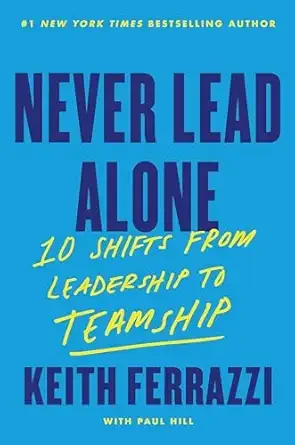
Never Lead Alone
10 Shifts from Leadership to Teamship
by Keith Ferrazzi
The 60-Second Take
In Never Lead Alone, executive coach Keith Ferrazzi argues that the era of the individual hero leader is dead. Drawing from decades of research, he outlines a transformational shift from traditional top-down management to "teamship." By embracing co-elevation, peer-to-peer accountability, and structured candor, organizations can dismantle the silos and conflict avoidance that destroy value. Master these shifts to build a deeply resilient, high-performing, and unified team.
The Era of the Hero Leader Is Over
For generations, corporate culture has celebrated the visionary executive. We are taught to revere the solitary genius who carries the weight of the organization, absorbing all the pressure, making all the hard calls, and singlehandedly steering the ship through the storm. It is a romantic notion. According to Keith Ferrazzi, it is also a massive liability.
In Never Lead Alone: 10 Shifts from Leadership to Teamship, Ferrazzi—along with co-authors Kian Gohar and Noel Weyrich—argues that the modern business landscape has simply become too complex, fast, and demanding for any one person to process. When organizations rely entirely on a hub-and-spoke model where every decision flows through the boss, the boss becomes a bottleneck. The solution is not to train leaders to work harder. The solution is to distribute the burden.
Ferrazzi proposes a radical departure from traditional hierarchical management. He calls this new paradigm "teamship." Based on decades of coaching and research involving thousands of high-performing groups, the book breaks down the fundamental shifts required to move from an individualistic approach to true collective responsibility. It is a highly tactical manual for rewiring how professionals interact, communicate, and hold one another accountable.
What You'll Learn
The difference between traditional hierarchical leadership and teamship
Why conflict avoidance systematically destroys shareholder value
How to run a "candor break" to instantly surface hidden truths in meetings
The power of "stress testing" to fortify team decisions
How to build shared resilience and authentic peer-to-peer accountability
The Hub-and-Spoke Trap
Most corporate teams are not actually teams; they are collections of individuals who happen to report to the same manager. Ferrazzi describes this as the hub-and-spoke model. The leader sits at the center (the hub), while the direct reports (the spokes) focus entirely on their own narrow objectives. Information flows up the spoke to the leader, the leader makes a decision, and instructions flow back down.
When the environment is stable and predictable, the hub-and-spoke system is functional. However, when an organization faces rapid disruption, the model collapses. The leader cannot possibly ingest enough data, understand every departmental nuance, or make decisions fast enough to keep pace. Furthermore, the spokes feel no responsibility for each other. If marketing is failing but sales is hitting its numbers, the sales spoke does not step in to help, because that is "the boss's job" to fix.
The first major shift is abandoning this structure. Exceptional performance requires moving to an interconnected web where peers are deeply invested in one another's success. The ultimate competitive advantage is no longer individual talent; it is the interdependent friction and collaboration of the group.
Co-Elevation and Peer Accountability
The defining characteristic of teamship is a concept Ferrazzi calls "co-elevation." Co-elevation is a shared commitment among teammates to actively push one another higher in pursuit of a common mission. It fundamentally redefines the social contract of the workplace.
In a traditional setup, accountability is entirely top-down. A good leader sets expectations and holds team members accountable for missing them. In a co-elevating team, the dynamics shift horizontally. A great leader designs the system so that the teammates hold each other accountable. If a project is falling behind, peers do not wait for the manager to issue a reprimand; they step in, ask hard questions, and offer direct support.
This requires intense personal trust, which Ferrazzi argues must be built purposefully rather than left to chance. Teams must stop relying on serendipitous water-cooler moments to build rapport. Leaders need to engineer vulnerability and connection, ensuring that every member understands the personal motivations and pressures driving their peers. When people feel genuinely supported by their equals, they are far more willing to accept the friction and honest feedback that high performance requires.
Curing Conflict Avoidance with Candor
Of all the bad habits that plague modern businesses, Ferrazzi identifies conflict avoidance as the single greatest destroyer of shareholder value. It happens because most teams operate under an unspoken, toxic social contract: "If I challenge your idea in front of everyone, I am attacking you." To protect egos and maintain a superficial sense of harmony, professionals silence their doubts. Blind spots multiply, flawed strategies are green-lit, and innovation suffocates.
You cannot fix conflict avoidance by simply telling people to be more honest. You have to change the mechanics of the meeting. Ferrazzi introduces high-return practices to force candor into the open, the most effective being the "candor break."
If a meeting feels superficial or tense, the leader pauses the discussion and calls a candor break. The team is asked to rate the current level of candor on a scale of zero to five. If the score is low, attendees are broken into pairs and given thirty seconds to discuss one question: "What is not being said right now that needs to be said?" By shrinking the audience to just two people, psychological safety spikes. When the larger group reconvenes, the hidden truths surface instantly.
A similar practice is "stress testing." Rather than presenting a report to a room of silently nodding peers, the presenter breaks the room into small groups and asks them to actively attack the plan. The pairs must identify risks the presenter missed and suggest bold innovations. Stress testing reframes criticism. It is no longer a personal attack; it is a collaborative requirement.
Shared Resilience and Asynchronous Agility
The shifts toward teamship extend beyond strategy and into emotional and operational well-being. Ferrazzi insists that a high-performing team must take ownership of shared resilience. Burnout is typically treated as an individual failing, something an employee must manage with a vacation day or a wellness app. Teamship makes energy a collective responsibility.
This is achieved through small, consistent habits. Meeting agendas should start with an "energy check," allowing members to honestly state their capacity and emotional state before diving into logistics. Meetings should close with "gratitude circles," where members specifically acknowledge a peer's contribution. These practices build the emotional reserves required to endure long, high-stress initiatives.
Operationally, teamship requires adopting agile ways of working, particularly asynchronous collaboration. Many teams waste hours sitting in conference rooms trying to brainstorm out loud, a format that heavily favors extroverts and rapid processors. Ferrazzi advocates shifting the initial phases of collaboration outside the meeting entirely. By using shared documents or spreadsheets beforehand, every team member has the time to reflect, analyze the problem, and document their solutions. By the time the actual meeting starts, the team is already aligned on the core data, introverted thinkers have had their say, and the group can focus strictly on debate and decision-making.
Teamship at a Glance
The hub-and-spoke trap. Relying on a central leader for all decisions creates bottlenecks and siloes.
Co-elevation. A commitment to lifting up your peers rather than competing with them.
Peer-to-peer accountability. The highest-performing teams do not wait for the boss to enforce standards; they hold each other accountable.
Conflict avoidance destroys value. Politeness often masks cowardice, allowing bad decisions to move forward unchallenged.
Candor breaks. Pausing a meeting to break into pairs drastically increases psychological safety and reveals what people are afraid to say.
Stress testing. Actively dividing a team to critique a plan reframes pushback from a personal attack into a required contribution.
Asynchronous agility. Shifting brainstorming to pre-meeting documents gives introverts a voice and makes live meetings shorter and sharper.
A Quick Start Guide to Shifting to Teamship
Redefine the social contract. Explicitly agree as a team that challenging an idea is an act of loyalty to the mission, not a personal attack on the creator.
Implement candor breaks. When a discussion stalls or feels superficial, stop the meeting. Have everyone pair up for thirty seconds to discuss what is being ignored, then share with the group.
Stress test big decisions. Before finalizing a strategy, force the team to poke holes in it. Ask specifically: "What risks do you see that I am blind to?"
Move brainstorming offline. Use a shared document for initial idea generation prior to a meeting so everyone, regardless of personality type, has an equal opportunity to contribute.
Start with energy, end with gratitude. Open meetings by asking the team to rate their energy levels, and close by having teammates publicly acknowledge each other's help and support.
Who Should Read Never Lead Alone (and Who Can Skip It)
Read it if you are an executive or manager who feels completely burned out by the pressure of having to supply every answer and solve every conflict for your department.
Read it if your organization suffers from a culture of "artificial harmony," where people nod in agreement during meetings but complain in the hallways afterward.
Read it if you want highly practical, easily implemented meeting frameworks (like candor breaks) rather than vague philosophical advice on corporate culture.
Skip it if you are an independent contributor who works in complete isolation and has no desire or structural need to collaborate with peers.
Skip it if you are looking for a biography of a famous CEO. This is a tactical playbook focused entirely on team dynamics and meeting mechanics.
Final Reflections
The fundamental premise of Never Lead Alone is both a relief and a challenge. It is a relief because it gives leaders permission to take the cape off; you do not have to be the solitary genius holding the company together. It is a challenge because distributing that leadership requires immense discipline, vulnerability, and a willingness to dismantle the ego.
Keith Ferrazzi excels at translating abstract cultural problems—like psychological safety and conflict avoidance—into mechanical, actionable habits. The book does not just tell you to be more honest; it gives you the exact script and meeting structure to force honesty into the room. While the sheer number of operational shifts and new terminology can occasionally feel dense, the underlying philosophy is profoundly effective. By refusing to lead alone, and insisting that peers take responsibility for one another, organizations can build teams that are infinitely more resilient, creative, and capable of surviving absolute volatility.
The Bottom Line
The era of the hero leader is dead, and the future belongs to teams that embrace co-elevation, peer-to-peer accountability, and structured candor to solve problems together.
Frequently Asked Questions
What is the main idea of Never Lead Alone?
The main idea is that the traditional "hub-and-spoke" model of leadership—where everything relies on a central boss—is too slow and fragile for modern business. Leaders must shift to "teamship," a model where peers share the burden of leadership, hold each other accountable, and actively push each other to succeed.
What does Ferrazzi mean by "co-elevation"?
Co-elevation is the core behavior of teamship. It is a conscious, active commitment among teammates to lift each other up, share resilience, and ensure that everyone succeeds in the aligned pursuit of the mission, rather than competing internally.
What is a Candor Break?
A Candor Break is a specific meeting practice designed to overcome conflict avoidance. The leader pauses the meeting and asks the team to break into pairs to discuss what is not being said. This temporary intimacy spikes psychological safety and surfaces hidden concerns that people were too intimidated to share with the full room.
Business Floss is reader-supported. When you use our links we may earn an affiliate commission that helps us keep the site running. Thank you for your support!