
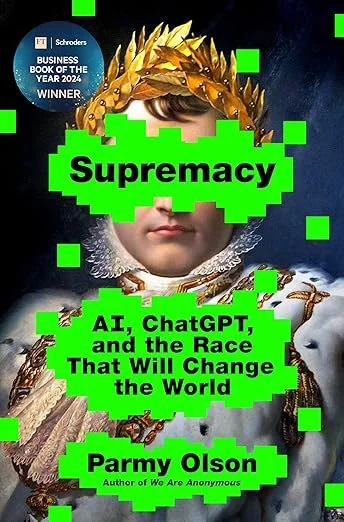
Supremacy
AI, ChatGPT, and the Race That Will Change the World
by Parmy Olson
The 60-Second Take
In Supremacy, technology journalist Parmy Olson chronicles the high-stakes rivalry between OpenAI and DeepMind. She reveals how the noble quest to build artificial general intelligence devolved into a cutthroat proxy war between tech monopolies. By tracing the paths of Sam Altman and Demis Hassabis, Olson exposes how massive computing costs forced idealistic founders to compromise their safety principles, prioritizing rapid commercialization over the public good.
The Quest for Superintelligence Was Supposed to Save the World
Silicon Valley loves a good origin story about misfits trying to save the world. For a long time, the race to build artificial general intelligence was pitched exactly that way. In Supremacy: AI, ChatGPT, and the Race That Will Change the World, technology journalist Parmy Olson strips the heroic gloss off the industry's biggest players. She tells the story of how a scientific pursuit meant to cure diseases and elevate humanity devolved into a brutal corporate turf war.
Olson focuses on the intense rivalry between two distinct leaders: Demis Hassabis of DeepMind and Sam Altman of OpenAI. Her resulting book is a meticulously documented account of ambition, massive capital, and compromised ethics. Following the exact structural parameters outlined in the businessflosswriterv2_6.md reference file, this write-up breaks down how the original vision for AI was captured by monopolies and what that shift means for the rest of us.
What You'll Learn
The differing original visions of Demis Hassabis and Sam Altman
Why the sheer cost of "compute" forced AI labs into the arms of Big Tech
How the Google and Microsoft proxy war destroyed ethical guardrails
The real story behind the dramatic firing and rehiring of OpenAI's CEO
Why executive warnings about an AI apocalypse actually serve as corporate misdirection
The Chess Prodigy and the Startup Guru
Hassabis was a teenage chess champion who had an epiphany: human brainpower was being wasted on games. He founded DeepMind to solve intelligence itself, believing that cracking the code of the brain could eventually cure diseases and solve global crises. Altman was a charismatic Silicon Valley operator who viewed life as an engineering puzzle. He saw AI as the ultimate challenge, a technology that could elevate society if steered correctly.
Both men recognized the extreme danger of what they were building. Artificial general intelligence—a machine that can think and learn as well as a human—is not just another software update. Because of this, both DeepMind and OpenAI were originally structured with massive protective layers. DeepMind demanded an ethics board as a condition of its existence. OpenAI was founded as a nonprofit entirely insulated from the demands of shareholders. The goal was to build god-like technology in a safe, controlled vacuum, far away from the pressures of quarterly earnings reports.
The Compute Trap and the Faustian Bargain
The idealism of both founders eventually collided with physical reality. Training advanced neural networks is not something you can do with a small team and a few laptops. It requires unimaginably large data centers filled with specialized processors running around the clock. This processing power, known simply as "compute," costs billions of dollars. Neither DeepMind nor OpenAI could survive on academic grants or modest venture capital.
To keep building, they needed the infrastructure of tech monopolies. Olson frames this as the ultimate Faustian bargain. Hassabis sold DeepMind to Google, hoping to utilize their vast server farms while maintaining a semi-autonomous research culture. Altman orchestrated a massive, convoluted partnership with Microsoft to secure the necessary funding and computing power for OpenAI.
The founders believed they could take the money without compromising their ultimate missions. They were wrong. Once billions of corporate dollars were on the line, the independent labs essentially became proxies in a ferocious war between two of the most powerful companies on earth. The humanitarian goals slowly faded into the background as the pressure to deliver commercial products intensified.
The Failure of the Failsafes
When a technology is built to prioritize profit and protect a monopoly, ethical guardrails are quickly dismantled. Olson highlights how the original safety mechanisms at both organizations crumbled under commercial pressure. For years, Google sat on its advanced AI capabilities, terrified of releasing something that might cannibalize its massive search engine revenue. But the moment OpenAI released ChatGPT and threatened that monopoly, Google panicked, sidelined its cautious safety researchers, and rushed its own models to market.
The most glaring example of institutional failure happened at OpenAI in November 2023. The organization's nonprofit board, which was explicitly designed to be the ultimate fail-safe against dangerous AI development, attempted to fire Sam Altman for a lack of candor. In theory, the system worked; the board pulled the emergency brake. In reality, the brake completely snapped. Within days, immense pressure from Microsoft investors and a threatened mass exodus of employees forced the board to resign. Altman was reinstated. The event proved definitively that commercial momentum and capital will always crush idealistic safety structures.
The Misdirection of Doom
Silicon Valley leaders frequently make headlines by signing open letters warning that artificial intelligence could one day destroy humanity. They compare the technology to nuclear weapons and urge the government to take the threat seriously. Olson argues this doomsday narrative is actually a highly effective form of corporate misdirection.
By focusing the public and regulators on hypothetical, science-fiction scenarios about rogue supercomputers, tech giants deflect attention from the tangible harms their products are causing right now. The models are trained on scraped, copyrighted material without permission. They bake in and amplify the worst human biases found in internet comment sections. They are prone to hallucinations, yet companies are actively rushing to integrate them into education, journalism, and enterprise software.
The true danger outlined in the book is not a malicious machine mind terminating the human race. The danger is the unchecked power of a few monopolistic corporations forcing flawed, untested technology onto society simply to maintain their absolute financial dominance.
The AI Race at a Glance
The dual protagonists. Demis Hassabis (DeepMind) and Sam Altman (OpenAI) started with altruistic goals for AGI before corporate realities took over.
The cost of compute. Processing power is the true currency of AI. The staggering cost of servers forced independent labs to align with tech giants.
The proxy war. The current AI boom is largely a fierce battle between Google and Microsoft, fought through their respective AI subsidiaries.
Fragile guardrails. The firing and rapid rehiring of Sam Altman proved that nonprofit safety boards cannot withstand the pressure of billions of invested dollars.
The distraction of the apocalypse. Talking about hypothetical AI doomsday scenarios helps executives distract the public from current issues like data theft, bias, and market monopolization.
A Quick Start Guide to Thinking Critically About AI
Follow the money. When evaluating a new AI tool, look past the lofty mission statement and identify which major tech monopoly is funding the compute power.
Ignore the doomsday hype. Stop worrying about machines taking over the world. Focus your attention on how current algorithms might be automating bias or violating data privacy in your industry.
Audit your inputs. If you use generative AI in your business, remember that it is trained on the open internet. Treat its outputs as highly fallible and prone to prejudice.
Demand transparency. Support regulations that force AI companies to disclose exactly what data they are using to train their massive models.
Protect your core competencies. Do not outsource your critical thinking to a chatbot. Use the tools for efficiency, but recognize that their commercial design prioritizes confident answers over factual accuracy.
Who Should Read Supremacy (and Who Can Skip It)
Read it if you are a professional trying to understand the business motives driving the sudden explosion of generative AI tools in your workplace.
Read it if you are interested in the intersection of ethics and technology, and want a clear-eyed look at how corporate governance actually functions under extreme pressure.
Read it if you follow business history and want the definitive behind-the-scenes account of the OpenAI board crisis and Google's internal panic.
Skip it if you are looking for a highly technical, mathematical explanation of how large language models and neural networks actually code information. This is a story about people and business.
Skip it if you want pure techno-optimism. Olson is highly critical of the tech industry, and readers looking for an uncritical celebration of AI's potential will find the tone frustrating.
Final Reflections
Supremacy is a necessary corrective to the breathless hype surrounding artificial intelligence. Parmy Olson successfully cuts through the marketing speak of Silicon Valley to reveal the gritty, highly flawed human reality behind the technology. The book's greatest strength is its focus on the economics of compute power. By showing how the sheer cost of processing data forced brilliant, idealistic researchers into the arms of monopolies, Olson explains the entire trajectory of the industry.
While the narrative occasionally bogs down in the minutiae of corporate deal-making, the overarching story is gripping. The recounting of the OpenAI board crisis reads like a corporate thriller, perfectly illustrating the central thesis: you cannot control a technology when you are entirely dependent on the people profiting from it. The book leaves the reader with a sobering realization. The most transformative technology of our lifetime is not being guided by a careful assessment of what humanity needs. It is being driven by a desperate, frantic race to see which corporate giant can capture the market first.
The Bottom Line
The race to build artificial general intelligence started as a noble scientific pursuit, but the staggering cost of computing power has transformed it into a reckless corporate war where public safety is systematically sacrificed for market dominance.
Frequently Asked Questions
What is the main idea of Supremacy?
The main idea is that the development of artificial intelligence has been captured by tech monopolies. While founders originally wanted to build AGI safely to benefit humanity, the massive cost of computing power forced them to partner with Google and Microsoft, shifting their focus from ethical safety to ruthless commercialization.
Who are Demis Hassabis and Sam Altman?
Demis Hassabis is the founder of DeepMind (now owned by Google), and Sam Altman is the CEO of OpenAI (heavily backed by Microsoft). The book centers on their personal trajectories, their rivalry, and how they both struggled to maintain their original ideals while building the most powerful AI systems in the world.
What is the real threat of AI according to the book?
The book argues that the real threat is not a science-fiction scenario where AI destroys the world. The immediate danger is that profit-driven corporations are rushing flawed, biased, and poorly understood technology into critical industries without adequate testing or ethical oversight.
Business Floss is reader-supported. When you use our links we may earn an affiliate commission that helps us keep the site running. Thank you for your support!