
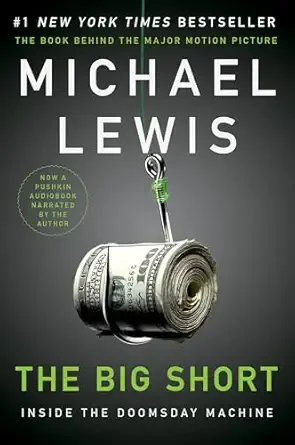
The Big Short
Inside the Doomsday Machine
by Michael Lewis
The 60-Second Take
In The Big Short, journalist Michael Lewis tells the story of a handful of investors who saw the 2008 housing crisis coming and bet against the mortgage bond market. The book uses their stories to explain how subprime lending, credit default swaps, and rating agency failures produced the financial crisis. Useful reading for any finance professional trying to understand how markets get things spectacularly wrong.
The Big Short: Inside the Trade That Saw 2008 Coming
In the years leading up to 2008, almost every credible voice in finance assumed the U.S. housing market would either keep rising or, at worst, flatten. Mortgage-backed securities were rated investment grade. Credit default swaps insuring them traded for pennies. The largest banks in the world held billions of dollars in this paper on their books, supremely confident in the math.
A small number of investors disagreed. They studied the loan tapes underneath the bonds, recognized the rot, and figured out how to bet against it. Michael Lewis's The Big Short: Inside the Doomsday Machine tells their story. The book is character-driven, deeply researched, and one of the clearest explanations available of how the 2008 financial crisis actually worked.
What You'll Learn
How the subprime mortgage market was structured and why it failed
The role of credit default swaps in the crisis
How rating agencies miscalibrated risk on trillions of dollars in paper
The handful of investors who saw it coming and how they made their bets
Practical lessons about market psychology and contrarian thinking
The Subprime Machine
Lewis's central explainer is the subprime mortgage machine. Lenders originated loans to borrowers with weak credit, often with no income verification and adjustable rates designed to reset higher after two or three years. Investment banks bought the loans, bundled them into mortgage-backed securities, and sliced the cash flows into tranches with different risk profiles.
The math worked on the assumption that housing prices would keep rising, allowing borrowers to refinance before the reset. When prices stopped rising, the machine broke. Borrowers defaulted, the lowest tranches absorbed the losses first, and then losses cascaded up through the structure.
Worse, much of the paper was wrapped in additional layers. Collateralized debt obligations bundled the worst tranches from many securities and re-sliced them, then got AAA ratings on the new top tranche through a mathematical sleight of hand that assumed the underlying defaults would be uncorrelated. They were not.
For finance professionals, the structural lesson is durable. Whenever a market relies on math that requires a specific assumption to hold, the failure mode is concentrated at that assumption.
The Trades
Lewis follows several traders who built positions against this machine.
Michael Burry, a former neurologist running a small hedge fund, read mortgage documents directly. He concluded that defaults would dwarf what the models implied. He convinced banks to write him credit default swaps on the specific bonds he had analyzed.
Steve Eisman, a contrarian hedge fund manager, recognized the rot from his experience with subprime credit card lenders in the 1990s. He scaled his short positions through the system.
Charlie Ledley and Jamie Mai, two amateurs running a tiny fund out of a garage, stumbled into the same trade by looking for cheap options on improbable outcomes.
These were not insiders. They were outsiders who actually did the work the system assumed had already been done. The story Lewis tells is partly about their financial winnings and partly about the surreal experience of being right while the market kept paying them to be wrong, sometimes for years.
Credit Default Swaps Explained
The book is exceptionally clear on credit default swaps. A CDS is essentially insurance on a bond. The buyer pays a premium. If the bond defaults, the seller pays out. The market was originally designed to let bondholders hedge their exposure.
The problem is that buyers did not need to own the underlying bond. Anyone could buy a CDS on any bond. This meant the total CDS market grew far larger than the underlying bond market, with the financial system effectively writing massive amounts of insurance on losses it had not anticipated.
When defaults came, the sellers of CDS owed enormous sums they had not reserved for. AIG was the most visible example. Its failure threatened the entire financial system, which is why the U.S. government chose to bail it out rather than let the contagion spread.
The Rating Agency Failure
Moody's and S&P assigned investment-grade ratings to mortgage-backed securities and CDOs that, in retrospect, deserved nowhere near those ratings. Lewis is sharp about why. The agencies were paid by the issuers of the bonds. Their models were calibrated using historical data that did not include a national housing decline. Their analysts were underpaid relative to the bankers they were rating, and the talent flowed in one direction.
The structural lesson is that any rating, audit, or certification system where the rated party pays the rater has a built-in conflict that compounds over time. The lesson generalizes to credit ratings, fund ratings, professional certifications, and other gatekeeping functions.
The Hardest Part: Being Right Too Early
The most useful chapters describe what it felt like to hold the short position for years before being vindicated. Burry's investors threatened to pull their capital. Eisman faced quarterly losses on positions he was certain would pay off. The contrarian trade is not the act of being right while everyone else is wrong. It is the act of staying right under pressure to capitulate.
Lewis captures this without romanticizing it. The traders second-guessed themselves. They argued with their teams. Some lost relationships and reputations. The eventual payouts were enormous, but the cost of getting there was real.
For working professionals, the lesson is that conviction is testable. Many people claim contrarian views. Few sustain them through long stretches of looking wrong.
A Quick Start Guide for Reading Markets
Pull these into your own work.
Read the source documents. Where everyone is relying on summary statistics, find someone who has actually read the underlying contracts.
Look for assumption-dependent math. Whenever a market is priced on a specific assumption holding, that assumption is the place to study.
Track conflicts of interest in gatekeepers. Rating agencies, auditors, sell-side analysts. Their incentives shape their outputs.
Build conviction the same way Burry did. With original analysis. Borrowed conviction collapses under pressure.
Pre-commit to a position size and stop loss. Contrarian trades require survival. Position sizing is the survival mechanism.
Final Reflections
The Big Short is the rare book that succeeds as both narrative and explainer. The characters are vivid. The technical explanations of mortgage bonds, CDS, and CDOs are unusually clear for a general-audience book. The lasting value, beyond the historical record of 2008, is the demonstration of how a financial system can be systematically wrong for years while the people who are right look like cranks. Required reading for anyone who builds, audits, or relies on financial models.
Business Floss is reader-supported. When you use our links we may earn an affiliate commission that helps us keep the site running. Thank you for your support!


