
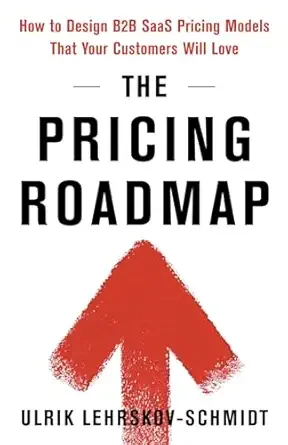
The Pricing Roadmap
How to Design B2B SaaS Pricing Models That Your Customers Will Love
by Ulrik Lehrskov-Schmidt
The 60-Second Take
In The Pricing Roadmap, B2B SaaS pricing expert Ulrik Lehrskov-Schmidt turns hundreds of real-world redesigns into a step-by-step framework for building pricing that grows revenue without torching customer trust. He shows why structure beats price points, how fencing and laddering shape commercial outcomes, and how to pick metrics, validate changes, and raise prices with confidence. Essential reading for any SaaS operator tired of guessing.
Stop Guessing, Start Engineering Your Price Tag
Pricing is the one lever in a SaaS business that touches everything: growth, retention, sales velocity, investor enthusiasm, and the mood of your product team on any given Tuesday. Yet most founders treat it like a decorating decision. They pick a number that feels right, slap together a three-tier "good, better, best" table on the website, and hope the market nods along. Then ACV stalls, discounts get ugly, and someone in a board meeting mutters that maybe pricing needs a look.
Ulrik Lehrskov-Schmidt has built a career cleaning up exactly that mess. In The Pricing Roadmap: How to Design B2B SaaS Pricing Models That Your Customers Will Love (2023), the Harvard-trained pricing consultant distills hundreds of commercial redesigns into a working playbook for anyone selling software to businesses. His argument is refreshingly blunt: the value does not live in the price point. It lives in the pricing structure. Get the architecture right and the numbers take care of themselves. Get the architecture wrong and no amount of A/B testing on a checkout page will save you.
What You'll Learn
Why packaging, not price points, is the real profit engine
How to pick a pricing metric that scales with customer value
The difference between fencing and laddering, and when to use each
How to run pricing experiments without torching your customer base
A practical sequence for raising prices on existing customers
How discounting can strengthen (or quietly gut) your go-to-market
Price the Customer, Not the Product
Lehrskov-Schmidt's opening move is to reframe what pricing actually is. Most teams obsess over a single question: how much should we charge? He argues the better question is, how should we charge? A $50,000 contract can be structured as a flat annual fee, a per-seat license, a usage-based meter, or a revenue share, and each of those choices creates wildly different incentives for your customers, your sales team, and your churn numbers.
Consider two SaaS companies selling identical analytics products. Company A charges $2,000 per user per month. Company B charges a platform fee plus $0.001 per event processed. When a customer's business grows, Company A has to renegotiate seats in a tense annual review. Company B just quietly collects more revenue as events tick upward. Same product, same value delivered, radically different growth curves. That is what Lehrskov-Schmidt means when he says you should price the customer, not the product.
The CUPID Framework for Mapping Your Pricing
Before you touch a spreadsheet, the book insists on understanding the commercial DNA of what you sell. Lehrskov-Schmidt offers a simple acronym, CUPID, to surface the variables that should drive every downstream decision.
Core Pricing Concepts at a Glance
Customers: Who actually signs the contract and owns the budget? This is rarely the same person who uses the product.
Users: Who touches the software day to day, and how does their usage grow?
Products: What are the distinct jobs your software handles, and can those jobs be sold separately?
Iteration: How will the pricing evolve as you learn more about value delivery?
Distribution: Self-serve, inside sales, field sales, or partner channel? Each demands a different pricing surface.
Skipping CUPID is how founders end up with per-seat pricing on a product that is mostly used by one admin who serves a whole organization. The seats do not grow. The revenue does not grow. And everyone wonders why expansion is dead.
Fencing and Laddering: The Two Design Moves That Matter
Once you understand the DNA, Lehrskov-Schmidt introduces his two structural principles. These are the load-bearing walls of any pricing model.
Fencing is the art of separating customers into distinct categories so you can charge each group differently without the other groups complaining. Airlines do this brilliantly. A business traveler pays four times what a leisure traveler pays for the same flight because the fence (refundability, flexibility, timing) is transparent and defensible. In SaaS, your fences might be company size, industry, or use case. The rule of thumb is that every customer should look at your pricing page and feel there is exactly one package meant for them.
Laddering is what happens inside a fence. It is the deliberate staircase you build so a customer who buys the entry-level package naturally wants to climb to the next tier as their usage matures. Lehrskov-Schmidt is sharp about the common mistake here. Most teams design the second tier around what they wish customers would buy. The customers, stubborn creatures that they are, keep buying the first tier. The fix is to design each rung around the next job the customer actually faces, not the job you want them to face.
Pricing Metrics: The Hidden Lever Nobody Optimizes
The pricing metric is the unit of consumption your invoice multiplies by. Per seat. Per API call. Per GB stored. Per transaction processed. Choose wrong and you will fight gravity for the life of the business. Choose right and your revenue grows as your customer succeeds, which is the whole point of SaaS in the first place.
What Makes a Pricing Metric Actually Work
Operational viability: Can you actually measure and bill it without a small army of accountants?
Value chain relevance: Does it track something the customer already cares about?
Willingness to pay: Does the metric scale alongside perceived value, not just cost?
Metric density: Is each unit meaningful, or are you selling air at fractions of a penny?
Fairness: Will the customer feel the bill reflects what they got?
A classic example: early Slack priced by active user rather than total accounts created. That single decision meant companies could roll Slack out aggressively without worrying about ghost accounts inflating the bill. The metric did the adoption marketing for them.
Validation, Migration, and the Art of Raising Prices
The final third of the book handles the part most founders dread: actually changing prices on a live business. Lehrskov-Schmidt argues that pricing should be validated before launch using conversations, not guesswork. Run structured interviews. Test willingness to pay against specific packaging options. Watch for the prospects who say your pricing is too cheap, because they are often the most revealing signal in the room.
When it comes to raising prices on existing customers, he recommends grandfathering strategically, announcing changes with enough runway, and framing increases around added value rather than margin needs. Discounts, meanwhile, get their own chapter for a reason. A discount is not a concession. It is a design element. If your sales team routinely gives 30% off to close deals, your list price is simply wrong, and the discount is papering over a structural problem.
Quick Start Guide for Rebuilding Your Pricing
Run a CUPID audit on your current model this week. Who buys, who uses, what jobs, what distribution, where is iteration possible?
Map your fences. Can a prospect find their package in under ten seconds? If not, you do not have fences, you have fog.
Inspect your pricing metric against the five criteria above. If it fails on two or more, start brainstorming alternatives.
Interview ten customers about willingness to pay and perceived value. Note the language they use to describe outcomes.
Draft two alternative pricing structures using your findings and pressure-test them with your sales and product leads.
Pilot with new logos first before migrating existing ones, and build a grandfathering plan for long-tenured accounts.
Set a pricing review cadence. Quarterly check-ins beat emergency overhauls every time.
Final Reflections
The Pricing Roadmap is the rare business book that respects both the craft and the chaos of SaaS commercialization. Lehrskov-Schmidt refuses to hand readers a single magic formula, because there is not one. Instead, he gives them a designer's toolkit: fencing and laddering to shape the offer, CUPID to map the commercial reality, pricing metrics to align revenue with value, and a validation discipline that replaces gut feel with evidence. The big idea running through all of it is that pricing is not a number you pick at the end of building a product. It is a product in its own right, engineered with the same care you would give any feature your customers rely on. Founders who internalize that shift stop losing sleep over list prices and start building revenue engines that compound quietly in the background.
Business Floss is reader-supported. When you use our links we may earn an affiliate commission that helps us keep the site running. Thank you for your support!