
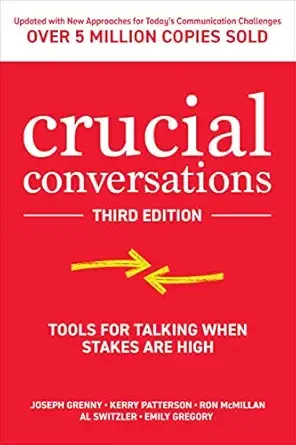
Crucial Conversations
Tools for Talking When Stakes are High
by Joseph Grenny, Kerry Patterson, Ron McMillan, Al Switzler & Emily Gregory
The 60-Second Take
In Crucial Conversations, authors Kerry Patterson, Joseph Grenny, Ron McMillan, and Al Switzler provide a practical framework for mastering high-stakes, emotional dialogue. They argue that successful communication depends on maintaining a safe "pool of shared meaning." By learning to manage your internal stories, restore mutual respect, and speak persuasively without being abrasive, you can resolve deep conflicts and turn volatile disagreements into productive action.
The Cost of Avoiding the Hard Discussions
The defining moments in any business rarely happen during formal presentations or quarterly planning retreats. They happen in the hallway after a meeting goes off the rails. They happen when a star employee threatens to quit, when a project is failing, or when a manager needs to address a toxic team dynamic. These moments require people to talk openly about highly sensitive issues, yet most professionals are spectacularly bad at doing so. When the pressure spikes, our biology betrays us. The adrenaline surges, blood leaves our brain's rational centers to prepare our bodies for a physical fight, and we end up either shutting down entirely or lashing out aggressively.
In Crucial Conversations, Kerry Patterson, Joseph Grenny, Ron McMillan, and Al Switzler offer a way out of this biological trap. Based on decades of research analyzing top performers across diverse industries, the authors discovered that the most effective people are not the ones with the highest IQs or the most technical expertise. The most effective people are the ones who can maintain open, honest dialogue when the stakes are highest. This summary explores their methodology for keeping your cool, ensuring others feel safe enough to share their true opinions, and turning heated arguments into actionable solutions.
What You'll Learn
The three elements that turn a normal discussion into a crucial conversation
How to identify and avoid the "Sucker's Choice" between honesty and harmony
The warning signs of Silence and Violence in a deteriorating conversation
How to use the tool of Contrasting to instantly restore safety and mutual respect
The Path to Action, and how separating facts from stories regulates your emotions
The STATE framework for expressing controversial opinions persuasively
The Pool of Shared Meaning
To understand the mechanics of dialogue, you first have to understand what makes a conversation "crucial." The authors define a crucial conversation as a discussion characterized by three specific elements: the stakes are high, opinions vary, and emotions run strong. This could be a salary negotiation, a debate over a strategic pivot, or a confrontation with a peer who consistently misses deadlines.
When these three elements are present, the goal is to get all the relevant information out into the open. The authors call this the "Pool of Shared Meaning." Every person walks into a conversation with their own unique history, opinions, and feelings. When people feel comfortable, they willingly contribute their thoughts to a collective pool. This pool becomes a robust database of information that allows a team to make smarter, more accurate decisions.
However, when people feel threatened, they stop contributing. They withhold their honest opinions, meaning the pool remains shallow. When a team operates from a shallow pool of meaning, they make terrible choices because they are acting on incomplete data. The entire framework of the book is built around a single objective: keeping the Pool of Shared Meaning flowing freely, regardless of how contentious the topic might be.
Start with Heart and the Sucker's Choice
Before you can fix a broken conversation, you have to fix your own internal motives. In the heat of the moment, it is incredibly easy to lose track of what you actually want. You might enter a meeting intending to solve a supply chain issue, but the moment a colleague insults your team, your motive shifts from "solve the problem" to "punish my colleague" or "save face." The authors call this "Starting with Heart." You must constantly ask yourself: What do I really want for myself? What do I want for others? What do I want for the relationship?
When you clarify your true motives, you naturally avoid the "Sucker’s Choice." This is the false dichotomy we invent to justify our own bad behavior. We tell ourselves, "I can either be honest and ruin my working relationship with my boss, or I can stay quiet and keep my job." We convince ourselves that candor and empathy are mutually exclusive.
The most skilled communicators reject the Sucker's Choice. They formulate a more complex, challenging question: How can I be 100 percent honest with my boss AND remain 100 percent respectful of our relationship? By demanding a solution that satisfies both conditions, you force your brain to abandon the fight-or-flight response and start searching for creative, diplomatic ways to express the truth.
Learn to Look: Silence and Violence
Because a crucial conversation requires a free flow of information, your primary job is to notice the exact moment that flow stops. People rarely announce that they feel unsafe. Instead, their behavior shifts into one of two predictable categories: Silence or Violence.
Silence is the act of purposefully withholding information from the pool. It takes many forms. Sometimes it is masking, where a person uses sarcasm, sugarcoating, or vague language to hide their true meaning. Other times it is avoiding, where they change the subject completely. In its most extreme form, it is withdrawing, where the person literally leaves the room or shuts down the conversation entirely.
Violence is the opposite end of the spectrum. It is any action taken to force your meaning into the pool and compel others to accept it. This includes controlling, where a person monopolizes the conversation, cuts others off, or overstates facts. It includes labeling, where people are dismissed under a broad, negative stereotype to invalidate their argument. And it includes attacking, which involves explicit threats, belittling, and personal insults.
The moment you spot Silence or Violence, you must step out of the content of the conversation. Do not argue the point being made. Instead, recognize that safety has been compromised and focus entirely on rebuilding it.
Make It Safe: Purpose, Respect, and Contrasting
Safety is built on two pillars. The first is Mutual Purpose. The other person must believe that you are working toward a common outcome and that you care about their goals. The second is Mutual Respect. The moment someone perceives that you do not respect them, the conversation immediately turns into a defense of their ego.
When a conversation goes off track, it is usually because one of these pillars has collapsed. Perhaps you suggest a new software tool, and your colleague immediately gets defensive, assuming you think their current IT strategy is a failure. You have inadvertently threatened their respect.
To fix this instantly, the authors introduce a powerful technique called Contrasting. Contrasting is a "don't/do" statement that addresses a misunderstanding before it spirals out of control. It works like this:
The Don't: You address the other person's exact fear or misunderstanding. ("I don't want you to think I am unhappy with how you have managed the IT department.")
The Do: You clarify your actual intent. ("I do want to explore ways we can automate this one specific reporting process to save your team some hours.")
Contrasting is not an apology. You are not taking back your feedback. You are simply defining the boundaries of your feedback so the other person stops feeling universally attacked and can re-engage with the actual problem.
Master Your Stories: The Path to Action
We often blame other people for making us angry. We say, "She made me furious when she questioned my budget." Crucial Conversations argues that no one can make you feel anything. Between observing an event and feeling an emotion, your brain tells a story. The authors call this the Path to Action.
It happens in a flash: You see or hear a fact. You tell a story about what that fact means. That story generates a feeling. That feeling drives an action.
If your boss asks you to double-check a report (fact), you might tell yourself a story that she thinks you are incompetent (story). That story makes you feel insulted (feeling), so you respond with defensive sarcasm (action). The trick to emotional regulation is realizing that the story is a complete fabrication.
When things go wrong, we naturally gravitate toward "clever stories" that justify our bad behavior:
Victim Stories: "It's not my fault." We ignore our own role in the problem and portray ourselves as innocent sufferers.
Villain Stories: "It's all your fault." We exaggerate the other person's negative traits and assume they have malicious intent, ignoring any reasonable explanation for their behavior.
Helpless Stories: "There's nothing else I can do." We convince ourselves that we are trapped and that taking healthy action is impossible.
To master your stories, you must retrace your Path to Action. Separate the objective facts (what was actually said or done) from the narrative you invented. Once you isolate the facts, you can usually write a much more generous, useful story that leads to a productive conversation rather than an emotional explosion.
The STATE Framework
When you have regulated your own emotions and ensured the environment is safe, you actually have to speak your mind. The authors provide the STATE framework to help you deliver controversial or negative feedback persuasively rather than abrasively. The first three skills describe what to do, and the last two describe how to do it.
Share Your Facts
Always start with the facts, not your conclusions. Facts are the least controversial and least insulting starting point. Saying, "You were twenty minutes late to the last three client meetings" is a verifiable fact. Saying, "You are completely unreliable" is a highly debatable, offensive conclusion. Lay out the objective data first to build a safe foundation.
Tell Your Story
Once the facts are on the table, you can carefully share the conclusion you have drawn from them. This is where you explain why those facts matter. "When you are late to the client meetings, it sends a message that we do not value their time, and it makes me worry we are going to lose the account." Because you led with facts, your story seems like a reasonable deduction rather than an unprovoked attack.
Ask for Others' Paths
After sharing your perspective, you must actively invite the other person to share theirs. The goal is the Pool of Shared Meaning, not a monologue. You ask, "How do you see it?" or "What am I missing here?" You have to genuinely want to hear their side, even if you strongly disagree with their initial premise.
Talk Tentatively
This is a stylistic rule. How you present your story determines how defensively the other person reacts. State your story as a hypothesis, not as an absolute, undeniable fact. Replace rigid phrasing like "The fact is..." or "It's obvious that..." with softer language like "In my opinion..." or "I am beginning to wonder if...". Talking tentatively does not mean being weak; it means leaving room for new information.
Encourage Testing
Make it actively safe for others to express opposing views. If people seem hesitant to disagree with you, you have to play devil's advocate against your own idea. Say something like, "I know I've been pushing this hard, but does anyone see a reason why this won't work?" When you invite pushback, you reduce the perceived risk of speaking up.
Move to Action
A crucial conversation that does not result in action is just a therapy session. To turn a shared pool of meaning into concrete business results, teams must decide how they are going to decide. The authors outline four methods of decision-making:
Command: Decisions are made by outside forces or by a single leader, and the team is simply told what to do.
Consult: A leader gathers input from the team to inform their choice, but ultimately makes the final call alone.
Vote: Used when efficiency is more important than total buy-in. The majority rules.
Consensus: Everyone must agree to support the final decision. This is highly effective for complex, high-stakes issues, but it is incredibly time-consuming and should be used sparingly.
Once the decision method is clear and the choice is made, document it meticulously. Write down exactly who is doing what by when, and establish how you will follow up. Ambiguity at the end of a crucial conversation guarantees that the conflict will resurface later.
Crucial Conversations at a Glance
The Pool of Shared Meaning. The ultimate goal of dialogue is ensuring all parties feel safe enough to contribute their honest facts, opinions, and feelings to a shared pool of information.
The Sucker’s Choice. The false belief that we must choose between telling the truth and keeping a relationship intact.
Silence and Violence. The two behavioral indicators that a person no longer feels safe in a conversation.
Contrasting. A "don't/do" statement used to instantly clarify misunderstandings and restore mutual respect.
The Path to Action. The sequence of See/Hear -> Tell a Story -> Feel -> Act. Regulating emotion requires separating objective facts from the subjective stories we invent.
The STATE Framework. Share facts, Tell your story, Ask for others' paths, Talk tentatively, Encourage testing.
A Quick Start Guide to High-Stakes Dialogue
Notice the physical signs. Before you open your mouth, pay attention to your body. If your heart is racing or your jaw is tight, the stakes are high, and you need to proceed with caution.
Identify your true motive. Ask yourself what you genuinely want to achieve for the business and the relationship. Let go of the desire to "win" the argument or punish the other person.
Lead with data, not judgments. When confronting someone, start with the objective facts (times, dates, exact quotes) before you share your interpretation of their behavior.
Use Contrasting to defuse tension. If the other person gets defensive, immediately pause the content. Say, "I don't want you to think X. I actually want Y."
Decide how to decide. Never leave a hard conversation without explicitly stating who is taking ownership of the solution and when the deadline is.
Who Should Read Crucial Conversations (and Who Can Skip It)
Read it if you are a manager who frequently avoids giving critical feedback because you hate dealing with employee defensiveness or tears.
Read it if your executive team suffers from "meeting after the meeting" syndrome, where people nod in the boardroom but complain in the hallways.
Read it if you are navigating a high-friction business partnership or a tense personal relationship and need a reliable method for expressing grievances cleanly.
Skip it if you are looking for manipulative sales scripts or tactical negotiation tricks to defeat a competitor. This book is about building shared alignment, not winning a zero-sum game.
Skip it if you refuse to analyze your own behavior. The entire methodology requires you to take radical responsibility for your own motives and emotional reactions before confronting others.
Final Reflections
Crucial Conversations is a masterclass in emotional intelligence masquerading as a communication manual. What makes the book so enduring is its relentless focus on internal mechanics rather than external manipulation. The authors recognize that you cannot force another person to be reasonable, but you can relentlessly manage the safety of the environment so that reason has a chance to survive. The STATE framework and the concept of Contrasting are remarkably simple to grasp, yet deeply challenging to apply when the adrenaline hits. For anyone tired of dealing with office politics, passive-aggression, and stalled projects, this book provides the definitive toolkit for transforming conflict into collaboration.
The Bottom Line
When stakes are high and emotions run hot, successful leaders do not choose between honesty and harmony; they use facts, empathy, and clear motives to create a safe environment where the hardest truths can finally be spoken.
Frequently Asked Questions
What is the main idea of Crucial Conversations?
The main idea is that the root cause of most organizational and personal failure is the inability to discuss high-stakes, emotional issues effectively. By ensuring that all parties feel respected and share a common purpose, individuals can safely express controversial opinions and turn deep conflicts into productive decisions.
What is the "Sucker's Choice"?
It is a false dilemma we create to excuse our poor communication. We tell ourselves that we only have two options: either speak the truth and ruin a relationship, or stay silent to keep the peace. Skilled communicators reject this and find ways to be entirely honest while remaining entirely respectful.
What is the STATE framework?
It is a five-step process for communicating sensitive information. You Share your facts, Tell your story (your conclusion based on the facts), Ask for others' paths (their perspective), Talk tentatively (frame your story as a hypothesis, not an absolute), and Encourage testing (invite opposing views).
Business Floss is reader-supported. When you use our links we may earn an affiliate commission that helps us keep the site running. Thank you for your support!


