
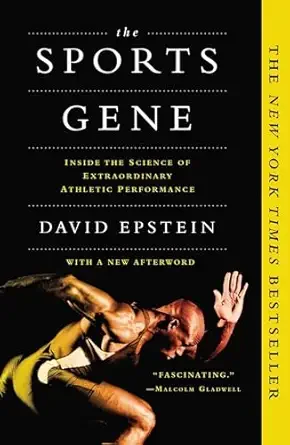
The Sports Gene
Inside the Science of Extraordinary Athletic Performance
by David Epstein
The 60-Second Take
In The Sports Gene, David Epstein takes apart the idea that 10,000 hours of practice explains athletic greatness. Drawing on genetics labs, Kalenjin villages, and Jamaican sprint clubs, he shows how body type, single-gene mutations, and wildly uneven responses to training shape who reaches the top. His conclusion is not nature over nurture but a case for how thoroughly the two are entangled.
The Uncomfortable Question Behind Every Training Plan
David Epstein was a Sports Illustrated investigative reporter and a college 800-meter runner, which is a useful combination for this particular book. He had watched teammates with a fraction of his training pull away from him, and he did not find the popular explanation satisfying.
That explanation was the 10,000-hour rule, drawn from Anders Ericsson's research on violinists and made famous by Malcolm Gladwell in Outliers. Practice enough, deliberately enough, and expertise follows. The Sports Gene, published in 2013, is Epstein's attempt to test that claim against the actual science of human performance, and the answer he lands on is messier and more interesting than either camp in the nature-versus-nurture argument tends to admit.
His real target is not practice. It's the assumption of a uniform human being underneath the practice.
What You'll Learn
What the 10,000-hour research actually found, and what got lost in the popular version
Why identical training produces wildly different results, and what the HERITAGE Family Study showed
How elite athletes' apparently superhuman reflexes are learned perception rather than fast wiring
What single genes like ACTN3 and the EPO receptor mutation do, and the limits of that story
Why elite body types have grown more extreme over the last century
How to read the book's chapters on ancestry and geography carefully
Donald Thomas, Stefan Holm, and the Trouble With Averages
Epstein's central illustration is a pair of high jumpers who met at the 2007 World Championships.
Stefan Holm of Sweden was the practice hypothesis made flesh. He had jumped since childhood, trained around a dozen sessions a week for two decades, and built a technique refined across tens of thousands of attempts. Donald Thomas was a Bahamian college basketball player who had tried the high jump on a dare, clearing roughly 6 feet 8 inches in borrowed shoes on his first day. Eight months later, with almost no formal training, he cleared 7 feet 8.5 inches and took the world title. Holm finished behind him.
Thomas had an unusual physical asset, notably exceptionally long Achilles tendons, which act as springs in a jump. He also, tellingly, barely improved afterward. His performance arrived nearly complete and then stalled.
The point Epstein extracts is subtler than "genes beat practice." Ericsson's violin research reported an average of roughly 10,000 hours among elite performers, and averages conceal their spread. Some in the elite group had logged far fewer hours, some far more. When a distribution with enormous variance gets compressed into a single memorable number, the number stops describing anybody. Holm needed decades. Thomas needed months. Both facts are real, and a rule that predicts one cannot explain the other.
The HERITAGE Family Study and the Trainability Gap
If one finding in the book deserves to outlive the rest, it is this one.
The HERITAGE Family Study, a collaboration across five universities in the United States and Canada, recruited sedentary two-generation families with no training history and put nearly 500 people through a tightly controlled five-month stationary-bike program. Same protocol, three sessions a week, supervised in a lab.
The results did not cluster. Roughly 15 percent of participants improved their aerobic capacity by 50 percent or more. Roughly 15 percent improved barely at all. Everyone else landed between. Crucially, the amount someone improved bore no relationship to how fit they were at the start, so this was not a matter of untrained people having more room to grow. Family members resembled each other strongly, and the range of response between pairs of brothers was six to nine times larger than within pairs. Statistical analysis put about half of a person's capacity to improve down to inheritance.
Strength training shows the same shape. Research at the University of Alabama at Birmingham put participants on an identical four-month lower-body program and found extreme responders whose muscle fibers grew dramatically, moderate responders with ordinary gains, and non-responders whose fibers did not grow at all.
The management implication travels well beyond sport. Most organizations, teams, and training programs are built on an implicit assumption that effort converts to results at a common rate, so unequal outcomes must reflect unequal effort. The HERITAGE data says the conversion rate is itself a variable. Epstein is careful about the reading here: none of this means exercise is pointless for the low responders, since health benefits appear across the range. It means that a single uniform program is not the neutral, fair default it appears to be, and that measuring response rather than compliance is the honest way to run one.
The Software Side: Why Great Hitters Are Not Faster, Just Better Informed
Epstein spends as much of the book on learned skill as on biology, and this is where he pushes back hardest on genetic determinism.
He opens with the softball pitcher Jennie Finch striking out elite major league hitters, among them some of the best in the game. These are men who routinely hit 95 mile-per-hour fastballs, and the physics says that is impossible to do by reacting to the ball. There simply isn't enough time between release and plate for a human visual and motor system to respond.
What they are actually doing is predicting. Over years of repetition they have learned to read a pitcher's grip, shoulder, arm slot, and release, compressing dozens of subtle cues into a single anticipation before the ball has traveled far. It is the same mechanism chess research identified decades ago, where masters recall board positions far better than novices, but only when the positions come from real games rather than random arrangements. The expertise lives in the pattern library, not the hardware.
Put those hitters against an underhand softball delivery and the library is useless. Their reaction time is unchanged and ordinary. Their advantage evaporates because it was never speed.
There is a hardware footnote worth knowing: professional baseball players test with unusually sharp visual acuity, well beyond 20/20 on average, and whether that is selected for or developed remains unsettled. But the headline finding runs the other way. The most spectacular-looking athletic feats are largely built, not born, and they are narrowly specific to the situation in which they were built.
Bodies, Genes, and Geography
The Big Bang of body types
A century ago, elite athletes across different sports looked broadly similar. As sport globalized, professionalized, and the talent pool widened, body types began flying apart toward specialized extremes, which Epstein calls the Big Bang of body types. Basketball players grew taller with wingspans disproportionate to their height. Distance runners grew smaller and lighter. Swimmers trend toward long torsos and shorter legs, close to the inverse of runners. Gymnasts and divers, who must rotate in the air, went small.
The practical consequence is that in many sports the body is a gate rather than a variable, and no amount of training moves it.
Single genes with outsized effects
Two examples carry most of the weight. ACTN3, often nicknamed the speed gene, governs production of a protein tied to fast-twitch muscle function; elite sprinters essentially all carry a working version, and people with two non-functional copies are effectively absent from elite sprint rosters. Separately, the Finnish cross-country skier Eero Mäntyranta carried a rare mutation in his erythropoietin receptor gene that drove his red blood cell count far above normal. He collected seven Olympic medals, and rivals long assumed he was doping. He wasn't.
Epstein also covers myostatin mutations, which remove the body's natural brake on muscle growth and explain both a famously muscular German child and the bizarre physiques of Belgian Blue cattle.
He is explicit about the limits, and this matters given how the book is sometimes summarized. Consumer genetic tests for athletic potential are close to useless, because performance is polygenic, and picking a career from one variant is like guessing a jigsaw picture from a single piece. A stopwatch remains the better instrument.
Kenya and Jamaica
The most-discussed and most-contested chapters examine two extraordinary concentrations of talent. Kenya's Kalenjin produce a wildly disproportionate share of elite distance runners, and Epstein points to a combination of factors: body proportions including notably thin lower legs, which cost less energy to swing with each stride, childhood running at altitude, and a culture in which running success is a genuine economic ladder. Jamaica's sprinting record gets a parallel treatment, blending population genetics with a school competition system that tests essentially every child for speed.
Epstein's framing is ancestral population variation interacting with environment and culture, and he explicitly rejects race as a biological category. The chapters remain the ones readers argue about most, and they should be read with that argument in mind rather than as settled ground.
Athletic Potential at a Glance
Trainability. The genetically influenced capacity to improve from training, which varies enormously between people given identical work.
Non-responder. Someone whose measured capacity barely changes on a program that transforms others, despite full compliance.
Chunking. The expert's compression of many small perceptual cues into a single recognized pattern, allowing prediction rather than reaction.
The Big Bang of body types. The century-long divergence of elite physiques toward sport-specific extremes.
ACTN3. A gene tied to fast-twitch muscle protein, present in working form in effectively all elite sprinters tested.
Gene-environment interaction. The finding that genetic advantage and environmental input multiply each other rather than compete.
A Quick Start Guide to Applying the Book
Measure response, not compliance. Track whether a program is actually moving your numbers. Months of effort with a flat curve is information, not a character flaw.
Change the variable, then re-measure. If a protocol isn't working for you, alter the stimulus rather than adding volume to something your body isn't answering.
Separate hardware from software. Ask which parts of a skill are physical ceilings and which are pattern libraries. The second kind rewards study and repetition far more than the first.
Build patterns in context. Perceptual expertise is narrow. Practice under the conditions and cues you'll actually face, not abstracted drills.
Choose the game that fits the equipment. Where physical structure is a gate, selecting a better-matched sport, position, or role beats fighting the gate.
Who Should Read The Sports Gene (and Who Can Skip It)
Read it if you coach, train, or design development programs, and want the evidence for why a single uniform plan produces very uneven results.
Read it if you enjoyed Outliers and want the serious counterargument, since Epstein engages the underlying research rather than the popularization.
Read it if you are interested in expertise generally. The chapters on anticipation and chunking apply to anything from trading floors to emergency medicine.
Read it if you like science journalism with real reporting behind it, including the labs and the athletes themselves.
Skip it if you want a training program. This is an explanation of variation, not a prescription, and the practical takeaways are thin relative to the page count.
Skip it if the ancestry and population-genetics material is something you would rather not wade into. It occupies real space in the book and cannot be skipped around cleanly.
Final Reflections
The reporting is strong, the writing is clear, and the trainability chapters alone justify the book. Epstein is also more careful than his critics and his fans often allow: he repeatedly refuses the single-cause story, dismisses consumer genetic testing for talent, and gives learned skill genuine weight rather than treating it as a foil.
Three fair caveats. First, the science has moved since 2013. The single-gene framing that makes ACTN3 memorable understates how polygenic athletic performance turns out to be, and later work has complicated the tidy version. Second, the book runs on vivid outliers, and Donald Thomas is by construction an extreme case. Selecting the most striking examples is exactly the methodological problem Epstein identifies in the practice literature, and he is not fully immune to it. Third, the ancestry chapters are handled responsibly but have been cited irresponsibly by others, and a reader should know that before treating any of that material as a conclusion.
It is also worth reading alongside Epstein's later Range, which argues for breadth and late specialization. That book is often described as a reversal. It reads more like the other half of the same investigation, with this one asking what people are given and the other asking what to do with it.
The Bottom Line
Effort does not convert into results at the same rate for everybody, which means a program applied uniformly is not a program applied fairly. Find out how you actually respond, then build around the answer.
Frequently Asked Questions
Does The Sports Gene disprove the 10,000-hour rule?
It disproves the popular version of it. The original research reported an average number of practice hours among elite performers, with an enormous spread around that average, and the rule as commonly quoted throws the spread away. Epstein's argument is that both the hours required and the returns on those hours vary substantially between individuals.
What is the main takeaway of The Sports Gene?
That athletic greatness comes from genes and environment multiplying each other rather than competing. Body type, trainability, and specific gene variants set the terms, while practice, coaching, culture, and opportunity determine what gets built on them. Neither side of the old debate survives the evidence intact.
Is The Sports Gene still accurate?
The core findings on trainability and expert perception hold up well. The genetics has dated somewhat, since research after 2013 has shown athletic performance to be far more polygenic than the single-gene stories suggest, so treat ACTN3 and similar examples as illustrations rather than explanations.
Business Floss is reader-supported. When you use our links we may earn an affiliate commission that helps us keep the site running. Thank you for your support!


