
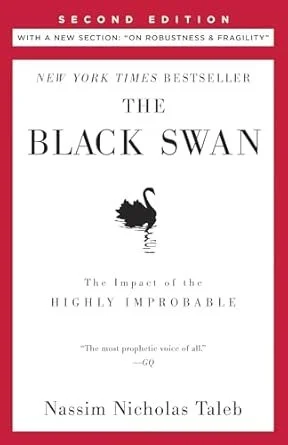
The Black Swan
The Impact of the Highly Improbable
by Nassim Nicholas Taleb
The 60-Second Take
In The Black Swan, former options trader and philosopher Nassim Nicholas Taleb exposes the severe limitations of human prediction. He argues that history is driven not by predictable trends, but by highly improbable, high-impact events he calls Black Swans. By abandoning flawed bell-curve risk models and adopting a robust "barbell" strategy, professionals can stop acting like the Thanksgiving turkey and learn to survive in an inherently unpredictable world.
The Illusion of Predictability in a Chaotic World
We desperately want the world to make sense. Corporate analysts build complex forecasting models, economists rely on standard bell curves, and investors look at past performance to guarantee future returns. Nassim Nicholas Taleb, a former options trader turned philosopher, spent his career proving that these models are not just slightly inaccurate—they are actively dangerous. In The Black Swan: The Impact of the Highly Improbable, Taleb dismantles the financial industry's reliance on standard statistics.
He points out that the modern world is not driven by the slow, predictable accumulation of average events. It is driven by the extreme, the unknown, and the highly improbable. A single market crash, an unforeseen technological invention, or a sudden geopolitical collapse can instantly rewrite the rules of global commerce. This summary explores Taleb’s framework for identifying our massive cognitive blind spots and provides a strategic approach to surviving—and even profiting from—a world we cannot actually predict.
What You'll Learn
The three defining characteristics of a Black Swan event
The critical difference between the predictable rules of "Mediocristan" and the chaotic reality of "Extremistan"
Why the Thanksgiving turkey provides the ultimate lesson in the dangers of historical data
How the narrative fallacy tricks our brains into thinking past events were entirely predictable
How to deploy the Barbell Strategy to protect your downside while capturing massive upside
The Turkey Problem and the Three Rules
Before the discovery of Australia, the Old World was absolutely convinced that all swans were white. That belief was supported by millions of empirical observations over thousands of years. The sighting of a single black swan invalidated a universal "truth" instantly. Taleb uses this historical anomaly to define a Black Swan event, which must possess three specific characteristics. First, it is an outlier that lies entirely outside the realm of regular expectations. Second, it carries an extreme impact. Third, human beings instinctively invent explanations for the event after the fact to make it seem predictable.
To explain why we are so blind to these outliers, Taleb introduces the Thanksgiving turkey. Consider a turkey being raised on a farm. For a thousand consecutive days, the farmer feeds the bird. If the turkey were an economist, it would chart this data and conclude with overwhelming statistical confidence that farmers are benevolent creatures who provide free food. The trend line points steadily up and to the right. Then, on day 1,001—the Wednesday before Thanksgiving—the turkey experiences a massive revision of belief.
The turkey's reliance on past data completely blinded it to the structural reality of the farm. When executives and investors rely strictly on historical financial data to model risk, they are acting exactly like the turkey. An absence of past volatility is not evidence of safety.
Mediocristan Versus Extremistan
Much of our predictive failure comes from applying the wrong mathematical rules to our current environment. Taleb divides the world into two domains: Mediocristan and Extremistan.
In Mediocristan, events follow a normal distribution—the classic bell curve. Physical traits live here. If you put one thousand random people in a stadium and add the heaviest human being on the planet to the group, that single extreme outlier will barely change the average weight of the crowd. In Mediocristan, the collective always outweighs the individual. The extremes do not matter.
In Extremistan, the bell curve is entirely useless. Social, economic, and informational traits live here. If you put one thousand random people in a stadium and add Jeff Bezos to the crowd, the total wealth of the group fundamentally changes. A single outlier accounts for almost the entire total. Book sales, stock market returns, venture capital, and digital audiences all operate in Extremistan. The fatal flaw of modern business is that we use the statistical tools of Mediocristan (like standard deviation) to manage the wild, winner-take-all risks of Extremistan.
The Narrative and Ludic Fallacies
If the world is so chaotic, why does history look so neat in textbooks? Taleb identifies this cognitive glitch as the narrative fallacy. The human brain hates raw, disconnected facts. To make sense of the world, we bind facts together with a narrative string, assigning cause-and-effect relationships where none actually exist. When a stock market crashes, pundits immediately publish highly logical stories explaining exactly why it happened. This storytelling comforts us, but it creates a dangerous illusion that the event was predictable. We confuse looking backward with the ability to look forward.
We also suffer from the ludic fallacy, which is the mistake of basing our real-world risk management on casino games or dice. In a casino, the odds are known. If you roll a pair of dice, you can calculate the exact probability of hitting a seven. The risk is bounded. Real life does not operate like a casino. In business and war, the odds are entirely unknown, the rules change constantly, and the most devastating risks are things you cannot even imagine. Using sterile, bounded models to predict unbound, real-world chaos leaves organizations completely exposed.
The Barbell Strategy
Taleb does not just diagnose the problem; he offers a specific mechanical solution for operating in Extremistan. He calls it the Barbell Strategy. Most investors and corporations are taught to seek the "golden middle"—they construct portfolios or strategies that carry a medium amount of risk for a medium amount of reward. Taleb views this middle ground as a death trap, because medium-risk investments are often just high-risk investments disguised by flawed bell-curve math.
Instead, you should structure your assets like a barbell, avoiding the middle entirely. Put 85 to 90 percent of your resources into the safest, most hyper-conservative vehicles available (like treasury bills or guaranteed cash equivalents). This protects you from negative Black Swans; no market crash can bankrupt you. Then, put the remaining 10 to 15 percent of your resources into hyper-aggressive, highly speculative bets (like early-stage venture capital or out-of-the-money options). You expose yourself to massive, positive Black Swans while mathematically capping your absolute worst-case scenario at 15 percent. You stop trying to predict what will happen, and you simply position yourself to survive the worst and capitalize on the extremes.
Black Swans at a Glance
The Black Swan. An unpredictable outlier event that carries extreme impact and is rationalized by humans after the fact.
The Turkey Problem. Relying exclusively on past historical data to predict future risk blinds you to catastrophic structural shifts.
Mediocristan. A domain governed by the bell curve, where single extreme events cannot significantly alter the total (e.g., human height).
Extremistan. A domain of extreme scale, where a single outlier can dominate the entire system (e.g., financial markets).
The Narrative Fallacy. Our psychological need to invent logical stories for random events, falsely convincing us that the past was predictable.
The Barbell Strategy. Protecting against ruin by placing the vast majority of resources in hyper-safe assets and a small fraction in hyper-speculative bets, avoiding the risky middle.
A Quick Start Guide to Surviving Extremistan
Accept your ignorance. Stop trusting five-year financial forecasts. Acknowledge that the most impactful events affecting your industry will be things you currently cannot imagine.
Audit your risk exposure. Identify any area of your business where a single, massive disruption could cause total bankruptcy. If your survival depends on perfect predictability, redesign your operations immediately.
Adopt the barbell. Move your investments and strategic initiatives to the extremes. Secure your baseline revenue with ultra-conservative choices, then take small, wild bets that carry massive potential upside.
Beware the storyteller. When an expert pitches a highly logical narrative explaining a recent market trend, remain skeptical. Recognize that humans force narratives onto random noise to comfort themselves.
Expose yourself to positive serendipity. Go to parties, meet people outside your industry, and live in highly connected areas. Positive Black Swans (like a chance encounter that launches a business) happen when you maximize your exposure to random opportunities.
Who Should Read The Black Swan (and Who Can Skip It)
Read it if you work in finance, economics, or risk management and want your foundational assumptions about probability completely dismantled.
Read it if you are an entrepreneur trying to structure a business that can survive severe market shocks and economic downturns.
Read it if you enjoy contrarian philosophy that blends history, mathematics, and sharp critiques of the academic establishment.
Skip it if you want a traditional, step-by-step corporate management playbook. This is a highly philosophical, sprawling exploration of epistemology and risk.
Skip it if you are easily offended by abrasive authors. Taleb is famously combative and frequently insults traditional economists and bankers by name.
Final Reflections
The Black Swan is arguably one of the most important books written on risk in the modern era. Nassim Nicholas Taleb forces the reader to confront a highly uncomfortable truth: we know far less than we think we do. His distinction between Mediocristan and Extremistan provides a brilliant, permanent mental model for evaluating the world. While his writing style is notoriously arrogant and prone to tangents, the underlying mathematics and logic are devastatingly effective. By exposing the fatal flaws in how we use historical data, Taleb gives us permission to stop pretending we can predict the future. Instead of fearing the unknown, he provides a pragmatic framework for making ourselves robust against the inevitable chaos.
The Bottom Line
The modern world is driven by highly unpredictable, extreme outlier events, and the only way to survive is to stop relying on flawed predictive models and build a barbell strategy that protects against ruin while exposing you to massive upside.
Frequently Asked Questions
What is the main idea of The Black Swan? The main idea is that the most impactful events in history and finance are highly improbable outliers, known as Black Swans. Because human beings are blind to these events and rely on flawed statistical models that assume a normal bell curve, we leave ourselves dangerously exposed to catastrophic ruin.
What is the difference between Mediocristan and Extremistan? Mediocristan is a realm of physical realities (like human weight) where the bell curve applies, and single extreme events cannot change the overall average. Extremistan is a realm of social and economic realities (like wealth or stock prices) where a single extreme outlier can disproportionately dominate the entire system.
What is the Barbell Strategy? It is Taleb's method for investing and managing risk in an unpredictable world. Instead of choosing "medium-risk" investments, you place 85 to 90 percent of your capital in hyper-safe, conservative assets to prevent total ruin, and use the remaining 10 to 15 percent to make hyper-aggressive bets that could yield massive returns.
Business Floss is reader-supported. When you use our links we may earn an affiliate commission that helps us keep the site running. Thank you for your support!


