
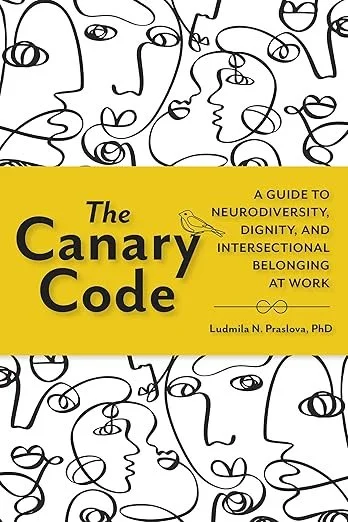
The Canary Code
A Guide to Neurodiversity, Dignity, and Intersectional Belonging at Work
by Ludmila N. Praslova, PhD
The 60-Second Take
In The Canary Code, organizational psychologist and autistic community member Ludmila N. Praslova provides a comprehensive framework for neuroinclusion at work. She argues that neurodivergent employees are like canaries in a coal mine, sensing toxic environments and broken workflows first. By shifting from a deficit model to a dignity-based approach built on six core principles, organizations can create flexible, transparent systems where all talent thrives.
Stop Trying to Fix the Canary; Fix the Coal Mine
For decades, the corporate approach to neurodiversity has been quietly paternalistic. Organizations assumed that employees with autism, ADHD, Tourette's syndrome, or learning differences needed to be managed, accommodated as special exceptions, or somehow corrected to fit the standard corporate mold. The burden of adaptation was placed entirely on the individual. In The Canary Code, organizational psychologist Ludmila N. Praslova flips this dynamic. Drawing on twenty-five years of global practice and her own lived experience as a member of the autistic community, she argues that neurodivergent individuals are the canaries in the corporate coal mine. When they struggle, it is usually the first sign of a deeply flawed, inflexible, or unhealthy work environment.
The statistics surrounding neurodivergent talent are stark. In the United States, an estimated 30 to 40 percent of neurodivergent people, and up to 85 percent of autistic college graduates, struggle with unemployment. This massive loss of talent is not due to a lack of skill or work ethic. It is the result of rigid, neuronormative systems that penalize differences. Praslova's book is a tactical, compassionate guide for dismantling these barriers. Rather than offering a superficial list of HR policies, she provides a systemic blueprint for rebuilding workflows based on dignity, intersectionality, and genuine human differences.
What You'll Learn
The meaning of the canary metaphor and why neurodivergent workers feel systemic failures first
The critical difference between the medical deficit model and a systemic inclusion model
The six foundational principles of the Canary Code framework
How traditional hiring metrics, like eye contact and "culture fit," systematically eliminate top talent
Practical strategies to redesign workflows based on outcomes rather than rigid processes
Why true inclusion must be intersectional, accounting for race, gender, and disability
The Miner's Canary and Neuronormativity
To understand the core of Praslova's argument, you have to understand the history of the coal mine. Early miners carried canaries into the tunnels because the birds possessed highly sensitive respiratory systems. If dangerous gases like carbon monoxide began to build up, the canary would succumb long before the miners felt the effects. Crucially, when the canary stopped singing, the miners did not blame the bird for being fragile. They recognized that the environment was toxic, and they evacuated to fix the ventilation.
Praslova applies this perfectly to the modern office. Neurodivergent professionals experience the friction of broken workflows, unclear communication, bullying, and psychological unsafety before their neurotypical peers do. They are highly attuned to ethical drift and systemic inefficiencies. Yet, instead of heeding their warnings, modern organizations often ignore the canary and blame the employee for failing to adapt to a toxic environment.
This happens because the business world operates on "neuronormativity." This is the unstated assumption that there is only one correct way to think, communicate, and process information. If an employee does not naturally align with this default setting—if they find a bustling open-plan office agonizingly loud, or if they struggle with the unwritten political rules of a meeting—they are viewed through a deficit lens. Praslova demands that leaders abandon this deficit-based approach. The goal is not to fix neurodivergent people so they can endure bad systems. The goal is to design transparent, flexible environments where diverse minds can operate without unnecessary friction.
The Six Principles of the Canary Code
To replace neuronormative standards, Praslova introduces a comprehensive framework designed to embed dignity across the entire talent cycle. She identifies six interconnected principles that organizations must adopt to move beyond surface-level accommodations and achieve true systemic inclusion.
1. Participation
This principle is rooted in the disability rights slogan, "Nothing about us without us." Organizations cannot design effective neuroinclusive policies in a vacuum. Neurodivergent people must be actively involved in shaping the systems, workflows, and environments that directly affect their daily lives.
2. Outcome Focus
Corporate culture is obsessed with process. Managers often judge employees by how they work—when they log on, how often they speak up in meetings, or how much time they spend at their desks. Praslova argues we must shift entirely to an outcome focus. If an employee delivers brilliant, high-quality work by operating on a non-traditional schedule or skipping unnecessary socialization, the organization should celebrate the result rather than penalizing the method.
3. Flexibility
Flexibility goes far beyond offering a remote work day. True flexibility means providing multiple acceptable pathways to achieve a goal. It involves offering choices in how people communicate, where they physically sit, and how they structure their deep-work hours. When flexibility is the default setting, employees do not have to exhaust themselves advocating for special accommodations.
4. Organizational Justice
Justice requires the fair, equitable distribution of resources and opportunities. This means actively dismantling the biases that prevent neurodivergent employees from accessing promotions, leadership training, and high-visibility projects. It also requires taking a hard line against workplace bullying, which disproportionately targets those who think or act differently.
5. Transparency
Unwritten rules are a minefield for neurodivergent individuals. Many organizations run on implicit social expectations, assumed knowledge, and vague feedback. Transparency eliminates this unnecessary cognitive load. By making expectations, performance criteria, and communication explicitly clear, leaders create an environment where everyone understands exactly what is required to succeed.
6. Valid Measurement
Perhaps the most tactical principle, valid measurement requires evaluating people on the criteria that actually matter for the job. Too often, performance reviews and hiring processes measure a person's ability to navigate neurotypical social norms rather than their ability to execute the specific duties of their role.
Redesigning the Talent Cycle
The traditional hiring process is essentially a gauntlet of neurotypical social tests. Candidates are routinely judged on the firmness of their handshake, their ability to maintain steady eye contact, and their facility with small talk. Praslova points out that for many autistic candidates, forced eye contact can be highly distracting or physically uncomfortable. When an interviewer penalizes a candidate for looking away, they are utilizing invalid measurement. They are evaluating social conformity, not technical competence.
This reliance on "culture fit" effectively weeds out exceptional talent. To build a neuroinclusive workforce, organizations must overhaul their talent acquisition strategies. This means relying on skills-based assessments rather than unstructured conversational interviews. It means providing interview questions in advance so candidates can process the information and provide thoughtful answers. It also means rethinking the physical workspace, recognizing that open-plan offices can be sensory nightmares that actively degrade the productivity of neurodivergent employees. By prioritizing valid measurement from the very first interaction, companies can bypass their own biases and hire the best minds for the job.
Intersectional Belonging and Leadership
A central theme of the book is that neurodiversity does not exist in a vacuum. Praslova emphasizes a holistic, intersectional approach. Human beings are complex, and their experiences of marginalization compound. An organization that champions gender diversity but ignores cognitive differences is failing its people. An autistic Black woman faces a vastly different, often much steeper, set of workplace hurdles than a white man with ADHD. True inclusion requires acknowledging the whole person and understanding how different aspects of identity overlap to create unique barriers.
Furthermore, Praslova challenges the notion that neurodivergent individuals are only suited for entry-level or highly technical, isolated roles. She dedicates significant space to the concept of neurodivergent leadership. The unique traits often associated with neurodivergence—intense focus, high ethical standards, deep empathy, and the ability to recognize complex patterns—are exceptional leadership qualities. Organizations must actively break the "neuroexclusion ceiling" by redesigning their leadership development programs to support and elevate diverse minds into the executive ranks.
Neuroinclusion at a Glance
The Canary in the Coal Mine. Neurodivergent people are highly sensitive to bad systems; when they struggle, it is a warning sign that the environment is flawed.
Neuronormativity. The false assumption that there is only one "correct" or "professional" way to process information and interact with others.
The Six Principles. Systemic inclusion requires Participation, Outcome focus, Flexibility, Organizational justice, Transparency, and Valid Measurement.
Valid Measurement. Stop evaluating candidates on eye contact or small talk if those skills are irrelevant to the actual job.
Intersectionality. Neuroinclusion must account for the whole person, recognizing how cognitive differences intersect with race, gender, and physical disability.
A Quick Start Guide to Designing for Dignity
Audit your hiring criteria. Review your job descriptions and interview rubrics to ensure you are measuring actual job skills, not just the ability to perform neurotypical social norms.
Provide interview questions in advance. Reduce unnecessary anxiety and cognitive load by allowing all candidates time to process and prepare their answers.
Shift to outcome-focused management. Stop tracking hours at a desk or participation in non-essential meetings; evaluate your team based strictly on the quality and delivery of their work.
Make the implicit explicit. Eliminate unwritten rules. Document communication preferences, project expectations, and team norms so nothing is left to guesswork.
Offer sensory flexibility. Allow employees to opt out of bustling open-plan environments, use noise-canceling headphones, or work remotely to manage their sensory needs without stigma.
Who Should Read The Canary Code (and Who Can Skip It)
Read it if you are an HR leader, DEI professional, or executive who wants to move past performative corporate messaging and build a genuinely inclusive organizational system.
Read it if you are a manager who wants to better understand, support, and extract the brilliant potential of the neurodivergent talent already on your team.
Read it if you identify as neurodivergent and want a rigorous, validating framework to help advocate for yourself and your peers in the workplace.
Skip it if you are looking for medical advice, diagnostic criteria, or clinical definitions of specific neurological conditions. This is an organizational psychology and management book.
Skip it if you want a quick list of superficial "hacks" to boost productivity. This book demands deep, systemic changes to how companies operate.
Final Reflections
The Canary Code is a powerful, paradigm-shifting text that challenges the foundational assumptions of modern management. Ludmila N. Praslova successfully bridges the gap between academic rigor and lived, human experience. Her writing is deeply compassionate, but it is also unsparing in its critique of systems that casually discard brilliant minds because they do not fit a narrow, outdated mold.
The brilliance of the book lies in its central thesis: creating a neuroinclusive workplace is not an act of corporate charity. It is a strategic imperative. The same rigid systems, unclear expectations, and toxic behaviors that marginalize neurodivergent workers also stress, disengage, and burn out neurotypical employees. By focusing on the canaries—by building systems rooted in flexibility, transparency, and valid measurement—leaders can construct environments where every single person has the dignity and support they need to do their best work. It is an essential read for anyone committed to the future of healthy, high-performing organizations.
The Bottom Line
Neurodivergent employees are the canaries in the corporate coal mine, and the solution is not to fix the people, but to redesign the workplace around flexibility, transparency, and outcomes so that all human talent can thrive.
Frequently Asked Questions
What is the main idea of The Canary Code?
The main idea is that workplaces should stop trying to force neurodivergent employees to conform to rigid, "neuronormative" standards. Instead, organizations should treat these employees as canaries in a coal mine whose struggles indicate systemic flaws, and redesign work using six core principles of inclusion to benefit everyone.
What does Praslova mean by "Valid Measurement"?
Valid measurement means evaluating employees and job candidates based strictly on their ability to perform the required outcomes of the job. It warns against penalizing people for irrelevant social behaviors, such as lack of eye contact or struggling with small talk during an interview.
Is this book only for HR professionals?
No. While it is highly relevant for human resources and DEI leaders, it is written as a practical guide for CEOs, managers, consultants, and any changemaker who wants to create a healthier, more psychologically safe team culture.
Business Floss is reader-supported. When you use our links we may earn an affiliate commission that helps us keep the site running. Thank you for your support!


