
The Personal MBA
Master the Art of Business
by Josh Kaufman
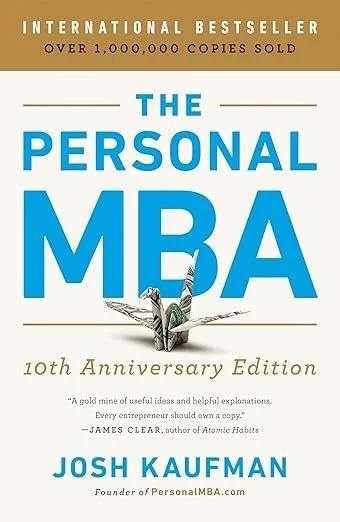
The 60-Second Take
In The Personal MBA, Josh Kaufman demystifies the corporate world by arguing that you do not need expensive graduate school to master business. He distills the entirety of business practice into five interdependent processes: Value Creation, Marketing, Sales, Value Delivery, and Finance. By understanding these core mechanics, alongside fundamental human psychology and systems thinking, anyone can build a profitable enterprise and make highly effective, real-world business decisions.
You Do Not Need a Piece of Paper to Build a Business
Every year, thousands of ambitious professionals take on crippling student loan debt to acquire a Master of Business Administration. They sit in lecture halls learning complex financial models, studying abstract management theories, and memorizing corporate case studies. The assumption is that this expensive piece of paper holds the secret to business success. In The Personal MBA, Josh Kaufman argues that this assumption is an expensive illusion. Business is not a mystical academic discipline reserved for the elite; it is a mechanical process composed of repeatable systems.
Kaufman, who famously skipped business school to educate himself using real-world experience and hundreds of foundational books, distills the entire discipline into its essential components. He proposes that you do not need to know everything about corporate finance or advanced macroeconomics to run a successful enterprise. You just need to understand basic human psychology, how to create something people want, and how to deliver it efficiently. This summary breaks down his overarching framework, providing a tactical blueprint for mastering the mechanics of commerce without the tuition bill.
What You'll Learn
The five interdependent processes that define absolutely every business
Why the "Iron Law of the Market" is the ultimate judge of your ideas
The core human drives that motivate people to spend their money
How to shift from cost-based pricing to value-based pricing
Why complex systems always fail unless they evolve from simple, working ones
The Five Parts of Every Business
Business school curricula are often fragmented into dozens of highly specialized disciplines, making the act of running a company seem impossibly complicated. Kaufman simplifies this by defining business as a system of five interdependent processes. If you remove any one of these five elements, you do not have a business; you have a hobby, a charity, or a failure.
The first is Value Creation. A business must discover or create something that other people genuinely need or want. If you are not producing value, you have nothing to offer the world. Kaufman outlines twelve standard forms of value that businesses can create. These include traditional forms like creating a Product or providing a Service, but also encompass models like a Shared Resource (a gym membership), a Subscription (cable TV), Audience Aggregation(selling advertising to a built audience), or an Option (movie tickets or licensing agreements).
The second process is Marketing. Once you have created value, you must attract the attention of the people who might want it and build demand. The third is Sales. This is the conversion mechanism. You must turn prospective demand into paying customers by successfully completing a transaction.
The fourth process is Value Delivery. After the sale is made, you must actually fulfill your promise. You have to give the customer what they paid for and ensure their expectations are met or exceeded. The final element is Finance. You must bring in enough money from your sales to cover the costs of creating and delivering your value, with enough left over to make the effort worthwhile. Kaufman insists that whenever a business is struggling, the problem can always be traced back to a breakdown in one of these five core areas.
The Iron Law and Core Human Drives
Many entrepreneurs fall in love with their own ideas and build products in a vacuum, assuming the market will eventually recognize their genius. Kaufman points out that this is a recipe for bankruptcy, governed by what he terms the Iron Law of the Market. The law is brutally simple: if you do not have a large group of people who really want what you have to offer, your chances of building a viable business are zero. You cannot force a market to exist. You must identify an existing market and serve it.
To find a viable market, you must understand what people inherently want. Kaufman identifies five core human drives that dictate all economic behavior. The first is the Drive to Acquire—the desire to obtain physical objects, status, and influence. The second is the Drive to Bond—the need to feel loved, valued, and connected to others. The third is the Drive to Learn—the desire to satisfy our curiosity. The fourth is the Drive to Defend—the need to protect ourselves, our loved ones, and our property. Finally, there is the Drive to Feel—the pursuit of new sensory experiences, pleasure, and entertainment.
If your product or service does not directly satisfy at least one of these core drives, it will fail. The most successful products in the world—like luxury cars, social media platforms, or advanced home security systems—often hit two or three of these drives simultaneously, creating massive, enduring demand.
Marketing and Sales: Earning Attention and Trust
Once you have a product that satisfies a core drive, you must master marketing and sales. Kaufman distinguishes between the two clearly: marketing is about capturing attention, while sales is about earning trust and closing the loop.
In modern markets, attention is the scarcest resource. To capture it, your marketing must be remarkable. It must literally be worthy of remark. If your offering is boring, people will ignore it, regardless of your advertising budget. You must also focus on receptivity. Sending the perfect message to the right person at the wrong time is useless. Great marketers figure out exactly when and where their target audience is actually open to hearing from them.
When marketing successfully hands a prospect over to sales, the dynamic shifts from attention to trust. A customer will not part with their money unless they believe you will deliver the promised value. One of the most critical elements of this transaction is pricing. Kaufman advises strongly against cost-based pricing (calculating what the product cost you to make and adding a standard margin). Instead, you must use value-based pricing. You charge based on the perceived value the product delivers to the specific customer. If a piece of software saves a corporation a million dollars a year, they do not care if it only cost you a hundred dollars to code; the value to them justifies a premium price.
Finance: The Scoreboard of Business
While value creation and delivery are the physical actions of a business, finance is the scoreboard. Kaufman demystifies corporate finance by focusing on the absolute essentials required to keep a company alive. The most important metric is your profit margin—the percentage of revenue you actually keep after all costs are paid. A business with massive revenue but zero margin will inevitably collapse.
To manage this, founders must understand the relationship between two crucial numbers: Customer Acquisition Cost (CAC) and Lifetime Value (LTV). If it costs you fifty dollars in marketing and sales effort to acquire a new customer, but that customer only ever spends forty dollars with you, you are running a failing system. The LTV must substantially exceed the CAC for the business to survive. By tracking these numbers, you stop viewing finance as complex accounting and start viewing it as the biological pulse of your organization. Cash flow is the oxygen that allows the other four parts of the business to function.
Systems, Delivery, and the Human Element
The final piece of the business puzzle is execution, which requires an understanding of systems and human behavior. Value delivery is essentially a system. Kaufman leans heavily on Gall's Law, a systems theory principle which states that a complex system that works is invariably found to have evolved from a simple system that worked. You cannot design a complex system from scratch; it will always fail. Founders must launch the simplest possible version of their product or service, prove that it works, and then slowly add complexity over time based on real-world feedback.
Running these systems requires working with people, which means managing the limitations of the human mind. People are not perfectly rational economic actors. They are prone to cognitive biases, easily distracted, and highly resistant to friction. A successful business leader minimizes friction everywhere. They make it incredibly easy for employees to do their jobs, and incredibly easy for customers to buy the product.
Furthermore, managing a business requires recognizing the limits of your own capacity. You cannot do everything. By utilizing the economic principle of comparative advantage, you must delegate the tasks you are relatively less efficient at, even if you are technically capable of doing them. The goal is to build a self-sustaining machine where the five core processes—creation, marketing, sales, delivery, and finance—operate smoothly, generating profit without requiring your constant, exhaustive intervention.
The Personal MBA at a Glance
The Five Parts of Business. Every company requires value creation, marketing, sales, value delivery, and finance.
The Iron Law of the Market. You cannot create a market; you must find a large group of people who already want what you are selling.
Core Human Drives. All economic decisions are driven by the need to acquire, bond, learn, defend, or feel.
Value-Based Pricing. Do not price based on your costs. Price based on the exact value the customer perceives they are receiving.
Gall's Law. Complex systems only work if they evolved from simple systems that already worked. Start small and iterate.
LTV > CAC. To survive, the lifetime value of a customer must always be significantly higher than the cost required to acquire them.
A Quick Start Guide to Business Mastery
Audit your five parts. Look at your current business or project and explicitly write down how you are handling value creation, marketing, sales, delivery, and finance. Identify the weakest link.
Identify the core drive. Determine which of the five core human drives your product satisfies. If it does not satisfy one clearly, redesign the product.
Calculate your CAC and LTV. Figure out exactly how much money you spend in marketing and sales to acquire one customer, and compare it to how much they spend with you over time.
Reduce customer friction. Map out the exact steps a customer must take to give you their money, and aggressively remove any unnecessary steps, forms, or waiting periods.
Embrace Gall's Law. If you are launching a new initiative, do not build a complex final version. Build a simple prototype, test it with real customers, and add complexity only when necessary.
Who Should Read The Personal MBA (and Who Can Skip It)
Read it if you are an aspiring entrepreneur or independent creator who feels intimidated by traditional business terminology and wants a plain-English translation of how commerce actually works.
Read it if you are currently considering taking on debt to attend business school; this book offers the foundational concepts at a fraction of the cost.
Read it if you are a specialized professional (like a designer or engineer) who wants to understand the broader mechanics of how your company generates revenue.
Skip it if your goal is to secure a job at a prestigious management consulting firm or an investment bank, where the actual credential of an MBA from a top-tier university is a strict hiring requirement.
Skip it if you are looking for highly advanced, theoretical financial modeling. This book provides practical fundamentals, not graduate-level accounting.
Final Reflections
The Personal MBA is a brilliant feat of synthesis. Josh Kaufman successfully takes thousands of pages of dense business theory and compresses them into highly actionable, accessible mental models. The book is ambitious in its scope, covering everything from human psychology to system mechanics, which means it sacrifices depth in certain areas for the sake of breadth. However, as a foundational text, this breadth is its greatest strength. It provides readers with a comprehensive map of the business world, allowing them to see exactly how marketing, sales, and finance connect to human behavior. It is an indispensable manual for anyone who wants to build, run, or simply understand a modern enterprise.
The Bottom Line
Every successful enterprise is simply a system of five interconnected processes—value creation, marketing, sales, delivery, and finance—and mastering them requires real-world execution, not an expensive academic degree.
Frequently Asked Questions
What is the main idea of The Personal MBA?
The core premise is that formal business school is an overpriced, unnecessary academic exercise for most professionals. Kaufman argues that by reading foundational books and understanding five core processes—Value Creation, Marketing, Sales, Value Delivery, and Finance—anyone can master the mechanics of running a successful company.
What are the five parts of every business?
Every business must create something of value, market it to attract attention, sell it to convert demand, deliver the promised value to the customer, and manage the finance to ensure the system generates a profit. If any one of these elements is missing, the business will fail.
What is the Iron Law of the Market?
The Iron Law states that no matter how brilliant your product is, if you do not have a large group of people who actively want what you are offering and are willing to pay for it, your business will not survive. You cannot create a market; you can only serve an existing one.
Business Floss is reader-supported. When you use our links we may earn an affiliate commission that helps us keep the site running. Thank you for your support!


