
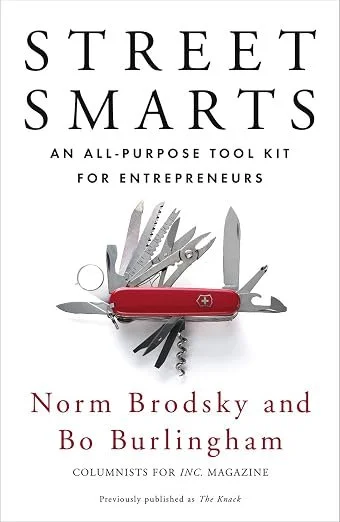
Street Smarts
An All-Purpose Tool Kit for Entrepreneurs
by Norm Brodsky & Bo Burlingham
The 60-Second Take
In Street Smarts, veteran entrepreneur Norm Brodsky and business journalist Bo Burlingham distill decades of company-building experience into a practical guide for founders. They argue that long-term survival relies on ignoring vanity metrics and mastering the fundamentals of cash flow, gross margins, and strategic pricing. By learning to fire bad customers, negotiate quietly, and keep overhead low, founders can build deeply resilient, highly profitable businesses that fund their own growth.
Why Top-Line Revenue Is a Dangerous Vanity Metric
Business schools teach entrepreneurs to build elaborate financial models, draft comprehensive fifty-page business plans, and prepare sophisticated slide decks for investors. But when you actually launch a company, the theoretical models instantly collide with reality. In the real world, survival does not depend on a slick presentation. It depends on whether you have enough cash to make payroll on Friday. In Street Smarts: An All-Purpose Tool Kit for Entrepreneurs, Norm Brodsky and Bo Burlingham cut through the academic theory to offer a masterclass in gritty, operational survival.
Brodsky, a veteran entrepreneur who has founded and grown multiple successful businesses, originally shared these insights in a long-running column for Inc. magazine co-written with Burlingham. Together, they outline a philosophy that is deeply skeptical of the standard "growth at all costs" mindset. They argue that most startups fail because founders focus on the wrong metrics, mismanage their working capital, and surrender their pricing power to bad customers. This summary breaks down their core operational rules for building a business that is not just growing, but genuinely profitable and built to last.
What You'll Learn
Why gross margin matters infinitely more than sales volume
The danger of the "whale" customer and why you should actively fire bad clients
How to manage cash flow and why a sale is not real until you collect
The concept of "critical mass" and how to achieve financial independence
Practical negotiation tactics to raise prices and protect your business's capacity
Gross Margin Over Sales Volume
In the early days of a business, founders tend to obsess over sales. They want to see top-line revenue increase constantly, believing that more sales automatically validate the business model. Brodsky warns that focusing exclusively on sales is a fatal trap, especially when working with limited capital. The most important number on an income statement is not revenue; it is gross margin.
Gross profit is your total sales minus the direct cost of goods sold, and gross margin is the percentage of sales that this profit represents. In the startup phase, your gross margin determines whether or not you will survive long enough to prove your concept. Once established, it dictates your ability to fund your own growth. Brodsky points out a harsh reality that many founders ignore: it takes the exact same amount of time, energy, and operational headache to manage a low-margin business as it does to manage a high-margin one.
Because of this, founders must ruthlessly protect their margins. A common mistake is discounting excess capacity. An entrepreneur might reason that their equipment or staff is currently idle, so taking on a discounted job is better than making no money at all. The authors argue this is a terrible decision. Discounting trains the market to devalue your product. Once you lower your price, it is incredibly difficult to raise it again, and you end up trapping your company in a cycle of high-volume, low-margin exhaustion.
A Sale Is Not a Sale Until You Collect
Another major psychological shift the book demands relates to how founders view a closed deal. Starting out, entrepreneurs tend to believe that when someone signs a contract or places an order, it is as good as money in the bank. They celebrate the sale and move on to the next prospect. But Brodsky insists on a sobering rule: a sale does not exist until the cash is collected.
When you deliver a product or provide a service before getting paid, you are not just doing business; you are acting as an unsecured bank. You are essentially making a short-term loan to your customer. If a customer strings you along for ninety days, they are draining your working capital to fund their own operations. If enough customers do this, you can easily go bankrupt while simultaneously breaking sales records.
To prevent this, businesses must treat receivables with the same intensity they treat lead generation. This means determining whether a customer is actually creditworthy before taking their order, and finding out exactly how long their accounting department takes to process invoices. Founders have to get into the habit of watching their average collection time like a hawk. If the collection time starts stretching, the business is bleeding cash, regardless of what the top-line revenue says.
The Danger of the Whale Customer
Every small business owner dreams of landing a "whale"—a massive corporate client whose single account could double the company's revenue overnight. It feels like the ultimate validation. Brodsky, however, views these massive accounts as existential threats. When one large client dictates a significant portion of your revenue, they effectively own your company. They know you cannot afford to lose them, which means they will eventually demand lower prices, longer payment terms, and custom accommodations that squeeze your margins.
To protect the business from catastrophic risk, the authors offer a strict formula for customer concentration:
The 10 Percent Rule: No single customer should ever account for more than 10 percent of your total business.
The 30 Percent Rule: All of your large customers combined should make up less than 30 percent of your overall revenue.
It is vastly superior to have a wide base of small, high-margin customers than a handful of large, low-margin whales. This philosophy requires mastering the most important word in business: "No." You cannot do business with everybody. If a prospective client demands terms that ruin your gross margin, you have to walk away. If a current client constantly pays late and drains your team's energy, you must be willing to fire them. Protecting your margins is always more important than protecting your ego.
Raising Prices and Quiet Negotiation
Pricing is never static. As inflation rises and your costs increase, your prices must adapt. Yet many entrepreneurs are terrified of raising prices, fearing a mass exodus of customers. Brodsky advises that the key to maintaining margins without inciting a rebellion is frequency. You should raise your prices regularly. Implementing a small, incremental price hike every year is an expected part of doing business. If you freeze your prices out of fear and wait five years to impose a sudden, massive increase to catch up, your customers will feel betrayed and leave.
When pushback does occur, founders must employ "quiet negotiation." When a client demands a concession, do not argue or get defensive. Listen closely to what they actually want, haggle on their terms, but always counter by extracting exactly what you need in return. The framework is simple: "I'll give you X, but I've got to have Y".
The authors also suggest a counterintuitive approach to managing demanding, price-sensitive prospects: let the low-margin customers come to you, and then negotiate the price up. By focusing your active sales energy purely on high-margin relationships, you establish a baseline of strength. When the bargain hunters eventually approach you, you can dictate the terms, padding the price until the margin justifies the headache.
Street Smarts at a Glance
Gross margin is king. Top-line revenue is a vanity metric; the percentage of money left over after direct costs is the only number that guarantees survival.
A sale isn't a sale until collected. Unpaid invoices are just unsecured loans you have made to your customers out of your own working capital.
Beware the whale. No single customer should make up more than 10% of your business to avoid catastrophic leverage and risk.
Never discount excess capacity. Rationalizing that "some money is better than no money" trains the market to devalue your product and destroys your margins.
Raise prices gradually. Consistent, small price increases are much easier for clients to swallow than sudden, massive hikes after years of stagnation.
A Quick Start Guide to Building a Resilient Business
Calculate your true gross margin. Stop looking at your top-line sales. Run the math to find out exactly how much money is left over after the direct costs of fulfilling your product or service.
Audit your customer concentration. Review your accounting to see if any single client makes up more than 10% of your revenue. If so, focus your immediate sales efforts entirely on diluting their share.
Tighten your collection terms. Treat your receivables like a life-or-death metric. Run credit checks on large new clients and establish strict boundaries for late payments.
Fire your worst customers. Identify the clients who demand the most operational energy while delivering the lowest margins, and respectfully part ways with them.
Implement regular price increases. Plan a small, standard price increase to roll out annually so your margins keep pace with inflation without shocking your customer base.
Who Should Read Street Smarts (and Who Can Skip It)
Read it if you are a first-time founder or small business owner struggling to transition from simply making sales to actually generating sustainable profit.
Read it if you run a service-based business or agency and feel constantly squeezed by demanding clients who dictate your pricing and payment terms.
Read it if you are dealing with severe cash flow anxiety and want a practical, numbers-based methodology for regaining control of your working capital.
Skip it if you are building a venture-backed tech unicorn where massive user acquisition and market share are explicitly prioritized over initial cash flow and profitability. Brodsky's rules are designed for businesses that need to be profitable from day one.
Skip it if you are looking for theoretical economic frameworks or academic management models. The advice here is entirely anecdotal, direct, and grounded in the daily reality of running a private company.
Final Reflections
Street Smarts stands out in a crowded field of business literature because it entirely ignores the glamour of entrepreneurship. Norm Brodsky and Bo Burlingham have no interest in visionary statements or disruptive theories. Instead, they focus relentlessly on the unsexy, mechanical realities of keeping a business alive. The distinction between "book smarts" and "street smarts" is evident on every page. Book smarts tell you to aggressively scale your revenue to capture market share; street smarts tell you that scaling bad margins will just bankrupt you faster.
The greatest value of this book is its absolute clarity regarding boundaries. By teaching founders how to say no—to bad customers, to discounted deals, to vanity metrics—the authors offer a blueprint for building a company that serves the founder, rather than a company where the founder is held hostage by their own clients. It is an essential, highly readable manual for anyone who wants to build a fundamentally sound, resilient organization.
The Bottom Line
Top-line sales revenue is a vanity metric that routinely bankrupts startups, so build your business around the relentless protection of cash flow, strict customer boundaries, and healthy gross margins.
Frequently Asked Questions
What is the main idea of Street Smarts?
The main idea is that surviving and thriving in business requires practical, real-world instincts rather than rigid academic formulas. The book emphasizes that protecting gross margins, managing cash flow, and avoiding bad customers are far more important to long-term success than simply chasing higher top-line sales.
Why does the book say you shouldn't focus on sales?
The authors argue that focusing exclusively on sales can be a fatal trap. If you increase your sales by taking on low-margin work or customers who refuse to pay on time, you are actually draining your company's resources. They advise founders to obsess over gross margin—the money left over after direct costs—because that is what actually keeps the business alive.
What is the rule for customer concentration?
To protect your business from catastrophic risk, the book recommends that no single customer should account for more than 10 percent of your overall business, and all of your large customers combined should not exceed 30 percent. This ensures that losing one client will not bankrupt the company.
Business Floss is reader-supported. When you use our links we may earn an affiliate commission that helps us keep the site running. Thank you for your support!


