
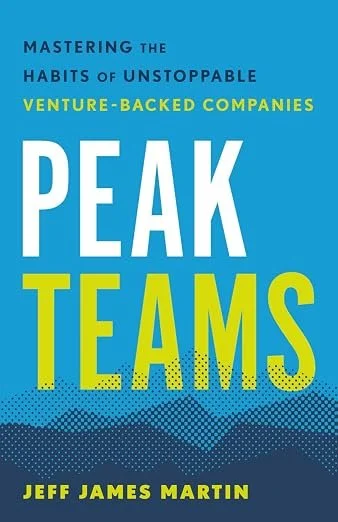
Peak Teams
Mastering The Habits Of Unstoppable Venture-Backed Companies
by Jeff James Martin
The 60-Second Take
In Peak Teams, executive coach Jeff James Martin provides a comprehensive operating system for venture-backed founders navigating the chaos of rapid growth. He argues that as startups scale, informal communication breaks down, creating a dangerous gap between mission and execution. By implementing the Peak Teams System—a framework of structured cadences, clear goals, and relentless visibility—leaders can align their teams, overcome internal friction, and scale efficiently.
The Fog of the High-Growth Mountain
Founding a company is difficult. Founding and scaling a venture-backed company is an entirely different species of pressure. When you accept institutional capital, you are no longer just building a product; you are strapped to a rocket ship with incredibly high expectations and zero roadmap. Founders must simultaneously manage aggressive growth targets, investor demands, board dynamics, and the constant threat of internal misalignment. It often feels like hiking up a steep, treacherous mountain while completely buried in a thick fog.
Jeff James Martin has spent over two decades in this exact environment. As an executive coach, investor, and founder of Collective Genius, he has worked on the ground with hundreds of VC-backed leadership teams from seed stage to exit. In Peak Teams: Mastering the Habits of Unstoppable Venture-Backed Companies, Martin codifies his observations into a highly practical operating manual. He noticed a persistent pattern: brilliant innovators frequently fail not because their product is flawed, but because they buckle under the weight of scaling their leadership. The book provides the Peak Teams System, an operating methodology designed to clear the fog, align disparate departments, and turn a group of stressed individuals into an unstoppable, cohesive unit.
What You'll Learn
The difference between proximity-based alignment and systematic execution
Why high mission clarity often masks deep operational confusion
How to bridge the gap between a three-year vision and daily tasks
The specific meeting cadences required to maintain momentum and accountability
How to use tools like OKRs, KPIs, and Talent Mapping to scale your team
The Illusion of Proximity Alignment
In the early days of a startup, alignment is rarely a problem because the team is small and everyone operates in the same room. The founder is intimately close to the work. Priorities are visible, communication is direct, and when the market shifts, the team can adapt in an afternoon. Because everyone hears the same conversations and sees the same customer signals, they naturally run in the same direction. Martin points out that as companies scale, this organic, proximity-based alignment quietly fractures.
New departments form, functional leaders are hired, and the work becomes highly specialized. The founder can no longer personally hold and distribute the full context of the business. Unfortunately, many leaders fail to recognize this shift. They assume that because the team still believes strongly in the overarching mission, they are fully aligned. Martin uses extensive organizational survey data to prove this assumption wrong. When surveyed, startup employees consistently score incredibly high on understanding the company's purpose and core values, but they score shockingly low on understanding the three-year vision, quarterly priorities, or how success is actually measured.
This discrepancy highlights a critical lesson: alignment is not a morale issue; it is an execution issue. A team can passionately agree on the mission while entirely disagreeing on what needs to be done this quarter. True alignment means sharing absolute clarity around direction, ownership, and tradeoffs. When proximity fades, you can no longer rely on informal hallway chats to keep the company on track. You must replace proximity with a formalized system of rhythm, visibility, and accountability.
The Peak Teams System: Vision to Execution
To solve the execution gap, Martin introduces the Peak Teams System. This framework is not a philosophical abstraction; it is a mechanical operating system designed to translate high-level purpose into coordinated, daily action. The system forces leadership teams to explicitly define and document every layer of their strategy, ensuring that nothing is left to assumption.
The foundation starts with clarifying the Mission Statement and Core Values. While most startups have these, Martin insists they must be actively utilized to guide hiring and behavior, not just painted on a wall. From there, the team must define their Three-Year Vision. This forces leaders to look beyond the immediate chaos of survival and articulate exactly what the mountain peak looks like. However, a three-year vision is too distant to govern daily work, so it must be compressed into a highly specific One-Year Plan.
The magic of the system lies in how that one-year plan is executed. Martin advocates for the rigorous use of OKRs (Objectives and Key Results) and KPIs (Key Performance Indicators). OKRs define the critical, transformative goals the company must hit to grow, while KPIs track the underlying health and ongoing operations of the business. By assigning clear, individual ownership to every OKR and KPI, you eliminate the ambiguity that plagues growing startups. When everyone knows exactly what number they are responsible for moving, accountability ceases to be a buzzword and becomes a structural reality.
Establishing the Rhythm: Cadences and Visibility
A brilliant strategy is useless if it is shoved into a digital drawer and only reviewed at an annual retreat. To maintain momentum, venture-backed companies must adopt strict operating rhythms. Martin details the necessity of the 90-Day and Weekly Cadence. By breaking the one-year plan into 90-day sprints, teams create a sense of urgency and focus. Every quarter, leadership must step back, assess what worked, recalibrate, and set the specific OKRs for the next ninety days.
These quarterly goals are then managed through weekly meetings. The weekly cadence ensures that the team remains hyper-focused on their immediate deliverables and allows them to catch small misalignments before they compound into massive failures. Martin emphasizes the importance of Triage and Team Surveys within these cadences. High-growth environments are chaotic, and leaders inevitably develop blind spots. Regular, structured feedback loops—where teams systematically identify bottlenecks and address internal friction—prevent small operational wounds from becoming fatal.
Finally, Martin addresses the human element of scaling through Talent Mapping. As the company grows, the skills required to succeed change dramatically. The executive who brilliantly managed a five-person engineering team might drown when tasked with managing fifty engineers. The Peak Teams System forces founders to continuously evaluate their roster, actively develop their people, and ensure that the right talent is deployed against the most critical problems. By combining clear strategy, relentless rhythm, and proactive talent management, VC-backed leaders can finally part the fog and build an organization capable of reaching the peak.
Peak Teams at a Glance
Proximity is not alignment. Relying on informal communication to keep a team coordinated fails the moment a startup begins to scale.
Mission vs. execution. Employees often understand the broader purpose of the company but lack clarity on their immediate priorities and metrics.
The Peak Teams System. A holistic operating model that translates purpose into a Three-Year Vision, One-Year Plan, and strict OKRs.
Accountability requires ownership. Every goal and metric must have a single, clearly identified owner to prevent ambiguity and dropped responsibilities.
The 90-Day Cadence. Breaking annual goals into quarterly sprints creates urgency, forces regular recalibration, and maintains organizational momentum.
Continuous feedback. Using Triage and regular Team Surveys helps leaders identify their blind spots and fix operational friction before it causes significant damage.
A Quick Start Guide to Scaling Your Startup
Audit your alignment. Ask your leadership team to independently write down the company's top three priorities for the quarter. If the answers do not match perfectly, your team is misaligned.
Define the one-year plan. Stop working strictly in survival mode and explicitly document what the company must achieve in the next twelve months to stay on track for your long-term vision.
Assign clear OKRs. Ensure every major strategic initiative has a specific, measurable key result and a single owner responsible for its execution.
Establish a weekly cadence. Institute a strict, recurring weekly meeting focused entirely on reviewing progress against the quarterly OKRs and clearing immediate bottlenecks.
Implement regular surveys. Create a formal, recurring feedback loop to solicit anonymous input from your team, helping you identify the operational blind spots you cannot see from the top.
Who Should Read Peak Teams (and Who Can Skip It)
Read it if you are a startup founder who has just secured institutional funding and needs to transition from a scrappy, informal culture to a structured, high-performance organization.
Read it if you are an executive at a fast-growing company feeling overwhelmed by internal friction, dropped balls, and a lack of clear accountability among your departments.
Read it if you are a venture capitalist or board member looking for a standardized operating framework to recommend to your portfolio companies.
Skip it if you run a slow-growing, traditional lifestyle business. While the principles of alignment apply, the specific intensity and tools are engineered for hyper-growth, venture-backed environments.
Skip it if you are looking for advice on how to pitch investors or structure a term sheet. This book is strictly focused on post-funding operations and team execution.
Final Reflections
Peak Teams stands out in a crowded market of management literature by focusing exclusively on the unique, high-pressure crucible of the venture-backed startup. Jeff James Martin avoids vague leadership platitudes, offering instead a highly mechanical, pragmatic system for scaling an organization. The book's greatest strength is its insight into the illusion of proximity. Many founders feel betrayed when their team stops operating with a hive-mind mentality, failing to realize that the organization simply outgrew its communication structure. While implementing the entire Peak Teams System requires a heavy administrative lift and significant discipline, Martin makes a compelling case that the cost of operating without a system is far higher. For founders tired of carrying the entire strategic weight of their company, this framework provides a clear path to distributed accountability and sustainable growth.
The Bottom Line
As startups scale, informal communication breaks down and mission alignment fails to translate into execution, forcing founders to adopt a strict operating system of clear metrics, quarterly cadences, and absolute accountability.
Frequently Asked Questions
What is the main idea of Peak Teams?
The core idea is that the informal communication and proximity that align a team in the early days of a startup will inevitably break down as the company scales. To survive the pressure of venture-backed growth, founders must implement a holistic operating system that translates long-term vision into rigorous, daily execution and accountability.
What is the Peak Teams System?
It is a comprehensive operating framework designed specifically for high-growth companies. It includes tools for clarifying purpose (Mission and Core Values), setting direction (Three-Year Vision and One-Year Plan), managing execution (OKRs and KPIs), and maintaining rhythm (90-Day and Weekly Cadences).
Why do teams struggle with alignment as they grow?
The author notes that while teams often agree on the company's broader mission, they lack clarity on execution. As new departments form and work becomes specialized, the founder can no longer personally communicate context to everyone, leading to confusion over quarterly priorities, tradeoffs, and ownership.
Business Floss is reader-supported. When you use our links we may earn an affiliate commission that helps us keep the site running. Thank you for your support!


