
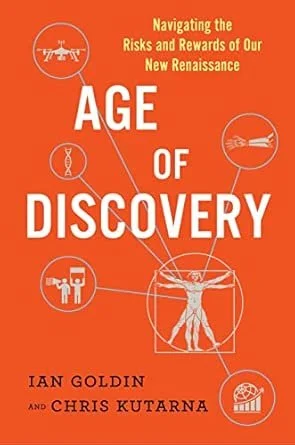
Age of Discovery
Navigating the Risks and Rewards of Our New Renaissance
by Ian Goldin and Chris Kutarna
The 60-Second Take
In Age of Discovery, Ian Goldin and Chris Kutarna argue that our current era of globalization and technological explosion represents a Second Renaissance. Just as Gutenberg’s press and global exploration birthed immense genius and devastating upheaval five centuries ago, today's hyper-connected world brings both unprecedented prosperity and fragile systemic risks. To survive, leaders must embrace bold innovation while managing the inevitable social backlash of rapid change.
Why the Modern World is Florence in the 15th Century
Five hundred years ago, the world experienced a rupture that permanently altered the course of human history. The invention of Gutenberg's printing press liberated information. Columbus and Magellan redrew the maps of the globe, connecting distant markets. Copernicus shifted humanity's understanding of the cosmos. It was the Renaissance—an era of staggering genius, wealth, and artistic triumph. But the history books often gloss over the dark side of this boom. The sudden entanglement of the world also brought terrifying pandemics, ruinous financial panics, and massive social division that fueled violent religious extremism.
In Age of Discovery, Ian Goldin and Chris Kutarna argue that we have been here before. Our current era is not just a period of rapid technological change; it is a literal Second Renaissance.
The authors—experts connected to the Oxford Martin School—make a compelling, macro-historical case. The internet is our printing press, globalization is our new map, and artificial intelligence is our Copernican shift. We are living in a moment where humanity is flourishing at an unprecedented rate, but that very success has woven a fragile, tangled web of systemic risk. If we want to reap the rewards of this new golden age, we must look to the past to understand the mechanics of the chaos we are currently living through.
What You'll Learn
The historical parallels between the First Renaissance and our current technological era
Why "new maps, new media, and a new human condition" are driving global upheaval
The nature of systemic risk and why hyper-connectivity makes us incredibly vulnerable
The Savonarola effect: why rapid progress always generates a fierce, populist backlash
Why Machiavelli believed that taking bold risks is safer than caution during times of chaos
The Pillars of the Second Renaissance
Goldin and Kutarna point out that the original Renaissance was driven by three massive shifts, which are repeating themselves today.
First, we have new maps. Five centuries ago, physical exploration connected the continents and birthed global trade networks. Today, globalization has shifted populations, capital, and production systems faster than at any point in history. We are no longer isolated nations; we are a fully enmeshed global economy.
Second, we have new media. The printing press destroyed the church's monopoly on information and democratized knowledge. Today, the internet, digitization, and social media have radically altered the economics of information exchange. The barriers to entry for sharing an idea—whether it is a medical breakthrough or a radical conspiracy—have vanished.
Finally, we have a new human condition. In the original Renaissance, human potential was elevated. Today, global health, wealth, and education are booming on an aggregate level. Literacy is soaring, meaning a vast majority of humanity is now plugging into the global knowledge network. The convergence of these three forces has created a breeding ground for staggering genius and accelerated discovery.
The Price of Entanglement: Systemic Risk
With unprecedented connection comes unprecedented vulnerability. The authors emphasize that our greatest strength—our entanglement—is also our most critical point of failure.
During the first Renaissance, the newly established trade routes allowed wealth to flow, but they also allowed diseases like syphilis to spread across continents with terrifying speed. Today, our globalized networks act as massive transmission mechanisms for localized shocks. A bad mortgage policy in the United States triggered the 2008 global financial collapse. A virus emerging in one hemisphere can paralyze the entire globe in weeks.
This is the definition of systemic risk. The danger is no longer just that a single company or nation might fail; the danger is that the deeply enmeshed systems that support the global economy will suffer cascading failures. Because we rely on shared infrastructure for supply chains, cybersecurity, and financial liquidity, a localized disruption can rapidly become an existential global threat. The authors warn that treating these interconnected problems with isolated, nationalistic solutions is mathematically guaranteed to fail.
The Savonarola Effect and the Populist Backlash
When reading about the Renaissance, it is easy to assume everyone loved it. The reality is that rapid progress creates massive social upheaval, and upheaval creates distinct groups of winners and losers. In the fifteenth century, as wealth concentrated in places like Florence, a fierce backlash emerged. The Dominican friar Girolamo Savonarola capitalized on the misery of those left behind. Using the new technology of the printing press to amplify his radical message, he convinced the public to burn art, books, and luxuries in the infamous Bonfire of the Vanities.
Goldin and Kutarna draw a direct, chilling parallel to the modern era. While global aggregate wealth is rising, the middle class in many advanced economies is hollowing out. Automation, artificial intelligence, and offshoring have displaced millions of workers. To those left behind by the digital economy, the macro-statistics about global prosperity are insulting.
When people feel excluded from the benefits of a Renaissance, they turn to radicalism. Today's populist movements, political polarization, and anti-globalization rhetoric are the modern manifestations of Savonarola's bonfire. If leaders only focus on the dazzling technological advancements and ignore the widening inequality, the social contract will tear, and the resulting backlash could destroy the very progress the era has achieved.
Embrace Impetuous Action
How do we survive an era defined by extreme genius and extreme risk? The authors look back to the political philosopher Niccolò Machiavelli, who lived through the original Renaissance.
Machiavelli observed the rapid upheaval around him and offered a highly counterintuitive piece of advice: "It is better to be impetuous than cautious." In normal times, when the environment is stable, caution is a virtue. You wait, you gather data, and you press pause. But during a Renaissance, the environment changes so violently that maintaining the status quo becomes the most dangerous strategy of all.
Goldin and Kutarna urge modern leaders to adopt this mindset. You cannot hide from globalization or un-invent artificial intelligence. Our present habits and outdated institutional structures are uniquely ill-suited for the modern world. The only viable path forward is to boldly redesign our social safety nets, radically rethink education for an automated world, and foster unprecedented international cooperation. We must take calculated risks, or we will be swept away by the current.
Age of Discovery at a Glance
The Second Renaissance. The modern convergence of new maps (globalization), new media (the internet), and the new human condition (rising literacy and health) mirrors the societal shifts of 1450-1550.
Systemic risk. Hyper-connectivity means localized shocks—like a financial crash, cyberattack, or pandemic—can trigger cascading global failures.
The Savonarola effect. Periods of rapid, unequal progress inevitably spark populist, extremist backlash from the people whose livelihoods are disrupted.
The danger of caution. When the rules of the world are being rewritten daily, clinging to the status quo is more dangerous than taking bold, impetuous risks.
The necessity of safety nets. We cannot enjoy the aggregate wealth of the New Renaissance without intentionally redistributing resources and rebuilding the social contract to protect the losers of globalization.
A Quick Start Guide to Navigating the New Renaissance
Acknowledge the systemic risks. When planning a corporate strategy or supply chain, assume that a distant geopolitical or health crisis will directly impact your operations. Build redundancy into your systems.
Lean into impetuous innovation. Stop waiting for markets to stabilize before launching a new initiative. The market will never stabilize. Take bold, calculated risks to stay ahead of the disruption.
Audit the "losers" of your success. If your company implements AI or outsourcing to boost efficiency, proactively address the displaced workforce. Ignoring the human cost breeds resentment and internal cultural backlash.
Update your mental maps. Stop relying on twentieth-century frameworks to solve twenty-first-century problems. Actively seek out cross-border, international collaborations for complex challenges.
Invest in lifelong education. The rapid pace of technological change means skills become obsolete faster than ever. Institutionalize continuous learning to keep your team relevant.
Who Should Read Age of Discovery (and Who Can Skip It)
Read it if you are an executive, policymaker, or strategist tasked with navigating global markets and want a sweeping, historical perspective on modern chaos.
Read it if you are trying to make sense of the sudden rise of political extremism and populism across advanced economies in the twenty-first century.
Read it if you enjoyed books like Sapiens or The Fourth Industrial Revolution and appreciate macroeconomic theory blended with rich historical storytelling.
Skip it if you are looking for granular, day-to-day management tactics for a small business. This is a macro-level book about global trends and societal shifts, not operational playbooks.
Skip it if you prefer books that focus purely on optimistic technological forecasting. The authors spend significant time detailing the dire, devastating consequences of systemic failures and social inequality.
Final Reflections
Age of Discovery is an incredibly sobering yet inspiring piece of historical analysis. By framing the frantic, confusing pace of modern life through the lens of the first Renaissance, Ian Goldin and Chris Kutarna provide readers with a rare gift: context. The book effectively strips away the illusion that our current political and economic crises are entirely unprecedented. We have navigated this exact type of disruptive genius and societal fracturing before. The ultimate message is a demanding one: history guarantees neither our salvation nor our doom. Our legacy will be determined entirely by our willingness to build inclusive systems capable of absorbing the shocks of progress.
The Bottom Line
We are living in a Second Renaissance where hyper-connectivity generates both staggering global progress and catastrophic systemic risks; to survive, leaders must boldly embrace rapid innovation while fiercely protecting the populations displaced by that very change.
Frequently Asked Questions
What is the "New Renaissance" discussed in the book?
The authors define the present day as a New Renaissance—a rare historical moment characterized by leaps in technology, migration, and connectivity. Just as the 1450–1550 Renaissance was shaped by the printing press and the discovery of the Americas, our era is shaped by the internet, artificial intelligence, and globalization.
Who was Savonarola and why does he matter today?
Girolamo Savonarola was a radical friar in Renaissance Florence who led the Bonfire of the Vanities, channeling the anger of the lower classes against the wealth and progress of the elite. The authors use him as an archetype for modern populists and extremists, demonstrating that rapid technological progress always triggers a fierce backlash from those left behind.
What does the book mean by systemic risk?
Systemic risk refers to the danger created by high global entanglement. Because our supply chains, financial systems, and travel networks are so deeply interconnected, a shock that happens in one localized area—such as a housing crisis or a new virus—can quickly cascade and cause the entire global system to collapse.
Business Floss is reader-supported. When you use our links we may earn an affiliate commission that helps us keep the site running. Thank you for your support!


