
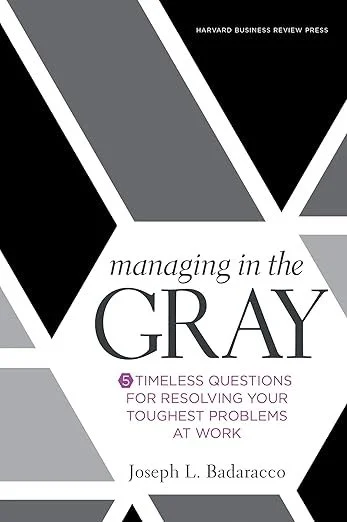
Managing in the Gray
Five Timeless Questions for Resolving Your Toughest Problems at Work
by Joseph L. Badaracco
The 60-Second Take
In Managing in the Gray, Harvard Business School professor Joseph L. Badaracco provides a framework for tackling your toughest workplace dilemmas. When data and standard analysis fall short, managers face complex gray areas that test their competence and character. Badaracco outlines five timeless questions drawn from humanism and history to help leaders balance pragmatic business needs with moral obligations, ensuring they make decisions they can actually live with.
You Cannot Outsource Hard Decisions to a Spreadsheet
If a problem has a clear solution, it rarely reaches the desk of a senior manager. The easy problems—the ones governed by standard operating procedures, legal precedents, or straightforward financial formulas—are solved further down the chain of command. By the time an issue makes its way to the top of an organization, all the obvious answers have been eliminated. You are left staring at a problem where the data conflicts, the experts disagree, and every available option carries a painful cost.
These are the gray areas.
In Managing in the Gray, Harvard Business School professor Joseph L. Badaracco explains that gray areas are the ultimate test of leadership. When confronted with blinding uncertainty, many managers freeze. They demand more research, commission more reports, and delay the choice, hoping the data will eventually tell them what to do. Badaracco argues that this is a fundamental misunderstanding of the job. At the edge of the data, management science ends. You have to approach these problems with the rigor of a manager, but you must resolve them using the intuition, ethics, and courage of a human being.
What You'll Learn
The difference between routine decisions and true "gray area" problems
Why relying entirely on data will paralyze you in high-stakes situations
The five timeless questions used to balance analytics with humanism
How to apply the "moral imagination" to understand your core obligations
Why intense pragmatism is absolutely necessary for ethical leadership
The Gray Area: Where Management Ends and Humanism Begins
A gray area usually involves a clash between two "rights" or two "wrongs." Imagine deciding whether to lay off a struggling division. If you keep the division, you risk the financial health of the entire company. If you cut it, you devastate the livelihoods of hundreds of loyal employees. A spreadsheet can calculate the severance costs, but it cannot weigh the moral burden of the choice.
Badaracco’s core thesis is that a manager must first do the hard, analytical work. You gather the data, assemble the right experts, map out the decision trees, and avoid jumping to hasty conclusions. But once the analytical tools are exhausted, you have to shift your perspective.
You have to tap into the humanist tradition. Badaracco built his framework by studying philosophers, theologians, and historical leaders who successfully navigated periods of extreme chaos. He distilled their collective wisdom into five specific questions. These questions do not provide an easy answer, but they provide a structured process for evaluating the human elements of a business problem.
Assessing the Impact: Consequences and Obligations
When the facts fail to provide an answer, you start by asking the first two questions. They focus entirely on the immediate and moral impact of your choices.
What are the net, net consequences?
This is not a simple return-on-investment calculation. When Badaracco says "net, net," he means looking broadly and deeply at the human impact of your decision. You have to consider everything that matters to people: joy, health, security, hazard, and suffering.
You cannot just look at the short-term financial hit. You have to ask what you are doing for people, not to them. This requires abandoning the model of the lonely leader sitting on a mountaintop. You need a team to aggressively poke holes in your assumptions. You need someone explicitly assigned to play devil's advocate, so you can accurately predict the full, cascading, real-world fallout of every available option.
What are my core obligations?
We all have duties that exist simply because we are human beings. You have obligations to respect others' rights, to act fairly, and to protect the vulnerable from harm.
To figure out your core obligations, you have to use your moral imagination. You must step entirely out of your comfort zone and put yourself in the shoes of the stakeholders who will be most hurt by your choice. If you were in their position, what would you consider fair? What would you be terrified of? What would you view as hateful or unjust? This question forces you to look past the company's bottom line and address the fundamental human rights at stake in the decision.
Facing Reality: Pragmatism and Identity
High ideals are necessary, but decisions have to survive in a messy, unforgiving world. The next two questions ground your choices in stark reality.
What will work in the world as it is?
You cannot base a high-stakes decision on a utopian vision of how people should behave. You have to deal with people exactly as they are. This is the Machiavellian element of Badaracco's framework. It is a harsh warning against letting idealistic notions distort your thinking.
If you have serious responsibilities, you must find a solution that is actually viable. It has to survive office politics, market pressures, and the aggressive self-interest of your competitors. A beautifully ethical strategy that immediately collapses upon implementation is a failure of leadership. You have a fiduciary duty to protect the people and the organization relying on you, which means your decisions must be intensely pragmatic.
Who are we?
Decisions are never made in a vacuum. You are part of a community, a team, and an organization. This question forces you to see your identity as woven into the fabric of your surroundings.
You have to step back and look at the defining stories of your company. Every organization has lore—the historical moments that everyone cites when explaining what the company stands for. If you choose a specific path through this gray area, how will it read as the newest chapter in your company's history? Your decision must reflect and express the actual norms and values of the group you represent.
The Ultimate Test: What Can I Live With?
The philosopher Friedrich Hegel noted that the hardest choices in life are rarely a battle between good and evil. They are usually a battle between two competing goods. Because you cannot satisfy every demand, your final choice will inevitably disappoint someone.
What can I live with?
At some point, the analysis has to stop. The meetings have to end. You have to make a call. Badaracco points out that in gray areas, you are rarely choosing a flawless, elegant solution. You are often just trying to meet a minimum standard of acceptability while doing the least amount of damage.
This final question tests your character. It forces you to rely on your gut, but only after your gut has been educated by the rigors of the first four questions. A gray area decision reveals the true personal priorities of the person making it. You have to take full responsibility for the choice, knowing that it might be flawed. You have to find an answer that aligns with your best judgment and your best self, act on it with conviction, and accept the consequences.
Managing in the Gray at a Glance
The gray area. A complex problem where facts, data, and standard management analysis fail to provide a clear answer.
The humanist approach. Work the problem rigorously as a manager, but resolve it ethically as a human being.
Net, net consequences. Look far beyond the financials to calculate the deep, real-world human impact of your choices.
Moral imagination. Step into the shoes of the most vulnerable stakeholders to understand your core human obligations to them.
Pragmatism. Make decisions that will actually survive in the messy, political reality of the world as it is.
The burden of command. Stop analyzing, trust your educated gut, and choose an outcome you can personally live with.
A Quick Start Guide to Resolving Tough Calls
Get the right people in the room. Do not try to solve a gray area alone. Assemble a diverse group of trusted advisors to ensure you are not acting in an echo chamber.
Assign a devil's advocate. Explicitly task one person with attacking your preferred solution to prevent groupthink and expose hidden, unintended consequences.
Use your moral imagination. Force yourself to argue the case entirely from the perspective of the person who will be hurt most by your decision.
Check your pragmatism. Ask yourself if your proposed solution relies on people acting perfectly. If it does, discard it and find a plan that works in the real world.
Write the company history. Imagine explaining your decision to a new hire ten years from now. Ensure the choice aligns with the core values you want your organization to stand for.
Who Should Read Managing in the Gray (and Who Can Skip It)
Read it if you are an executive or manager who frequently faces high-stakes, ethically complex decisions that keep you awake at night.
Read it if you are heavily reliant on data and spreadsheets and want a structured, philosophical framework for developing your intuition and judgment.
Read it if you enjoyed the ethical explorations in Badaracco's previous work, like Defining Moments.
Skip it if you are looking for quantitative formulas, risk assessment matrices, or hard statistical models for decision-making.
Skip it if you are an entry-level employee whose daily tasks are highly routine and formulaic. The dilemmas described here are typically reserved for those carrying significant organizational weight.
Final Reflections
Managing in the Gray is a quiet, contemplative book that addresses the loudest, most stressful parts of a leader's job. Joseph L. Badaracco does not offer a magic bullet. He admits upfront that gray areas are messy, painful, and unforgiving. His contribution is giving leaders a reliable process to trust when they can no longer trust the data. By anchoring modern management dilemmas in ancient humanistic philosophy, he elevates the role of the manager from a simple administrator to a moral agent. The insistence on balancing high-minded ethics with stark, Machiavellian pragmatism makes this framework incredibly durable for the real world.
The Bottom Line
When data and analytics fail to solve your hardest problems, you must step beyond your role as a manager and use your moral imagination, pragmatism, and character to resolve the issue as a human being.
Frequently Asked Questions
What exactly is a "gray area" problem?
It is a complex, high-stakes situation where you have gathered all the facts, run all the numbers, consulted the experts, and the correct path forward is still entirely unclear. These problems usually involve competing priorities, massive uncertainty, or deep ethical dilemmas.
Why does Badaracco focus on "the world as it is"?
He warns leaders against the trap of idealism. A solution that relies on perfect conditions or flawless human behavior will quickly fail. To be a responsible leader, you have to make decisions that are pragmatic enough to actually work in a messy, self-interested, and political reality.
Should I just trust my gut?
Yes, but only at the very end of the process. Badaracco warns that relying on your gut first is extremely hazardous. You must educate your intuition by rigorously working through the data and the first four timeless questions. Only then should you rely on your best judgment to make the final call.
Business Floss is reader-supported. When you use our links we may earn an affiliate commission that helps us keep the site running. Thank you for your support!