
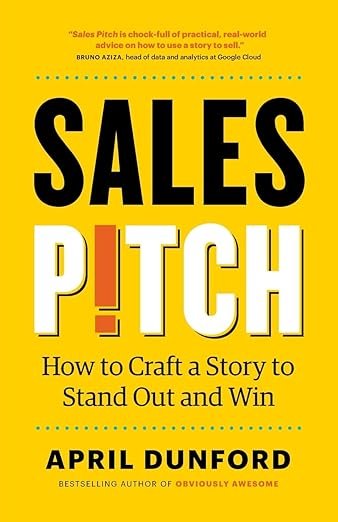
Sales Pitch
How to Craft a Story to Stand Out and Win
by April Dunford
The 60-Second Take
In Sales Pitch, product positioning expert April Dunford shifts the focus of B2B sales from pushing features to guiding buyers. She argues that complex sales are most often lost to buyer indecision, not direct competitors. By outlining an eight-step narrative framework, Dunford shows teams how to establish market context, evaluate alternatives, and confidently present their differentiated value so customers feel safe saying yes.
The Hidden Enemy in Every B2B Deal: Indecision
In B2B sales, vendors spend an enormous amount of time worrying about their direct competitors. They build elaborate battle cards, train their sales reps on every granular feature advantage, and obsess over undercutting the other guy's pricing. But in Sales Pitch, product positioning expert April Dunford points out that most lost deals do not go to a competitor. They go to the status quo. Buyers simply do nothing.
The book explores the psychological reality of purchasing complex software or services. B2B buyers are overwhelmed by choices, confused by overlapping feature sets, and terrified of making a bad decision that could cost them their jobs. Dunford argues that a successful sales pitch is not a monologue about how great your product is; it is a structured narrative designed to cut through the confusion and help a paralyzed customer make a confident choice.
What You'll Learn
Why buyer indecision and the "do nothing" outcome are your biggest threats
The fundamental difference between an investor pitch and a customer pitch
Why traditional feature walkthroughs fail to close complex deals
The eight-step framework for building a narrative that guides the buyer
How to define a "perfect world" criteria before you ever introduce your product
Stop Pitching Features, Start Teaching How to Buy
Most companies approach a sales call with a deeply flawed mindset: they believe their job is to show the customer the product, list its impressive features, and assume the customer will figure out why it matters. Dunford calls this the "feature walkthrough," and it is uniquely unhelpful to a confused buyer.
When a customer evaluates solutions, they usually lack a comprehensive grasp of the market. They know they have a problem, but they do not intuitively understand the pros and cons of the different technological approaches available to solve it. When you show up and simply demo your software, you expect the customer to connect the dots between a technical capability and their specific business pain. That requires them to do all the heavy lifting.
Instead of pushing features, Dunford suggests that salespeople need to act as trusted guides. You understand the solution space better than the buyer ever will. Your job is to educate them on the landscape, objectively explain the trade-offs of different approaches, and teach them how to evaluate their options. By clarifying the market for them, you build immense trust. You transition from a vendor trying to hit a quota to an advisor helping them safely navigate a high-stakes decision.
Why Your Investor Pitch Is Ruining Your Sales
Often, founders attempt to sell their product using the exact same slide deck they used to raise venture capital. Dunford warns that this is a fatal mistake. Investors and customers look for completely different kinds of proof, and using the wrong narrative will actively kill a deal.
Investors love disruption. They want to hear a grand vision about how you are going to completely upend a massive industry and dominate the market in five years. They invest in the glorious future. Customers, however, are terrified of disruption. From a customer's perspective, disruption implies that they will have to throw away their existing systems, retrain their entire staff, and endure months of painful implementation.
If you pitch a grand, disruptive vision to a corporate buyer, you will likely induce fearful paralysis. For example, a startup might pitch investors on building a revolutionary "enterprise omni-channel retail platform." But when pitching a retail customer, that grand vision sounds like a massive, risky IT headache. Instead, the sales pitch must focus on the immediate, tangible problem: "a mobile solution for sales associates." You must position your product as uniquely valuable for the specific pain they are experiencing today, not the world domination you hope to achieve tomorrow.
The Setup: Defining the Perfect World
To fix the traditional pitch, Dunford structures her ideal sales narrative into two distinct phases. The first phase is The Setup. This is where most sales pitches fail because reps rush past it to get to the demo. Before you ever introduce your company, you must establish a shared understanding of the market.
The Setup involves three crucial steps:
Insight: You start with a unique perspective your company has on the underlying "problem behind the problem." This proves you deeply understand the customer's space.
Alternatives: You objectively group the current solutions (including the status quo) and discuss the honest pros and cons of each. You do not badmouth competitors; you simply highlight where traditional approaches fall short.
Perfect World: Based on the flaws of the alternatives, you define the exact criteria a hypothetical, flawless solution would need to meet.
By the time you finish the Setup, the customer should be nodding in agreement. You have organized their messy problem into a clear framework.
The Follow-Through: Proving Your Value
Only after the buyer agrees on the criteria for a "perfect world" do you transition to the second phase: The Follow-Through. Because you have just defined what the ideal solution looks like, introducing your product now makes logical sense.
You introduce the company, but you immediately pivot to your Differentiated Value. You highlight only the specific capabilities that set you apart and map directly to the perfect world criteria you just built. You are no longer listing features in a vacuum; you are demonstrating exactly how your product solves the gaps left by the alternatives.
From there, you provide Proof—such as case studies, quantified results, and validation from similar companies—to de-risk the purchase. Emotion plays a vital role in B2B purchases, and the primary emotion is fear. By providing undeniable proof and proactively dismantling common Objections before the buyer even brings them up, you show them that you have guided dozens of other companies through this exact transition safely. When the buyer feels safe, "do nothing" loses its appeal, and they are ready for the Ask.
Sales Pitch at a Glance
Buyer indecision. The primary reason complex deals fail is not direct competition; it is the buyer's fear of making a wrong choice, resulting in no decision at all.
The feature walkthrough trap. Demonstrating product capabilities without context forces the customer to translate features into business value, causing confusion and fatigue.
The Setup. The critical first half of a pitch that establishes market context, reviews alternatives, and builds the criteria for a perfect solution.
The Follow-Through. The second half where you introduce your product, prove your differentiated value, and proactively handle risk.
Differentiated value. The unique thing you can do for customers that no other alternative on the market can do. This must be the star of the pitch.
A Quick Start Guide to the 8-Step Framework
Insight. Start with a unique, illuminating perspective on the market and the real problem the customer is facing.
Alternatives. Objectively group the current solutions (including the status quo) and explain their trade-offs.
Perfect World. Define the specific criteria a hypothetical, ideal solution would need to possess to fix the flaws of the alternatives.
Introduction. Briefly introduce your company and product as the answer to the perfect world criteria.
Differentiated Value. Focus heavily on the unique value you provide that the alternatives cannot, and show the features that enable it.
Proof. Provide case studies and metrics to validate your claims and reduce buyer anxiety.
Objections. Proactively address common concerns before the buyer even brings them up.
Ask. End with a clear, specific request for the next step in the buying process.
Who Should Read Sales Pitch (and Who Can Skip It)
Read it if you are a product marketer responsible for building sales decks, positioning guides, and enablement materials for a B2B sales team.
Read it if you are a founder doing founder-led sales and struggling to explain why your startup is better than entrenched legacy competitors.
Read it if your sales team frequently loses deals to "no decision" and needs a structured way to build buyer confidence.
Skip it if you are looking for a book on negotiation tactics, cold-calling scripts, or closing tricks; this is strictly about narrative structure and positioning.
Skip it if you sell low-cost, transactional consumer goods where buyer indecision and complex technical evaluations are not a factor.
Final Reflections
Sales Pitch is fundamentally a masterclass in empathy. April Dunford correctly identifies that modern B2B buyers do not need more information; they need clarity. By shifting the role of the salesperson from a persuasive debater to an objective guide, she provides a framework that respects the buyer's intelligence while systematically leading them to a logical conclusion. The brilliance of her eight-step narrative is that it forces companies to stop talking about themselves and start talking about the market. For organizations tired of delivering generic product demos that fall flat, this book offers a highly practical, repeatable blueprint for making your value undeniable.
The Bottom Line
To win complex deals, stop pitching a laundry list of features and start acting as an objective guide who helps paralyzed buyers evaluate the market and make a confident decision.
Frequently Asked Questions
What is the main idea of Sales Pitch?
The main idea is that B2B deals are mostly lost to buyer indecision, not competitors. To win, vendors must replace generic feature walkthroughs with a structured narrative that teaches the customer how to evaluate the market and clearly highlights the vendor's differentiated value.
What is the difference between an investor pitch and a sales pitch?
An investor pitch focuses on future disruption, massive market potential, and long-term vision. A sales pitch must focus on solving a specific, painful problem right now. Customers hate disruption because it implies risk; they want a safe, proven solution for their immediate needs.
What does it mean to define the "Perfect World"?
In Dunford's framework, the "Perfect World" step happens before you introduce your product. After reviewing the flaws of the current market alternatives, you define the exact criteria a hypothetical, flawless solution would have. This implicitly maps to your product's unique strengths, making your eventual introduction feel like the logical answer.
Business Floss is reader-supported. When you use our links we may earn an affiliate commission that helps us keep the site running. Thank you for your support!


