
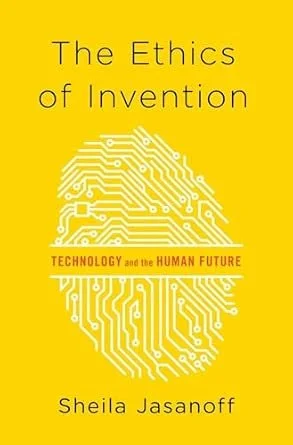
The Ethics of Invention
Technology and the Human Future
by Sheila Jasanoff
The 60-Second Take
In The Ethics of Invention, Harvard professor Sheila Jasanoff explores how technology rules society as powerfully as written law. By dismantling the pervasive myths of technological determinism and technocracy, she reveals how delegating decisions to engineers and data oligarchs endangers democracy. Jasanoff provides a compelling framework for treating innovation not as an inevitable, amoral force, but as a deeply political process requiring urgent democratic oversight.
We Are Governed by Code as Much as by Law
Every time you cross a busy intersection, navigate a website, or submit an application for a medical procedure, you are submitting to a silent, unelected power. We think of ourselves as citizens governed by laws written by politicians and interpreted by judges. But in reality, the boundaries of our daily lives—what we can do, who knows our secrets, and what risks we are exposed to—are increasingly dictated by technology. While we demand rigorous democratic oversight for our legal systems, we routinely give our technological systems a free pass.
In The Ethics of Invention, Sheila Jasanoff, a pioneering professor of science and technology studies at Harvard, argues that this disconnect is one of the greatest threats to human freedom. We have bought into the illusion that technology is merely an apolitical tool, a neutral force of nature moving steadily toward progress. Jasanoff dismantles this idea. She charts society's embrace of technological solutions and proves that innovation is a deeply political act that requires the same ethical scrutiny we apply to government policy. This summary explores her frameworks for understanding how we surrender our power to machines, and how we might begin to reclaim it.
What You'll Learn
The three pervasive fallacies that prevent us from holding innovators accountable
Why traditional, expert-led risk assessment often fails the most vulnerable people
The critical difference between scientific data and experiential knowledge
How "sociotechnical imaginaries" shape the funding and direction of our future
Why technology companies act like sovereign governments, and how they redefine privacy
The ethical boundaries challenged by biotechnology and gene editing
The Three Fallacies of Innovation
To understand why citizens feel so helpless in the face of massive technological shifts, Jasanoff examines the stories we tell ourselves about innovation. In modern social discourse, three distinct fallacies dominate the narrative. These doctrines are incredibly convenient for inventors and corporations because they systematically remove values, politics, and responsibility from the discussion.
Technological Determinism
The first fallacy is technological determinism. This is the widespread belief that technology possesses an unstoppable, internal momentum. Once a technology is invented, this theory suggests, it will inevitably reshape society to fit its own insatiable demands. We hear this in phrases like "you cannot stop progress" or "the internet wants to be free." Determinism treats human beings as passive recipients of the future. If machines possess their own logic and push society along an inevitable pathway, there is very little room left for moral debate. Jasanoff argues that we must entirely reject this passive stance. Technologies only take hold because human institutions, legal frameworks, and financial markets actively choose to support them.
Technocracy
The second fallacy is technocracy, which is the belief that rule by experts is the only viable option for a modern society. The argument goes like this: engineering design, algorithmic processing, and the assessment of chemical risks are simply too complicated for ordinary people to understand. Therefore, the public should step aside and let the specialists make the decisions. Jasanoff views this as a profound distortion of democracy. While technical expertise is necessary to build a bridge or write code, deciding whether to build the bridge, who it displaces, and who profits from it are questions of human values. Leaving those decisions exclusively to technologists removes the citizen from the equation entirely.
Unintended Consequences
The third fallacy is the doctrine of unintended consequences. When a massive technological system fails—whether it is a catastrophic chemical spill or a social media platform facilitating political violence—the creators frequently claim that the disaster was unforeseeable. Viewed through this lens, the complexities of large systems mean there is no realistic alternative to living with uncertain threats. Jasanoff points out that leaning on "unintended consequences" operates as a shield against accountability. It implies that because we cannot predict every possible outcome, we cannot be blamed for any of them. It discourages the kind of rigorous, holistic ethical forecasting that should precede the release of any world-altering technology.
The Limits of Expert Risk Assessment
When governments and corporations do attempt to regulate technology, they typically rely on a formal process known as risk assessment. This discipline aims to analyze potential hazards mathematically and design regulations to reduce those hazards to an acceptable level. While this sounds perfectly rational on paper, Jasanoff identifies severe structural flaws in how risk assessment is practiced.
The primary issue is that standard risk assessment is designed to measure highly specific, quantitative variables, completely ignoring qualitative factors and the unequal distribution of harm. When an agency calculates the acceptable risk of a new pesticide, it looks at aggregate data. It rarely accounts for the fact that the risk is not shared equally; it is disproportionately borne by the vulnerable, low-wage agricultural workers who interact with the chemical daily. Jasanoff notes that our failure to aggregate a technology's harmful effects on individual, marginalized lives allows significant, systemic risks to go unnoticed for decades.
Furthermore, risk assessment is fiercely exclusionary. It privileges scientific data while dismissing what Jasanoff calls "experiential knowledge." The lived experience of ordinary citizens is routinely set aside by policymakers as subjective, biased, or unscientific. Yet, experiential knowledge is often remarkably accurate precisely because it is based on direct, prolonged interaction with environments and machines. An industrial worker intimately understands the hidden, practical dangers of their specific factory floor far better than the design engineer sitting in an office miles away. A local farmer understands the subtle, long-term cycles of their specific ecosystem better than a global agricultural corporation. By shutting citizens and their lived experiences out of the risk assessment process, we design regulations that look perfect on a spreadsheet but fail entirely in the real world.
Sociotechnical Imaginaries and Data Oligarchs
One of Jasanoff's most significant contributions to the philosophy of technology is the concept of "sociotechnical imaginaries." An imaginary is not just a fantasy; it is a collective vision of what a good, desirable future looks like, driven by scientific and technological progress. These imaginaries are incredibly powerful because they carry implicit ideas about public purposes and the collective good, and they dictate where a society directs its funding, laws, and attention.
For example, during the space race, the sociotechnical imaginary was one of national supremacy and conquering the final frontier. In the early days of the internet, the imaginary was a decentralized utopia of free information and global connection. Understanding which imaginary is currently dominating the culture is essential because these visions fabricate power. They determine who gets to set the rules.
In the realm of information technology, the utopian imaginary of a free internet has morphed into a reality governed by "data oligarchs." Jasanoff argues that giant search and social media companies now operate essentially as sovereign entities. They control and exploit our data-driven vulnerabilities, structure our interactions, and redefine the very concept of privacy, all without the accountability or interest in civic welfare that we demand from democratic governments. Because our current sociotechnical imaginary still largely views these platforms as innovative private businesses rather than essential public infrastructure, we lack the conceptual tools to regulate them properly.
Bioethics: Tinkering with the Definition of Life
The ethical stakes are raised even higher when Jasanoff turns her attention to biomedicine and biotechnology. Advances in areas like genetically modified organisms (GMOs) and gene editing have given humanity the tools to alter life itself. This is not merely an engineering challenge; it is a profound philosophical disruption.
Technologies that blur the boundaries between human biology and proprietary data create intense friction between our cultural concerns for human dignity and corporate interests in scientific progress. When a company can patent a genetic sequence, we are forced to ask who actually owns our genetic information. When we can edit the DNA of an unborn child, we challenge the traditional definitions of human nature. Jasanoff points out that the populations most affected by these biological interventions—from patients in the developing world to consumers eating modified crops—are almost entirely excluded from the conversations about whether to release them. We are marching heedlessly into ethically troubled waters, driven by the momentum of the market rather than by thoughtful democratic consensus.
The Ethics of Invention at a Glance
Technological determinism. The false theory that technology has its own unstoppable momentum that society must inevitably adapt to.
Technocracy. The belief that technical systems are too complex for citizens, and must therefore be governed exclusively by experts.
Unintended consequences. A narrative shield used by innovators to avoid responsibility for the harms their creations cause.
Experiential knowledge. The highly valuable, lived wisdom of ordinary people (like farmers or factory workers) that is routinely ignored by formal risk assessments.
Sociotechnical imaginaries. The collective visions of technological progress that societies use to justify funding, laws, and power structures.
Data oligarchs. Massive technology companies that exert government-like control over communication and privacy without democratic accountability.
A Quick Start Guide to Democratic Innovation
Question the inevitable. The next time a vendor or executive claims that a new software tool or AI system is "the inevitable future," push back. Technologies only succeed when we actively choose to fund and adopt them.
Separate the technical from the ethical. Trust your engineers to explain how a system works, but do not rely on them exclusively to determine if it should be deployed. That is a question of shared company values.
Elevate experiential knowledge. When assessing the risk of a new operational tool, do not just look at the manufacturer's data. Interview the frontline workers who will actually use the tool every day.
Forecast the failures. Reject the excuse of unintended consequences. Hold formal pre-mortems to aggressively imagine how a new product could be abused or cause harm before you launch it.
Examine your imaginary. Ask yourself what vision of the future your business is actively building. Ensure that your definition of progress aligns with the actual well-being of your customers, not just efficiency.
Who Should Read The Ethics of Invention (and Who Can Skip It)
Read it if you work in public policy, law, or compliance and want a sophisticated framework for thinking about how to regulate emerging technologies.
Read it if you are a technology executive or product manager trying to build more ethical, responsible products that genuinely serve the public good.
Read it if you are fascinated by the intersection of philosophy, science, and sociology, and want to understand why we feel so powerless against massive technology companies.
Skip it if you are looking for a tactical, step-by-step checklist for corporate IT security. This is a highly academic, philosophical exploration of governance, not a technical manual.
Skip it if you firmly believe that free-market capitalism and unhindered technological disruption will automatically solve all of humanity's problems without intervention.
Final Reflections
The Ethics of Invention is not a pessimistic book, nor is it a blind celebration of technological progress. Sheila Jasanoff carefully walks a middle path, insisting that the success or failure of any technology can only be understood within the context of the human institutions that give it form. Her most vital contribution is dismantling the artificial wall between the "expert" and the "citizen." By exposing how the doctrines of determinism and technocracy strip away our moral agency, she demands that we treat technology as a subject of rigorous civic debate. We cannot simply leave the future of human dignity, privacy, and safety to a handful of engineers and corporate executives. Managing the promises and perils of the future requires the messy, difficult, but absolutely essential work of democratic dialogue.
The Bottom Line
Technology governs our lives as strictly as any written law, meaning we must stop leaving innovation exclusively to the experts and start treating it as a deeply political process that requires democratic oversight.
Frequently Asked Questions
What is the main idea of The Ethics of Invention?
The core argument is that technological systems govern human behavior and society just as much as legal systems do, yet they operate with almost zero democratic oversight. Jasanoff argues that we must stop treating technology as an inevitable, apolitical force and start actively governing it to protect human rights and dignity.
What is a "sociotechnical imaginary"?
It is a concept developed by Sheila Jasanoff that describes how a society envisions a desirable future based on scientific and technological progress. These collective visions are important because they implicitly define what is considered a "public good" and dictate where power and funding flow.
What does Jasanoff mean by "experiential knowledge"?
Experiential knowledge is the practical wisdom gained by ordinary people through direct, repeated interaction with their environment or machinery. Jasanoff argues this knowledge—like a factory worker knowing the real dangers of the assembly line—is just as valuable as expert scientific data, yet it is usually ignored in formal risk assessments.
Business Floss is reader-supported. When you use our links we may earn an affiliate commission that helps us keep the site running. Thank you for your support!


