
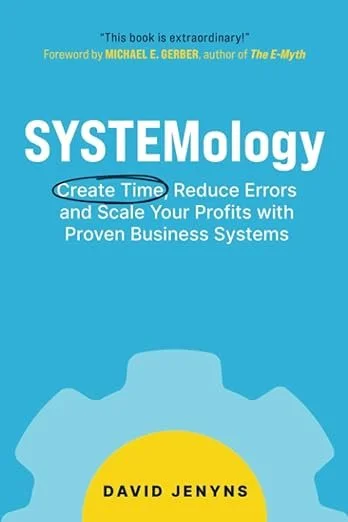
SYSTEMology
Create Time, Reduce Errors and Scale Your Profits with Proven Business Systems
by David Jenyns
The 60-Second Take
In SYSTEMology, David Jenyns provides a practical, seven-step framework to help small business owners escape the daily operations trap. Recognizing that founders fail at systemization by trying to document everything themselves, Jenyns focuses on capturing the Critical Client Flow and empowering team members to extract processes. The result is an actionable guide for reducing errors, scaling profits, and building a business that thrives without you.
Why You Are the Worst Person to Write Your Company's Manual
Many business owners start their companies because they possess a highly valuable skill. They might be an exceptional graphic designer, a master plumber, or a brilliant financial planner. They hang a sign on the door, start doing the work, and eventually hire a few people to help. But as the company grows, they hit a brutal ceiling. They discover they have not built a self-sustaining enterprise; they have built a high-stress job where they are the primary bottleneck for every decision, complaint, and operational hiccup.
The classic advice for this trap is to "systemize your business." Everyone knows large franchises run flawlessly on systems, but when the average small business owner tries to replicate that, they fail miserably. They picture massive, corporate-style operations manuals. They try to write perfect, granular instructions for every single task while still managing the daily chaos of running the company.
In SYSTEMology, entrepreneur David Jenyns argues that this overwhelming approach is exactly why systemization efforts die. He presents a highly accessible, seven-step framework proving that you do not need to document hundreds of tasks to see immediate results. By identifying the core processes that actually generate revenue, and by explicitly removing the business owner from the documentation process, Jenyns provides a realistic blueprint for turning a chaotic operation into a scalable, valuable asset.
What You'll Learn
Why the business owner should never be the person writing the procedures
How to map your Critical Client Flow (CCF) to identify the vital 20 percent of your operations
The 7-step SYSTEMology framework for capturing and organizing knowledge
Why "ugly" systems are vastly superior to perfect, delayed ones
How to leverage a Systems Champion to document processes without slowing down your top performers
The Myth That Systems Kill Creativity
Before you can build a systemized business, you have to overcome the psychological barriers that prevent founders from starting. The most common resistance Jenyns encounters is the belief that systems will turn a dynamic, creative company into a rigid, bureaucratic nightmare. Business owners often pride themselves on their agility, believing that strict processes will stifle innovation and turn their employees into mindless robots.
Jenyns argues that the exact opposite is true. When a business lacks systems, every minor problem requires a custom, ad-hoc solution. Your team wastes immense cognitive energy figuring out how to handle routine tasks like onboarding a new client, processing an invoice, or responding to a customer complaint. This constant reinvention causes burnout and leaves zero mental bandwidth for actual innovation.
Systems do not kill creativity; they liberate it. By standardizing the mundane, repetitive tasks that keep the business running, you free up your team's energy to focus on high-value, creative problem-solving. When your staff does not have to worry about the mechanics of delivering the product, they can focus entirely on improving the product and delighting the customer.
Target the Critical Client Flow (CCF) First
The second major hurdle to systemization is sheer overwhelm. If you look at a business as a whole, there are hundreds of processes: hiring, firing, payroll, marketing, social media, customer service, and IT troubleshooting. Trying to document all of this at once guarantees failure.
To solve this, Jenyns introduces the concept of the Critical Client Flow (CCF). The CCF is the linear, step-by-step journey that turns a prospect into a paying, satisfied customer. It is the core financial engine of your business. The CCF typically consists of just 10 to 15 key systems, divided into broad phases: lead generation, lead conversion, delivery of the core product or service, and customer retention.
By focusing exclusively on the CCF first, you ignore the administrative noise and target the 20 percent of systems that produce 80 percent of your results. Documenting these specific processes ensures that your business can consistently acquire customers and deliver value, even if you, the founder, are not in the office. Once the CCF is documented and functioning smoothly, you will have bought yourself enough time and breathing room to systematically tackle the rest of the business.
The Seven Steps to a Systemized Business
Jenyns structures his methodology into a proprietary 7-step process. This framework is designed to take a business from entirely dependent on key personnel to fully operationalized.
1. Define
The process begins by defining the Critical Client Flow. You map out the bare minimum steps required to deliver your core service. You do not write the detailed "how-to" manuals here; you simply list the essential stages of the client journey to create a high-level overview.
2. Assign
This step addresses the primary reason systemization fails: the owner trying to do it all. In the Assign phase, you identify the team members who currently perform each task in the CCF best. Crucially, you also assign a "Systems Champion." This is a team member, often an administrative or operations-focused person, who will be responsible for actually capturing and organizing the systems. The owner must step back.
3. Extract
This is where the knowledge is pulled out of the heads of your best workers. Instead of asking your top salesperson to stop selling and write a manual, the Systems Champion simply records them performing the task. This two-person extraction method is the secret to fast, frictionless documentation.
4. Organize
A system that nobody can find is a system nobody will follow. In this phase, you take the extracted knowledge and store it in a central, easily searchable repository. Whether you use a dedicated software platform or a simple, well-structured cloud drive, the goal is to create a single source of truth for the entire company.
5. Integrate
Having documented systems is useless if the team refuses to use them. Integration is about driving cultural adoption. You train the staff to rely on the systems, ensuring that checking the documented process becomes the default behavior. You make it clear that following the systems is simply "how things are done around here."
6. Scale
Once the Critical Client Flow is fully integrated, the business will experience a massive increase in efficiency and stability. At this point, you can begin scaling your systemization efforts. You expand beyond the client journey and start documenting the secondary systems, such as human resources, finance, and internal team management.
7. Optimize
People naturally want to optimize a process before they document it. Jenyns warns that this is a fatal trap. You must document what you are currently doing first, even if it is flawed. Only in step seven, once the baseline systems are running, do you begin analyzing the data, identifying bottlenecks, and tweaking the processes for maximum efficiency.
The Magic of the Two-Person Extraction Method
Perhaps the most practical takeaway from SYSTEMology is its approach to actually capturing the work. When you ask a skilled employee to write a standard operating procedure (SOP), they stare at a blank page, get overwhelmed by the granular details, and eventually abandon the project. They suffer from the curse of knowledge—they do the work so naturally that they cannot articulate the individual steps.
The two-person extraction method solves this completely. The knowledgeable worker simply does their job. If it is a computer-based task, they share their screen and record it while talking out loud. If it is a physical task, the Systems Champion records them with a smartphone. The Systems Champion then watches the recording and writes out a simple, bulleted checklist of the steps.
Jenyns emphasizes that your first system should be "ugly." It does not need high-production video, branded flowcharts, or perfect formatting. It just needs to exist. An ugly system—a rough screen recording accompanied by a five-point checklist—is infinitely more valuable than a perfect manual that never gets written. You can always refine and polish it later during the Optimize phase.
SYSTEMology at a Glance
The Critical Client Flow (CCF). The 10 to 15 core steps required to attract a lead, make a sale, and deliver your product. Systemize this first.
The Systems Champion. A dedicated team member responsible for extracting and organizing processes, removing the burden from the business owner.
Two-person extraction. Never ask a worker to write their own manual. Have them perform the task while the Systems Champion records and documents it.
Ugly systems first. Do not wait for perfection. A rough video recording and a simple checklist are enough to get started.
Document before optimizing. Capture exactly how the work is currently being done before you try to improve or streamline it.
A Quick Start Guide to Systemizing Your Business
Map your client journey. Grab a piece of paper and write down the essential steps a customer goes through from first contact to final delivery.
Identify your best performers. Next to each step on your CCF, write the name of the team member who currently executes that task the best.
Appoint a Systems Champion. Find an organized, detail-oriented person on your team to lead the documentation effort, so you do not have to.
Record the work in real-time. Have your Systems Champion sit with your best performers and record them doing their job. Do not overthink the production quality.
Create a central hub. Store these raw videos and simple checklists in a shared, organized cloud folder that every employee can easily access.
Who Should Read SYSTEMology (and Who Can Skip It)
Read it if you are a small business owner working 60-hour weeks and feeling trapped by your own company's success.
Read it if your business operations heavily depend on a few key "hero" employees, and their departure would cause a crisis.
Read it if you are planning to sell your business in the next few years and need to build transferable value.
Skip it if you run a massive enterprise that already has established, dedicated operations and compliance departments.
Skip it if you are looking for highly technical, Six Sigma-level process improvement theories. This book is heavily weighted toward practical, immediate execution for small businesses.
Final Reflections
SYSTEMology succeeds because it directly addresses the psychological and practical roadblocks that cause business owners to abandon systemization. David Jenyns understands that the pursuit of perfection is the enemy of progress. By giving founders permission to create "ugly" systems and actively discouraging them from doing the documentation themselves, he turns a monumental corporate chore into a manageable, delegation-friendly project. While some of the concepts overlap with foundational books like The E-Myth Revisited, Jenyns's contribution is the "how-to" manual that those earlier books lacked. It is a highly tactical, realistic guide that strips away the intimidation of process management and offers a clear path to reclaiming your time.
The Bottom Line
To build a business that runs without you, stop trying to write perfect operations manuals yourself; instead, empower a Systems Champion to record your best employees doing the 15 tasks that actually generate revenue.
Frequently Asked Questions
What is the main idea of SYSTEMology?
The main idea is that business owners must remove themselves as the primary bottleneck of their operations. By following a structured, 7-step process to document the core revenue-generating tasks, founders can build a scalable, consistent business that functions perfectly without their daily involvement.
What is the Critical Client Flow (CCF)?
The Critical Client Flow is a high-level map of the 10 to 15 essential steps required to take a prospect from initial lead to satisfied customer. It helps business owners focus their systemization efforts on the exact processes that drive revenue, rather than getting overwhelmed by administrative tasks.
Why shouldn't the business owner write the systems?
Business owners are usually too busy, suffer from perfectionism, and know the tasks so instinctively that they struggle to break them down into basic steps. Assigning a dedicated Systems Champion to extract the knowledge from the staff ensures the documentation actually gets done.
Business Floss is reader-supported. When you use our links we may earn an affiliate commission that helps us keep the site running. Thank you for your support!