
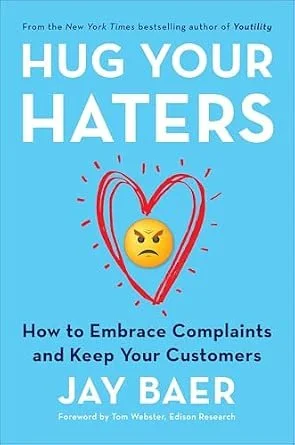
Hug Your Haters
How to Embrace Complaints and Keep Your Customers
by Jay Baer
The 60-Second Take
In Hug Your Haters, customer experience expert Jay Baer argues that businesses must fundamentally change how they handle complaints. Drawing on extensive research, Baer reveals that customer service is no longer a private exchange; it is a public spectator sport. By categorizing complainers into "offstage" customers seeking private resolution and "onstage" customers seeking a public audience, he provides a practical playbook for answering every complaint, defusing trolls, and turning negative feedback into loyal advocacy.
Why Customer Service Is Now a Spectator Sport
For decades, customer service was a private transaction. If a patron had a bad meal or received a defective product, they called a toll-free number or mailed a letter. The interaction happened behind closed doors, and the financial risk to the company was limited to the loss of that single relationship. Today, a disgruntled customer simply pulls out their smartphone and broadcasts their frustration to thousands of people on Twitter, Yelp, or Reddit. Customer service has moved from the back office to a public stage.
In Hug Your Haters, Jay Baer explains that this shift terrifies most business owners, causing them to hide from criticism or argue defensively. But this instinct is entirely backwards. Backed by extensive research from Edison Research, Baer argues that complaints are a massive opportunity hidden in plain sight. Answering negative feedback publicly and compassionately is the most cost-effective way to build trust and increase customer retention. This summary breaks down Baer’s taxonomy of complainers and his tactical playbook for turning your harshest critics into your best marketing asset.
What You'll Learn
The "80/8 disconnect" that blinds companies to their actual service quality
Why the silent "meh in the middle" customers are far more dangerous than vocal complainers
The psychological differences between offstage and onstage haters
Why community forums and social media generate the highest levels of brand advocacy
The Rule of Reply Only Twice for gracefully managing online trolls
A framework for answering every complaint, in every channel, every time
The Canary in the Coal Mine
There is a staggering lack of self-awareness in modern business. Baer highlights a famous statistic: 80 percent of companies believe they deliver outstanding customer service, yet only 8 percent of their customers agree. This massive perception gap exists because businesses routinely ignore the signs of friction right in front of them. When a customer complains, the default corporate reaction is to view them as an unreasonable annoyance.
Baer flips this framing entirely. He argues that haters are the canary in the coal mine for your company. They are an early warning detection system. When someone takes the time out of their busy day to complain about a broken process, a rude employee, or a confusing website, they are doing you a favor. They are providing free consulting.
The real enemy of your business is not the hater. The real enemy is the "meh in the middle." These are the customers who experience mediocre service, shrug, and simply take their money to a competitor. They never give you the chance to fix the relationship, and worse, they never alert you to the systemic flaws in your operation that are quietly driving away other customers. Haters, by contrast, care enough to speak up. Embracing them is a lucrative strategy: Baer notes that a mere 5 percent increase in customer retention can boost overall profits by anywhere from 25 to 85 percent. Fixing what the haters point out makes the business better for everyone else.
Offstage Versus Onstage Haters
To effectively hug your haters, you must understand how they operate. Baer’s research divides complainers into two distinct archetypes based on their venue of choice and their underlying psychological motivations: offstage haters and onstage haters.
Offstage haters are the traditional complainers. They utilize legacy channels like telephone calls, emails, or private website contact forms. Their primary motivation is resolution. They genuinely want the company to fix their problem, refund their money, or replace their product. Because they are reaching out directly, their expectations for a response are incredibly high—roughly 91 percent of offstage haters expect the company to reply. Dealing with offstage haters requires speed, empathy, and a straightforward solution. If you fix their issue privately, they are usually satisfied, though their likelihood of publicly praising you afterward is only moderate.
Onstage haters are the modern evolution of the complainer. They air their grievances on social media platforms, online review sites like TripAdvisor or Yelp, and dedicated discussion forums. Their motivation is vastly different from offstage complainers. Onstage haters are often looking for an audience. They want public validation of their frustration and a platform for their righteous indignation. Interestingly, because they are shouting into the digital void, their expectations for a company response are actually quite low—only about 42 percent expect the brand to reply.
This low expectation creates a massive business opportunity. When a company steps into an onstage venue and offers a helpful, empathetic response, it completely surprises the complainer. Baer’s research shows that responding to onstage haters yields a dramatic boost in customer advocacy—up to a 25 percent increase when answering complaints on forums, and a 20 percent increase on social media.
The Spectator Sport of Social Service
The single most important concept in dealing with onstage haters is realizing that you are no longer communicating with just one person. Customer service in public channels is a spectator sport.
When you reply to a scathing Google review, the irate customer who wrote it is only a fraction of your audience. The real audience consists of the hundreds or thousands of prospective customers who will read that interaction over the next several years. They are watching to see how your business handles adversity. Do you get defensive? Do you blame the customer? Do you ignore the problem entirely? Or do you take the high road, apologize for the friction, and offer a path to make it right?
When you answer an onstage complaint gracefully, you are demonstrating your company's core values to the market. You prove that you are reasonable and that you stand behind your work. This is why Baer’s central mandate is so absolute: Answer every complaint, in every channel, every time. You cannot cherry-pick the easy emails and ignore the brutal Twitter mentions. Answering only the private complaints while leaving the public ones unaddressed allows a toxic narrative to fester on the digital shelf indefinitely.
The Rule of Reply Only Twice
One of the most common reasons companies hesitate to engage with onstage haters is the fear of being dragged into a public, never-ending argument. They worry about feeding the trolls—people who cannot be satisfied and simply want to argue for the sake of arguing. To solve this, Baer introduces a highly tactical boundary: The Rule of Reply Only Twice.
Here is how it works in practice. When an onstage hater posts a complaint, your first reply should acknowledge their frustration, apologize for the negative experience, and offer a way to resolve it offline (e.g., "I am so sorry to hear your meal was cold. Please email our manager at this address so we can make this right.").
If the hater replies with another wave of vitriol and refuses to take it offline, you deploy your second and final reply. You reiterate your empathy, restate that you would love to solve the problem, and point them to the offline channel once more. And then, critically, you stop. You do not reply a third time.
By replying twice, you have shown the audience of spectators that you are deeply committed to fixing the issue. If the hater continues to rant after you have offered a solution twice, the spectators will immediately recognize that the hater is being unreasonable, not the business. The Rule of Reply Only Twice protects your brand’s dignity while proving your commitment to service.
Hug Your Haters at a Glance
The 80/8 disconnect. The massive gap between the 80% of companies that think they provide great service and the 8% of customers who actually agree.
The meh in the middle. Customers who have a mediocre experience but never complain. They are the true threat because they quietly leave without giving you a chance to improve.
Offstage haters. Customers who complain via phone or email. They want a private resolution and highly expect a reply.
Onstage haters. Customers who complain on social media or review sites. They want an audience and have low expectations for a reply, creating a huge opportunity to surprise them.
The spectator sport. The reality that public customer service interactions are judged by thousands of prospective customers, not just the original complainer.
Reply Only Twice. A firm boundary for online interactions to ensure you demonstrate empathy to spectators without getting dragged into an endless argument with trolls.
A Quick Start Guide to Hugging Your Haters
Change your mindset. Stop viewing complaints as a nuisance. Treat them as free consulting that highlights exactly where your operations need improvement.
Commit to every channel. Adopt a policy of answering every single complaint, whether it arrives via a private email or a public Yelp review. Consistency is key.
Prioritize speed for offstage haters. When complaints come through phone or email, reply as fast as humanly possible. Speed defuses anger and proves you take their private concerns seriously.
Take the high road onstage. When replying to public criticism, remember the spectators. Never get defensive, never blame the customer, and always offer a clear path to resolution.
Use the two-reply limit. Acknowledge an online complaint and try to move the conversation offline. If the customer refuses and continues attacking, clarify your offer once more, then walk away.
Who Should Read Hug Your Haters (and Who Can Skip It)
Read it if you are a founder, manager, or executive who feels overwhelmed by online reviews and needs a structured way to handle internet negativity.
Read it if you work in customer success or social media management and want data-backed strategies to prove the ROI of answering public complaints.
Read it if your business relies heavily on local search and public reputation (restaurants, hotels, home services) to acquire new customers.
Skip it if you are looking for an overarching textbook on broad business strategy; this book is laser-focused specifically on the mechanics of customer complaints and retention.
Skip it if you operate a purely B2B monopoly where public social media sentiment has absolutely no bearing on your closed-door contract renewals.
Final Reflections
Hug Your Haters is a remarkably practical book that attacks a universal business anxiety: the fear of public criticism. Jay Baer takes an emotional, highly stressful aspect of running a business and breaks it down into a calm, mathematical process. By proving that onstage haters actually expect very little, he turns the terrifying landscape of social media complaints into an arena of outsized opportunity. The book's greatest strength is its insistence that customer service is no longer a localized department, but rather the most public-facing marketing asset a company possesses. In an era where products and prices are easily replicated by competitors, the willingness to stand on a digital stage and treat an angry customer with grace is a rare and profound competitive advantage.
The Bottom Line
Stop ignoring your critics; answering every complaint publicly and compassionately proves your character to thousands of observing prospects and is the most reliable way to turn an operational failure into fierce customer loyalty.
Frequently Asked Questions
What is the main idea of Hug Your Haters?
The core idea is that businesses must stop avoiding customer complaints and instead embrace them as free, actionable feedback. By understanding the difference between private (offstage) and public (onstage) complainers, companies can systematically respond to all criticism, defuse anger, and publicly demonstrate their commitment to customer care.
What is the difference between offstage and onstage haters?
Offstage haters complain privately via phone or email, expect a rapid reply, and simply want their specific problem resolved. Onstage haters complain publicly on social media or review sites, want an audience for their frustration, and rarely expect a brand to respond.
Why should a company reply to a troll?
You should reply because customer service on public platforms is a spectator sport. You are not just replying to convince the troll; you are replying to show the hundreds of other potential customers reading the thread that your company is reasonable, professional, and willing to fix its mistakes.
Business Floss is reader-supported. When you use our links we may earn an affiliate commission that helps us keep the site running. Thank you for your support!


