
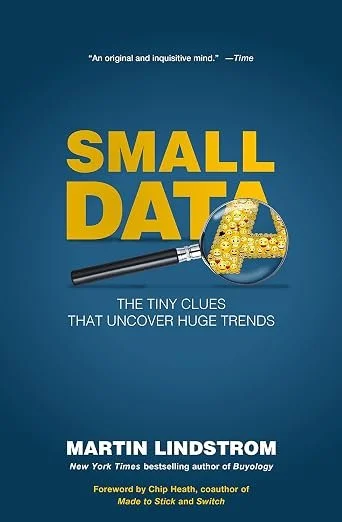
Small Data
The Tiny Clues That Uncover Huge Trends
by Martin Lindstrom
The 60-Second Take
In Small Data, branding expert Martin Lindstrom challenges the assumption that algorithms hold all the answers. He argues that while big data reveals broad correlations, it takes tiny, seemingly insignificant behavioral clues to uncover the emotional desires driving our choices. By blending forensic psychology with cultural observation, Lindstrom shows how paying attention to hidden habits helps businesses solve the mysteries that scale alone misses.
Why Algorithms Need Anthropologists
We live in an era obsessed with scale. Millions of data points are scraped, sorted, and analyzed every second to tell companies exactly what consumers are doing. Yet, as Martin Lindstrom points out in Small Data, knowing what people are doing is very different from understanding why they are doing it. When we rely exclusively on massive datasets, we miss the human context—the subtle, irrational, and deeply emotional reasons behind our choices.
Small Data makes the case for looking closer. Lindstrom, a branding expert who spends hundreds of days a year living with consumers in their own homes, argues that the most powerful business insights rarely come from a spreadsheet. They come from worn-out sneakers, the arrangement of refrigerator magnets, and the way a toothbrush is placed in a cup. This summary explores how paying attention to the tiny details of human behavior can reveal the profound unmet desires that drive massive trends.
What You'll Learn
The distinction between big data correlations and small data causation
How to conduct subtext research by looking past the "perception room"
The 7Cs framework for translating tiny observations into breakthrough ideas
Why people's hidden "twin self" often dictates their buying habits
How cultural imbalances and unspoken frustrations create business opportunities
The Blind Spot of Big Data
Big data is defined by volume, velocity, and veracity. It is incredibly effective at identifying patterns and correlations across massive populations. If a million people suddenly start buying a specific type of coffee, big data will flag the trend instantly. However, algorithms are notoriously poor at capturing emotion, context, or the friction of daily life. They can tell you that a trend is happening, but they cannot tell you what human frustration or desire gave birth to it.
Lindstrom illustrates this limitation through the near-collapse of LEGO. In the early 2000s, massive datasets indicated that future generations were losing their attention spans, driven by the rise of instant digital gratification. Trusting the data, LEGO aggressively simplified its sets, assuming kids no longer had the patience for complex builds. Sales plummeted.
The turnaround only happened when researchers visited an 11-year-old boy in Germany. When asked about his most prized possession, the boy produced a heavily worn pair of Adidas skate shoes. The scuffs and tears were a badge of honor, proving to his peers that he had mastered a difficult skill. That tiny piece of small data revealed a completely different narrative: kids still craved mastery and the social currency that came from doing something hard. LEGO returned to its roots, making difficult, intricate sets, and the company flourished. The algorithm saw a lack of patience; the small data revealed a desire for achievement.
Subtext Research: Reading the Emotional DNA
To find these insights, Lindstrom employs a method he calls subtext research. This involves embedding himself in the daily lives of consumers, visiting their homes, examining their possessions, and observing their routines. He operates under the assumption that every individual leaves behind traces of their emotional state—an emotional DNA—scattered throughout their physical environment. These seemingly insignificant behavioral observations are the raw material of small data.
A critical part of subtext research is understanding the difference between the face people present to the world and their actual, unvarnished reality. Lindstrom notes that the living room is often the "perception room." It is curated for guests, filled with books meant to look smart, art meant to convey depth, and objects meant to signal success. If you only look at the perception room, or if you only rely on what people say in focus groups or on their social media profiles, you are interviewing an idealized version of the consumer.
To find the truth, you have to look in the margins. The contents of a refrigerator, the clutter in a garage, the arrangement of a medicine cabinet, or the apps hidden on the second page of a smartphone screen—these are the spaces where the guard comes down. By contrasting the curated perception room with the unfiltered private spaces, an observer can spot the contradictions and imbalances that define a person's true emotional state. When a brand can speak to the reality hidden in the bedroom rather than the fiction displayed in the living room, it builds a profound connection with the consumer.
The 7Cs Framework
Lindstrom structures his methodology through the 7Cs framework. This step-by-step process moves from broad, unbiased observation to the creation of a tangible business concept. It is a systematic way to ensure that tiny clues are actionable insights.
Collecting
The first step is gathering perspectives without the distortion of your own cultural filters or corporate biases. Lindstrom advises talking to people who act as local observers—bartenders, hairdressers, and expats. These individuals have a unique vantage point; they interact with a broad swath of the community and can spot cultural quirks that locals take for granted. This establishes a baseline understanding of the environment before you step foot inside a consumer's home.
Clues
Once inside the home, the goal is to look for distinctive emotional reflections. A clue is a physical object, a habit, or a physical gesture that stands out. Crucially, Lindstrom argues that you must pay attention to what is absent just as much as what is present. The objective here is to identify the consumer's "twin self"—their inner emotional age and their deepest, often suppressed, desires.
Connecting
Small data becomes powerful when isolated clues begin to form a pattern. In the connecting phase, you look for similarities among the accumulated observations. Does the immaculate organization of the living room contrast sharply with the chaotic state of the kitchen drawers? Are multiple clues tilting in the same direction, suggesting an emotional gap—perhaps a feeling of being overwhelmed, isolated, or restricted?
Causation
This is the analytical core of the framework. Causation requires you to step into the consumer's shoes and ask what specific emotion is driving the connected clues. It is the process of synthesizing the physical evidence into a psychological reality. If you observe that a consumer displays a massive collection of antique keys, causation asks you to figure out if that behavior stems from a need for security, a longing for a romanticized past, or a desire to signal intellectual depth.
Correlation
Emotions and habits rarely appear in a vacuum. Correlation involves tracing the identified behavior back to its origin. When did the consumer start displaying this need? Usually, these shifts are triggered by a significant life event—marriage, a new job, a geographic move, or a cultural shock. Understanding the entry point of the behavior helps contextualize why the desire exists in the first place.
Compensation
Every piece of small data ultimately points toward an unmet desire. Human beings are constantly striving for balance; when we are deprived of something in one area of our lives, we compensate for it in another. If a culture is highly restrictive and heavily monitored, consumers will seek out private, rebellious ways to express freedom. The compensation phase defines the exact emotional void that needs filling.
Concept
The final step is translating the unmet desire into a practical business solution. Lindstrom notes that this "big idea" rarely arrives while staring intensely at a whiteboard. Because the brain needs time to process and associate the gathered data, the concept phase often crystallizes during moments of downtime—taking a walk, swimming, or riding a bike. The result is a product, service, or marketing campaign perfectly calibrated to answer the consumer's unspoken need.
Finding the Imbalance
The engine that drives small data is the concept of imbalance. People, communities, and entire nations naturally oscillate between extremes, constantly seeking equilibrium. When life feels too chaotic, we crave control; when life feels too rigid, we crave rebellion. It is the gap between a person's current reality and their desired balance that represents the greatest opportunity for a brand.
Lindstrom found that Roomba owners often gave their robotic vacuums names and treated them like pets, even revealing a bit of the machine from under the couch to show it off to guests. The small data revealed that the Roomba was not just a cleaning tool; it was compensating for a lack of companionship or animating a sterile environment. By understanding the specific imbalance a consumer is trying to correct, companies can design products that resonate on a deeply emotional level, moving far beyond mere utility.
Small Data at a Glance
Big data vs. small data. Big data reveals correlations at scale; small data uncovers the causal, emotional reasons behind those trends.
The perception room. People curate their living rooms and social profiles to project an ideal self. True insights live in hidden spaces like bedrooms and refrigerators.
Subtext research. The practice of observing seemingly insignificant behavioral clues in natural, unfiltered environments.
The twin self. A person's inner emotional age and their deepest, often unexpressed desires.
The 7Cs framework. A seven-step process (Collecting, Clues, Connecting, Causation, Correlation, Compensation, Concept) for turning observations into business ideas.
Emotional imbalance. Consumers naturally seek equilibrium. Brands succeed when they offer a way to compensate for a missing emotional element.
A Quick Start Guide to Subtext Research
Look outside your own bubble. Before studying a target demographic, talk to local observers like bartenders or expats who can point out cultural blind spots you might miss.
Focus on the hidden spaces. Do not just listen to what people say in focus groups. Pay attention to the areas of their life where their guard is down.
Hunt for contradictions. When a consumer's curated public persona directly conflicts with their private habits, you have found an emotional friction point worth exploring.
Identify the entry point. When you notice a distinct behavior, try to correlate it with the life event or cultural shift that triggered it.
Design for the unmet desire. Do not just build a product that adds a feature; build a concept that compensates for the emotional imbalance your customer is feeling.
Who Should Read Small Data (and Who Can Skip It)
Read it if you are a marketer, product designer, or researcher trying to understand why customers actually buy what they buy.
Read it if you are fascinated by behavioral psychology and enjoy reading about cultural quirks from around the world.
Read it if your company relies heavily on quantitative analytics and you need a framework for reintroducing human empathy into your strategy.
Skip it if you are looking for a rigorous, data-science manual. This book relies heavily on anecdotal, observational storytelling rather than statistical proof.
Skip it if you cannot realistically implement qualitative, ethnographic research in your business model and prefer immediate, scalable digital marketing tactics.
Final Reflections
Small Data serves as a powerful counterbalance to the modern obsession with algorithms. Martin Lindstrom's ability to extract profound meaning from the most mundane objects—a worn sneaker, a magnet, a cluttered drawer—demonstrates that human behavior is far too complex to be entirely captured by a spreadsheet. The book is rich with engaging, almost Sherlock Holmes-style narratives that make his methodology feel both magical and accessible. While strict statisticians might find his intuitive leaps a bit subjective, the core premise is undeniable: companies that lose touch with the messy, irrational reality of human emotion will eventually lose their customers. It is a compelling reminder that the best way to understand people is simply to pay attention to them.
The Bottom Line
Algorithms can tell you what millions of people are doing, but it takes careful, human observation of tiny, everyday clues to understand the emotional reasons why they are doing it.
Frequently Asked Questions
What is the main idea of Small Data?
The main idea is that massive datasets often miss the human context behind consumer behavior. To truly understand what drives purchasing decisions, businesses must observe the tiny, seemingly insignificant details of people's lives—their habits, physical environments, and hidden frustrations—to uncover unmet emotional desires.
What is the difference between big data and small data?
Big data deals with volume, velocity, and broad correlations; it tells you what is happening at scale. Small data focuses on human-centric, qualitative observations; it tells you why it is happening by revealing the emotional and psychological drivers behind the trends.
What is the 7Cs framework?
It is a methodological process developed by Martin Lindstrom to turn observations into business ideas. The steps are Collecting (gathering baseline perspectives), Clues (finding emotional reflections), Connecting (grouping similarities), Causation (understanding the driving emotion), Correlation (finding the trigger event), Compensation (identifying the unmet desire), and Concept (creating the solution).
Business Floss is reader-supported. When you use our links we may earn an affiliate commission that helps us keep the site running. Thank you for your support!


