
Bringing Your Boldest Self to Your Biggest Challenges
by Amy Cuddy
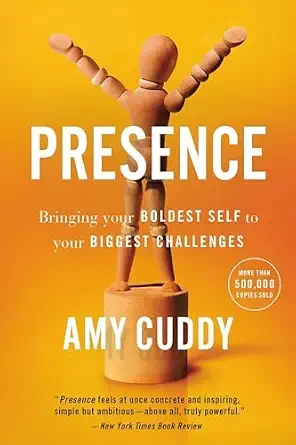
The 60-Second Take
In Presence, Amy Cuddy explores how people can bring their real abilities into moments that provoke self-doubt. The book connects authenticity, personal power, imposter feelings, self-affirmation, and small behavioral changes with a practical question: how can you engage with the situation instead of becoming absorbed in how you are being judged? Its famous power-posing material requires caution because the original hormone and risk-taking claims did not hold up in a major replication. Read with that distinction, the broader book offers an accessible way to think about preparation, belonging, and expressing yourself under pressure without promising a quick transformation.
You Can Be Nervous and Still Show Up Fully
You prepared for the meeting, but once it begins your attention splits. One part listens to the question. Another reviews your last answer, wonders how your expression looks, and predicts what the other person thinks of you. The knowledge is there, yet you struggle to use it.
Amy Cuddy's Presence examines how people can reconnect with their abilities in such moments. Her account brings together personal stories, psychological research, and practices for engaging more fully with a challenge. The book is often associated with power posing, but its larger subject is how to express yourself without letting fear of evaluation direct the entire interaction.
What You'll Learn
Bring your attention back to the conversation when self-doubt takes over.
Separate personal agency from authority over other people.
Compare imposter feelings with evidence of your actual abilities.
Prepare with meaningful values instead of exaggerated self-praise.
Distinguish power-posing claims from what later research supports.
What Presence Means
Cuddy describes presence as being connected with your genuine thoughts, feelings, values, and abilities and able to express them comfortably. The emphasis is on congruence: what you communicate is grounded in something you recognize as your own.
This differs from constructing an impressive character for the room. Trying to look endlessly confident can add another task to an already demanding situation. You monitor the performance of confidence while also attempting the actual work.
Presence allows more attention to move toward the conversation. You hear what is being asked, respond to what is relevant, and remain open to information that does not fit your prepared script.
Consider a hypothetical presenter who has memorized a polished answer to every anticipated question. When someone asks something unexpected, the presenter searches for the nearest script rather than understanding the concern. A more present response might begin by clarifying the question.
That is not a rejection of rehearsal. Familiarity with the material can free attention for listening. The problem arises when preparation becomes so rigid that any deviation feels like failure.
Personal Power and Imposter Feelings
Cuddy distinguishes personal power from authority over others. Personal power concerns a sense that you can act and bring your abilities to a situation. Someone with a senior title can lack that feeling, while someone with little formal authority can retain it.
The distinction matters because practical opportunities often begin before certainty arrives. If you wait until you feel unquestionably entitled to contribute, you may withhold a useful question or decline a role you are capable of learning.
Imposter feelings complicate this. Achievements can be interpreted as luck, while one mistake becomes evidence that you never belonged. The person keeps moving the standard for being legitimate beyond the evidence already available.
Cuddy's treatment draws emotional force from her own experience of rebuilding after a serious brain injury. Her personal story helps explain why belonging and self-doubt receive more than a passing mention.
For an application, imagine a capable employee entering a meeting with more experienced colleagues. They may not know everything, but they can still contribute the evidence from their own work. Acknowledging what they do not know is compatible with having something valuable to add.
Avoid turning this into a rule that anyone who doubts themselves must be highly competent. Feelings and ability need separate assessment. Some situations require more preparation, mentoring, or skill development, and confidence alone does not provide them.
The practical goal is to prevent a feeling of inadequacy from making every decision in advance. Compare the feeling with specific evidence, ask what preparation is needed, and identify the contribution you can responsibly make now.
Self-Affirmation
Self-affirmation in the book concerns reconnecting with genuinely held values. It is not simply repeating flattering claims about yourself or insisting that a difficult event will go well.
The underlying idea is to place one evaluation within a broader sense of who you are. An interview may assess your suitability for a role, but it cannot fully assess every relationship, commitment, and capacity that matters in your life.
As a practical application, choose a value and recall an occasion when you acted on it. If reliability matters to you, remember a commitment you honored. If curiosity matters, think of a time you changed your mind after learning something.
Specific examples are more useful than grand declarations. You are reminding yourself of something real rather than creating a persona that you must then defend.
This does not make the event irrelevant. A presentation can still affect a project, and an interview can still affect a career. The aim is to reduce the temptation to interpret the outcome as a complete judgment of your worth.
Nor does affirmation replace substantive preparation. You still need to understand the role, organize the evidence, or practice the explanation. Perspective helps you use that preparation with less defensive self-focus.
One workplace use is before receiving feedback. Reconnecting with a broader identity may make it easier to hear a specific correction without immediately treating it as a rejection of the whole person. The response can then be directed toward the work.
Small Self-Nudges
Cuddy favors modest changes over waiting for an entirely new personality. A self-nudge is a small adjustment that helps you enter or remain in a more useful state.
The practical attraction is that behavior can begin while confidence is still incomplete. You might slow your pace, notice how tightly you are holding yourself, or redirect attention toward the person speaking.
Small steps also make learning easier. If you change everything at once, it is hard to know what helped. Trying one adjustment across several comparable situations gives you more useful feedback.
The important outcome is participation. Did you ask the relevant question, listen more carefully, or recover after losing your place? A dramatic internal feeling is less necessary than a practical improvement in the interaction.
Post-event review should follow the same logic. Identify one action that worked and one adjustment for next time. Replaying every imperfect phrase can turn reflection into another episode of self-monitoring.
A manager can support this by making expectations clear and allowing people to prepare. Individual practices are easier to use in a setting where questions and reasonable uncertainty are accepted.
Small self-nudges should therefore sit alongside organizational responsibilities. People cannot be expected to solve exclusion, unpredictable demands, or a punitive culture merely by changing their posture or perspective. The book is most useful when its personal practices are applied within a realistic account of the setting.
Power Posing and the Evidence
The most famous recommendation associated with Presence is adopting an expansive posture before a challenging interaction. Cuddy's original research linked such poses with subjective feelings of power and also reported hormone and risk-taking effects.
A larger, blinded replication published in 2015 did not reproduce the hormone or risk-tolerance findings. The replication study. The distinction is essential: feeling more powerful, undergoing a physiological change, and performing better are different claims.
A 2022 meta-analysis found support for changes in self-reported feelings, but no physiological effects. Its behavioral findings were sensitive to publication bias, outliers, and possible demand effects. It also left open whether expansive or upright positions help, contracted or slumped positions hurt, or both. That is a much narrower conclusion than a reliable performance shortcut. The 2022 research review.
A reader can try a comfortable posture as a personal preparation practice without treating it as a scientifically guaranteed intervention. If it helps you feel less contracted, that experience may be useful to you. It is still a limited observation.
Context matters as well. Privately preparing yourself differs from adopting a dominant stance toward another person. An interaction benefits from responsiveness, and an exaggerated attempt to occupy space can interfere with that.
Presence Under Pressure at a Glance
Presence: Congruence between genuine abilities and what you can express.
Personal power: A sense of agency distinct from authority over others.
Self-affirmation: Reconnecting with lived values rather than exaggerated self-praise.
Self-nudge: A modest behavioral adjustment toward useful engagement.
Power-posing evidence: Subjective, physiological, and performance claims requiring separate evaluation.
A Quick Start Guide to Preparing for a Challenging Interaction
For your next challenging conversation:
Define a useful contribution. Decide what you need to explain, ask, or learn.
Prepare the substance. Rehearse the facts and explanations that need precision.
Recall a lived value. Choose a specific example of curiosity, reliability, care, or another value that matters to you.
Choose one small adjustment. Allow a pause, slow your pace, or turn your attention back to the speaker.
Review what you did. Record one useful contribution and one improvement for next time. Avoid grading your entire identity.
Who Should Read Presence (and Who Can Skip It)
Read it if self-monitoring interferes with your ability to contribute under pressure.
Read it if you want accessible ideas about authenticity and lived values.
Read it if you can read the posture discussion alongside later research.
Skip it if you want a proven posture shortcut to success.
Skip it if you need clinical treatment for anxiety rather than a general preparation book.
Final Reflections
Presence offers a humane response to a familiar problem: having abilities you struggle to access when you feel judged. Its most useful idea is that you can participate while nerves and uncertainty are still present.
The book's famous posture advice deserves more scrutiny than its enthusiastic presentation originally encouraged. Distinguishing subjective feelings from physiology and actual performance lets readers consider a preparation practice without accepting claims the evidence does not establish.
For a reader whose self-doubt crowds out listening or contribution, the broader message remains valuable. Prepare well, reconnect with something real about yourself, and give the people in front of you more attention than the imaginary audience evaluating your every move. You do not need to feel invulnerable to offer a thoughtful answer.
The Bottom Line
Prepare the substance, reconnect with a value you have lived, and give the conversation your attention. You can contribute without first eliminating every trace of doubt.
Frequently Asked Questions
How is presence different from performing confidence?
Presence concerns expressing the abilities and values you actually bring to the situation. A performance of certainty can consume attention while leaving the real task and your preparation untouched. Return to what you know, what you need to contribute, and what you can honestly acknowledge as uncertain.
Do you need to use power posing to apply the broader ideas in Presence?
The book also examines preparation, self-affirmation, personal agency, and small changes in how you engage with a difficult situation. Those ideas can be considered separately from the disputed claims about particular poses. Evaluate a practice by what it helps you do, without treating a momentary feeling as proof of improved performance.
Business Floss is reader-supported. When you use our links we may earn an affiliate commission that helps us keep the site running. Thank you for your support!