
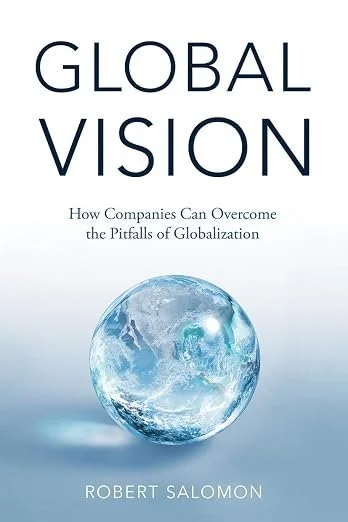
Global Vision
How Companies Can Overcome the Pitfalls of Globalization
by Robert Salomon
The 60-Second Take
In Global Vision, NYU Stern professor Robert Salomon dismantles the myth that the modern business world is flat and borderless. He introduces the concept of Institutional Distance, demonstrating how political, economic, and cultural differences create a dangerous "liability of foreignness" for expanding companies. By teaching leaders to mathematically price global risk, the book provides a rigorous toolkit for avoiding the costly pitfalls of international expansion.
The Myth of the Flat World
For the last two decades, business leaders have been sold a highly optimistic story about international expansion. Driven by the rise of high-speed internet, streamlined supply chains, and frictionless communication tools, the prevailing narrative insisted that the globe had become one massive, homogeneous marketplace. If your business model worked in Chicago, the logic suggested, it should seamlessly scale to Shanghai, Berlin, or São Paulo with just a few minor adjustments.
In Global Vision: How Companies Can Overcome the Pitfalls of Globalization, NYU Stern professor Robert Salomon aggressively challenges this narrative. He points out that the corporate graveyard is packed with incredibly sophisticated, well-capitalized companies that failed spectacularly abroad because they bought into this hype. Salomon replaces the blind optimism of globalization with a cold, mechanical framework for risk assessment. He argues that borders still matter immensely, and the difference in national institutions is the primary reason global expansions bleed cash. This summary breaks down how to stop underestimating global risk and start accurately pricing the complexities of operating outside your native market.
What You'll Learn
The danger of assuming the world is a single homogeneous market
The concept of Institutional Distance and how to measure it
The three distinct pillars of risk: political, economic, and cultural
How the "liability of foreignness" puts expanding companies at an immediate disadvantage
A practical method for mathematically pricing international risk into your financial forecasts
The "Globaloney" and the Liability of Foreignness
Salomon uses the term "Globaloney" to describe the dangerous, oversimplified hype that surrounds international business. It is incredibly easy for an executive sitting in a domestic headquarters to assume that consumers everywhere share the same baseline desires and operational environments. However, entering a foreign market introduces a structural disadvantage known as the liability of foreignness.
When you expand into a new country, you are fighting against local incumbents who possess a native understanding of the market. They already have established supply chains, government relationships, and deep cultural alignment with the consumer base. As a foreign entrant, you are operating with an information deficit. You have to learn the unwritten rules of business in that region from scratch.
To illustrate this, business history provides countless examples of retail giants stumbling. When major global brands attempted to conquer foreign territories, they assumed their massive economies of scale and operational brilliance would guarantee success. Instead, they ran into fierce cultural resistance, misunderstood local supply chain logistics, and completely misread consumer preferences. They failed because they underestimated the friction of operating in a market that simply did not share their native context.
The Core Framework: Institutional Distance
The heart of Salomon’s thesis is the concept of "Institutional Distance". The ease or difficulty of doing business in a foreign country is not determined solely by that country's local norms; it is determined by the gap between the target country's norms and the norms you are accustomed to in your home country. The wider this gap, the higher the risk of the expansion.
Salomon argues that leaders must systematically evaluate this distance before committing capital. He breaks Institutional Distance down into three distinct dimensions: political, economic, and cultural.
Political Distance
Political distance measures the variance in government structures, legal frameworks, and regulatory environments. A company accustomed to a stable, transparent democracy with strong intellectual property protections will face massive political distance if it expands into an authoritarian state with arbitrary legal enforcement. Political risk includes sudden changes in tax law, the threat of asset expropriation, corruption, and the difficulty of enforcing basic vendor contracts. When regulatory environments differ wildly, the cost of compliance and the risk of sudden operational disruption skyrocket.
Economic Distance
Economic distance evaluates the macroeconomic differences between the home and host countries. This goes far beyond simply looking at a nation's gross domestic product. It encompasses currency volatility, the quality of physical infrastructure (roads, energy, and technology), and the availability of financial services. For example, a logistics company that relies on just-in-time delivery in a highly developed nation will face severe operational friction if it expands into a country where the transportation infrastructure is unreliable. Furthermore, massive fluctuations in currency exchange rates can instantly wipe out the profit margins of a supposedly successful foreign venture.
Cultural Distance
Cultural distance is often the most insidious because it is largely invisible until you violate it. It measures the differences in societal traditions, consumer behaviors, and workplace etiquette. Cultural norms dictate how employees expect to be managed, how consumers perceive marketing messages, and what constitutes a fair negotiation. If a company tries to import an aggressive sales strategy into a country that values collective harmony and consensus, the local workforce will reject the management style, and the expansion will collapse from the inside out.
Developing Global Acumen and Pricing the Risk
Recognizing Institutional Distance is only the first step. The true utility of Salomon’s framework is converting these qualitative observations into quantitative business decisions. He introduces the concept of "Global Acumen," which is the ability to accurately account for these institutional risks and price them into financial models.
Most companies use standard net present value models or return on investment calculations when evaluating a global expansion. However, they frequently use the same discount rate for a foreign project as they do for a domestic one. This is a catastrophic error. Because the Institutional Distance introduces significant friction and volatility, the expected cash flows from a foreign venture must be discounted at a much higher rate.
Salomon provides a framework for generating "risk spreads"—mathematical premiums added to the discount rate that accurately reflect the specific political, economic, and cultural distance of the target market. By mathematically quantifying the Institutional Distance, executives can see the true, risk-adjusted value of the opportunity. In many cases, once the appropriate risk premium is applied, a market that looked incredibly lucrative on paper suddenly reveals itself to be a losing proposition. This rigor prevents leaders from expanding just for the sake of planting flags on a map.
Global Vision at a Glance
Beware of a homogeneous world. Assuming that diverse international markets operate as one uniform landscape leads to expensive strategic failures.
The liability of foreignness. Expanding companies inherently face steep disadvantages compared to local incumbents who already understand the native context.
Institutional Distance. The risk of a global expansion is directly proportional to the gap between your home country's norms and the target country's norms.
The three pillars of risk. Distance must be evaluated across political, economic, and cultural dimensions.
Price the friction. You must apply a specific risk premium to your financial forecasts to mathematically account for the higher volatility of operating abroad.
A Quick Start Guide to Pricing Global Risk
Audit your native assumptions. Before looking outward, explicitly document the political, economic, and cultural realities that your current business model relies on to function smoothly.
Calculate the Institutional Distance. When evaluating a new country, map the specific differences between their legal system, infrastructure, and consumer behavior against your own native baseline.
Avoid the vanity expansion. Refuse to enter a market simply because it is large or because your competitors are doing it; require a clear, risk-adjusted financial justification.
Engage local expertise. Mitigate cultural and political distance by hiring experienced, indigenous leadership to navigate the unwritten rules of the local market.
Adjust your discount rate. Never use your domestic hurdle rate for an international project. Add a quantitative risk spread to your financial models to account for the liability of foreignness.
Who Should Read Global Vision (and Who Can Skip It)
Read it if you are an executive or board member evaluating international expansion opportunities and need a sober, mathematical framework to assess the true risks.
Read it if you are a manager overseeing an existing global portfolio and struggling to understand why operations in certain regions consistently underperform expectations.
Read it if you work in strategy, management consulting, or private equity, where accurately pricing international risk is critical to your investment thesis.
Skip it if you are a small business owner strictly focused on local or regional domestic growth without any international supply chain or sales aspirations.
Skip it if you are looking for specific tactical advice on setting up foreign tax entities or legal incorporation documents. This is a book about high-level strategic risk assessment, not localized legal compliance.
Final Reflections
Global Vision is a highly necessary corrective to the unbridled optimism that dominated business literature over the last few decades. Robert Salomon successfully translates the abstract complexities of international relations into a structured, pragmatic tool for corporate executives. The book’s greatest strength is its insistence on quantifying the qualitative. By forcing leaders to view cultural and political differences not just as interesting societal quirks, but as tangible financial liabilities, Salomon protects organizations from their own blind spots. While the process of calculating precise risk spreads requires deep research and rigorous honesty, it is vastly cheaper than launching a doomed global initiative. It is an indispensable read for anyone responsible for steering capital across international borders.
The Bottom Line
Global expansion is incredibly dangerous if you underestimate the massive political, economic, and cultural gaps between countries; success requires calculating that "Institutional Distance" and actively pricing the risk into your financial strategy.
Frequently Asked Questions
What is the main idea of Global Vision?
The main idea is that the concept of a borderless, homogeneous world is a dangerous myth for businesses. Expanding internationally carries severe, hidden risks based on the institutional differences between countries. Companies must accurately measure and mathematically price these risks to avoid devastating financial losses.
What is Institutional Distance?
Institutional Distance is a framework used to measure the gap between the norms of a company's home country and those of a target foreign market. It evaluates the specific differences across three primary dimensions: political systems, economic structures, and cultural behaviors.
Why do companies fail when expanding globally?
Companies often fail because they suffer from the "liability of foreignness" and underestimate the cost of adapting to a new environment. They assume their domestic operational advantages will automatically translate abroad, failing to recognize how differences in infrastructure, local regulations, and consumer habits actively work against them.
Business Floss is reader-supported. When you use our links we may earn an affiliate commission that helps us keep the site running. Thank you for your support!


