
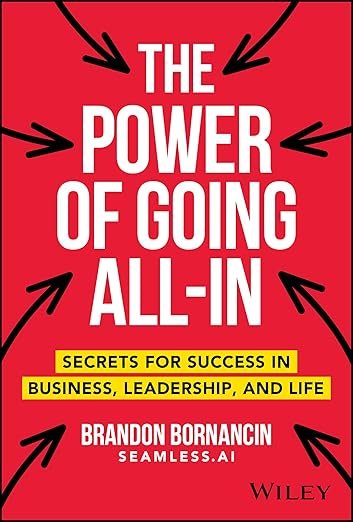
The Power of Going All-In
Secrets For Success In Business, Leadership, and Life
by Brandon Bornancin
The 60-Second Take
In The Power of Going All-In, serial entrepreneur Brandon Bornancin delivers a practical framework for unleashing your team's ultimate potential. Drawing on his experience building companies to over $150 million in sales, he argues that true leadership requires replacing micromanagement with extreme accountability and servant leadership. Master these principles to inspire top-tier performance, eliminate burnout, and consistently shatter goals.
The Era of the Armchair Dictator Is Over
Corporate leadership is broken. Far too many managers sit in their offices handing down directives and relying on their titles to generate authority. When their teams inevitably miss targets, these managers blame the employees for a lack of motivation. Brandon Bornancin views this dynamic as a catastrophic failure of leadership. Having built technology companies that reached over $150 million in sales and achieved billion-dollar valuations, he knows what it takes to actually scale an organization. In The Power of Going All-In, he argues that you cannot mandate high performance. You have to cultivate it through relentless, daily servant leadership.
Bornancin strips away the corporate jargon. He demands that executives stop acting like armchair dictators and start acting like coaches. The book is a highly practical toolkit for building a culture of extreme accountability and autonomy. It is designed for managers, entrepreneurs, and founders who want to stop babysitting their staff and start producing exceptional results.
What You'll Learn
The definition of the all-in mindset and why your job title means nothing.
How to eradicate micromanagement and build a culture of true independence.
Why you should cut your project timelines in half to drive aggressive growth.
The mechanics of immediate feedback and coaching employees through their weaknesses.
How to identify and immediately promote your top performers before they leave.
The All-In Mindset: Beyond the Title
Leadership is rarely about the letters behind your name or the fancy title on your office door. It is a specific mindset. Bornancin defines the all-in leader as someone who demonstrates absolute, unwavering commitment to excellence, growth, and accountability. You cannot expect your team to dedicate themselves to a project if you are treating your own role as a passive management gig. You have to embody the energy and the discipline you expect to see on the floor.
To get a team to go all-in, you have to give them a reason that transcends a paycheck. Bornancin emphasizes the absolute necessity of a bold, clear vision. A grand purpose unites a disparate group of employees. If the vision is vague or buried in a corporate handbook, it is useless. The vision must be universally understood by everyone from the executive suite to the front-line representatives, requiring an infinite commitment to realizing it.
Once the vision is clear, the all-in leader sets incredibly ambitious goals. Bornancin advocates for a specific tactic here: take your original schedule for a major project and cut it in half. Artificial constraints force innovation. When you set a tight schedule, you force the team to ruthlessly prioritize the tasks that actually generate value. You stop looking at market competitors with envy and instead emulate the absolute top performers, setting the expectation that your team will become just as good as them.
Eradicating Micromanagement and Building Trust
One of the fastest ways to destroy an all-in culture is through micromanagement. When you constantly monitor your employees and dictate their every move, you strip them of their autonomy. This leads directly to burnout and low morale. Bornancin insists that leaders must provide an effective alternative to these counter-productive strategies.
True independence means giving your staff the space to try new ideas, even if those action strategies result in failure. If an employee is terrified of being punished for a misstep, they will never take the creative risks required to scale a business. You have to build an environment where employees feel seen and understood. This level of psychological safety ensures that everyone enjoys productivity and respect.
Building this trust requires transparent communication. Bornancin challenges leaders to share top-level strategies and management decisions with the entire team, as long as there is no specific barrier preventing it. You should also develop the emotional intelligence to listen between the lines and hear the sub-text of what your team is saying. When an employee brings you a problem, your job is not to provide the answer. Your job is to help them analyze the situation, and then explicitly transfer the authority and responsibility back to them for the solution. This creates robust self-reliance.
The Coach, Not the Dictator
The core responsibility of an all-in leader is advancing the capabilities and performance of their employees. Everything starts with talent development. Bornancin frames the manager as a coach whose primary directive is to help their staff reach a level where they can independently change the world.
This begins by understanding what actually drives your people. You need to sit down with your employees and help them define their personal goals and share their vision of success. Once you know their individual passions, you can assist them in translating that energy into a passion for the company and its products. You also have to invest regularly in their training. This means actively identifying each employee's weaknesses and coaching them directly to deal with those flaws.
Feedback must be immediate. If you wait for an annual performance review to correct behavior, you have wasted a year of potential growth. Provide constructive feedback instantly, and educate your employees to become resilient to criticism. The goal is to advance an employee to the point where they can take on a task and complete it fully without pushing, reminders, or external assistance.
The Calculus of Talent and Retention
Building a world-class company starts at the front door. Bornancin highlights that going all-in requires extreme discipline during the recruitment process. Every single request to hire a new employee must be treated as a major investment. You must examine the precise positioning of the intended employee, the inherent advantages and disadvantages of the recruitment, and the explicit return on investment (ROI) that the new hire is expected to generate.
Founders and managers often treat interviewing as an informal conversation. Bornancin argues that leaders must systematically invest in learning how to interview and select suitable people efficiently. You are not looking for someone to just fill a desk; you are looking for an individual capable of adopting the all-in mindset.
Once you have secured this talent, your focus shifts to retention and elevation. You have to examine what your employees actually do, not just what they say during meetings. When you spot an outstanding employee who consistently over-delivers, you must aggressively secure their loyalty. Bornancin is clear on this point: promote your top performers immediately. The corporate temptation is always to delay or wait for a specific opportunity to open up. This hesitation is fatal, because exceptional talent may not stay until then. You have to create clear, tangible levers for advancement for every single role in the organization and continuously train middle managers to become future leaders.
Going All-In at a Glance
The All-In Mindset. Leadership is a mindset of full commitment to excellence and growth, not a fancy corporate title.
Bold Vision. Organizations require a grand purpose and a bold, perfectly clear vision to unite the team.
Artificial Constraints. Setting a tight schedule by halving the original timeline forces teams to prioritize and innovate.
Eradicate Micromanagement. Giving employees the independence to try new strategies and fail builds crucial psychological safety.
Immediate Feedback. Managers must identify weaknesses quickly, provide instant feedback, and coach employees through their flaws.
Promote Instantly. Outstanding employees must be identified and promoted immediately, avoiding the temptation to delay.
A Quick Start Guide to Servant Leadership
Define a bold vision. Establish a grand purpose that is clear and understandable to everyone, demanding infinite commitment.
Cut timelines in half. Look at your next major project and intentionally cut the estimated schedule in half to drive ambitious execution.
Transfer the authority. When a team member brings you a problem, help them analyze it but explicitly transfer the responsibility for the solution back to them.
Coach through weaknesses. Do not ignore an employee's flaws; actively identify them and provide real-time coaching to build their resilience to criticism.
Evaluate hiring ROI. Before approving any recruitment request, strictly examine the positioning, the disadvantages, and the expected return on investment for that specific role.
Who Should Read The Power of Going All-In (and Who Can Skip It)
Read it if you are a founder or executive looking for effective strategies to inspire your people to achieve more and unleash your team's full potential.
Read it if you want a practical toolkit to eliminate counter-productive habits like micromanagement and employee burnout.
Read it if you are a newly promoted manager searching for a daily mentor to guide you through building a high-performance culture with straightforward, actionable advice.
Skip it if you are looking for highly technical financial modeling or academic management theories. The book is straightforward, transparent, and focused on behavioral leadership.
Skip it if you prefer a hands-off, passive approach to management. This framework requires intense, daily engagement and a deep commitment to coaching your direct reports.
Final Reflections
The Power of Going All-In serves as a highly digestible, powerful reality check for modern executives. Brandon Bornancin succeeds in translating his massive entrepreneurial success into a clear, actionable roadmap for anyone responsible for the performance of others. The book’s greatest strength lies in its transparency and its refusal to sugarcoat the grueling realities of business. By focusing relentlessly on servant leadership and extreme accountability, Bornancin provides an essential text that helps leaders step away from their egos and focus entirely on advancing their employees. For professionals willing to abandon the safety of micromanagement and truly trust their teams, this framework offers a definitive path to legendary leadership.
The Bottom Line
To build a world-class company, leaders must abandon micromanagement and adopt an all-in mindset that prioritizes extreme autonomy, immediate feedback, and the relentless advancement of their employees.
Frequently Asked Questions
What is the main idea of The Power of Going All-In?
The main idea is that exceptional business results are driven by a leadership mindset of full commitment to excellence and growth. The book argues against micromanagement, instead advocating for a servant leadership framework where managers actively coach their teams, grant them independence, and quickly promote outstanding performers.
What does it mean to be an "all-in" leader?
According to the author, being an all-in leader is a mindset and a set of actions pursued in both work and life to achieve excellence. It means moving beyond fancy titles and taking personal responsibility for helping employees reach their highest potential.
How does the book suggest handling project deadlines?
Bornancin recommends setting incredibly tight schedules for achieving goals. Specifically, he suggests looking at the original estimate for a project and cutting that timeline in half to force the team to prioritize and execute ambitiously.
Business Floss is reader-supported. When you use our links we may earn an affiliate commission that helps us keep the site running. Thank you for your support!


