
Mind Mapping
Improve Memory, Concentration, Communication, Organization, Creativity, and Time Management
by Kam Knight
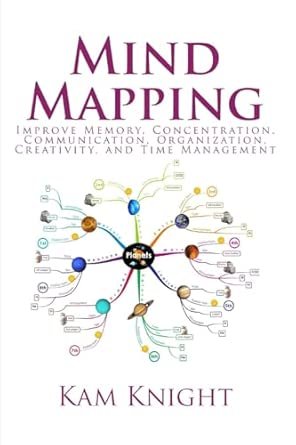
The 60-Second Take
In Mind Mapping, Kam Knight explains how translating thoughts into visual diagrams drastically improves memory, focus, and productivity. Because the human brain processes information through associative networks rather than straight lines, traditional linear note-taking is inherently inefficient. By mastering central concepts, radiating branches, and visual hierarchies, professionals can organize complex projects, solve stubborn problems, and retain information significantly faster.
Why Linear Notes Are Failing Your Brain
If you attend a typical corporate meeting, you will see a room full of people typing bulleted lists into a document. This is how we are taught to capture information: start at the top, write a line, hit return, and write the next line. In Mind Mapping, Kam Knight argues that this hierarchical, linear method of recording data is entirely unnatural. Our brains do not work like typewriters. They work like webs.
Knight is an expert in rapid learning and memory, and his book serves as a highly practical manual for changing how you process the world. He explains that human memory relies on association. Every new piece of information we encounter is instantly linked to existing knowledge, radiating outward in multiple directions simultaneously. When we force these multi-directional thoughts into a straight, rigid list, we strip away the context that actually makes the ideas memorable. By replacing standard notes with visual diagrams, professionals can rapidly organize chaotic projects, generate better ideas, and remember what they learn.
What You'll Learn
The biological reason why traditional bulleted lists hinder memory retention
How to construct a foundational mind map using central concepts and subtopics
The difference between a standard mind map, a concept map, and a flow chart
How to use visual branching for brainstorming and strategic planning
Practical applications for using mind maps in everyday business environments
The Science of Associative Thinking
To understand why visual diagrams are so effective, you have to understand how the brain handles data. Knight points out that when you think of a word like "apple," your brain does not just see the letters A-P-P-L-E. It instantly recalls the color red, the crunching sound, the taste of cider, the brand of a computer, and a memory of a specific orchard. This is associative thinking. One core node sparks dozens of connected branches.
Traditional note-taking restricts this natural flow. If you have an idea that connects back to something you wrote three pages ago, a linear document makes it incredibly difficult to illustrate that relationship. You end up with isolated facts stacked on top of one another.
Mind mapping solves this by mirroring the brain's associative biology. Because you start in the center of a blank page and radiate outward, you are never constrained by margins or line breaks. You can draw a line connecting a subtopic on the far left directly to a detail on the far right. This structural freedom allows you to capture the relationships between ideas, rather than just capturing the ideas themselves. When you understand how concepts relate, your comprehension and retention naturally increase.
The Mechanics of a Mind Map
Building a mind map is straightforward, but it requires breaking old habits. You always begin by writing the main topic or core concept directly in the center of the page. From that central hub, you draw thick lines outward to represent your primary subtopics.
From those subtopics, you draw thinner branches for finer details, examples, and elaborations. Knight emphasizes the importance of brevity during this process. You should not write full sentences on the branches. You use single keywords or incredibly short phrases. This forced brevity strips away filler words and makes you distill the information down to its absolute essence.
Furthermore, Knight heavily advocates for incorporating visual elements. Engaging your sense of sight is critical for memory. Use different colors to represent different themes or categories. Draw small icons or shapes next to important keywords. People possess a remarkably high recognition accuracy for images, meaning that a quickly sketched star or arrow will trigger your memory much faster than a paragraph of dense text.
Beyond Basic Brainstorming
Many professionals mistakenly assume that visual diagrams are only useful for creative brainstorming sessions. While they are phenomenal for generating ideas without the judgment of linear structure, Knight demonstrates how they can be used across almost all business functions.
For example, mind maps are highly effective for planning complex projects. You put the project goal in the center, branch out to major milestones, and then branch further into specific tasks, timelines, and responsible personnel. Because the entire project exists on a single visual plane, you can immediately spot bottlenecks or dependencies that would be buried in a twenty-page project brief.
They are also incredibly useful for writing. When drafting a report or presentation, starting with a mind map allows you to dump all your potential talking points onto the page at once. You can visually group related concepts, identify the strongest arguments, and structure your narrative before you ever try to write a complete sentence. This approach cures writer's block by separating the act of organizing from the act of drafting.
Concept Maps, Flow Charts, and Cognitive Maps
While the traditional mind map relies on a central hub, Knight also explores alternative visual frameworks for different types of thinking. He dedicates sections of the book to concept maps, flow charts, and cognitive maps.
A concept map is similar to a mind map but is structurally more complex. Instead of a single central hub radiating outward, concept maps often have multiple hubs that interconnect, forming a web of knowledge. The lines connecting the concepts usually feature action verbs explaining exactly how the two nodes relate (e.g., "leads to," "causes," "requires"). This makes them excellent for diagnosing problems or analyzing complex systems.
Flow charts are highly linear visual tools used specifically to document a process from start to finish, highlighting decision points and procedural steps. Cognitive maps are even more abstract, tracking the subjective relationships and emotional associations a person has with a particular space or idea. By understanding these variations, you can choose the exact visual tool required to solve the specific problem sitting on your desk.
Mind Mapping at a Glance
Associative over linear. The brain links information in sprawling networks, making visual branching a more natural way to think than top-to-bottom lists.
The central hub. Every map starts with a single core idea in the middle of a blank canvas, with subtopics radiating outward.
Thrive on brevity. Use single keywords on your branches rather than full sentences to rapidly summarize and distill information.
Use visual cues. Incorporating colors, varying branch widths, and drawing simple icons engages the visual cortex and drastically improves recall.
Flexible connections. Unlike rigid documents, diagrams allow you to easily draw relationships between entirely separate categories of thought.
Project planning. Visualizing a project on a single page allows you to see dependencies and missing steps instantly.
A Quick Start Guide to Visual Thinking
Start in the center. Take a blank piece of paper, turn it sideways (landscape), and write your primary goal, problem, or topic directly in the middle.
Branch out with subtopics. Draw three to five thick lines radiating from the center and write your main categories or themes along those lines.
Use single keywords. Force yourself to abandon sentences. Distill your supporting details down to one or two words and place them on thinner branches extending from your subtopics.
Color code your ideas. Grab a few different pens and assign a specific color to each main branch to create a clear, memorable visual hierarchy.
Draw connections. Look across the entire page and find details on different branches that relate to one another, then draw a line connecting them to highlight the relationship.
Who Should Read Mind Mapping (and Who Can Skip It)
Read it if you constantly feel overwhelmed by information overload and need a faster way to process and organize dense research.
Read it if you manage complex, multi-phase projects and find that traditional spreadsheets and text documents fail to capture the big picture.
Read it if you are a visual learner who struggles to remember details from lectures or meetings when taking standard linear notes.
Skip it if your daily work consists of highly predictable, repetitive tasks that do not require creative problem solving or project management.
Skip it if you are looking for advanced tutorials on specific digital mind-mapping software. The book touches on software, but it is primarily a methodology guide focused on the cognitive process itself.
Final Reflections
Mind Mapping is a highly effective, tactical guide to changing the way you process information. Kam Knight avoids burying the reader in dense neurological theory, opting instead to provide clear instructions and numerous visual examples. The book proves that visual thinking is not just an artistic exercise; it is a rigorous productivity tool. The only minor limitation is that the method takes practice. Adults have spent decades taking notes in a linear format, and switching to a radial, keyword-based system feels awkward at first. However, for professionals willing to push through that initial discomfort, the framework offers a massive return on investment, fundamentally upgrading the speed at which they can learn, plan, and create.
The Bottom Line
Traditional note-taking fights against your brain's natural biology, so you must use visual, branching diagrams to accurately capture the associative relationships between ideas and drastically improve your memory and organization.
Frequently Asked Questions
What is the main idea of Mind Mapping?
The main idea is that the human brain processes information through associative, non-linear networks. By using visual diagrams—starting with a central idea and branching outward—you can mirror this natural biological process to improve learning, creativity, and project organization.
Can I use mind mapping during a live meeting or lecture?
Yes, but it requires practice. Taking visual notes during a live presentation can be challenging because you do not know the full structure of the talk in advance. The author suggests starting with a central topic and adding branches as the speaker introduces new themes, though it is often easiest to refine the map after the meeting concludes.
What is the difference between a mind map and a concept map?
A mind map usually has a single central topic with subtopics radiating outward in a hierarchical structure. A concept map is more complex; it can have multiple central hubs connected by lines that explicitly state the relationship between the nodes (e.g., using verbs to describe how one concept affects another).
Business Floss is reader-supported. When you use our links we may earn an affiliate commission that helps us keep the site running. Thank you for your support!


