
What I Learned About Investing From Darwin
by Pulak Prasad
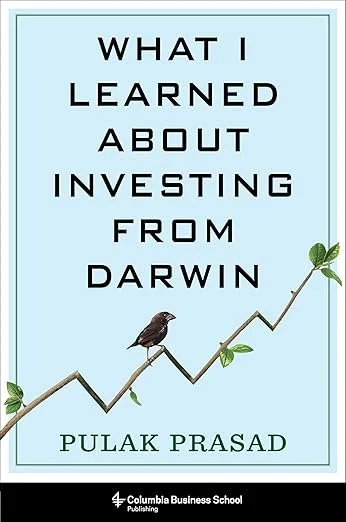
The 60-Second Take
In What I Learned About Investing from Darwin, Pulak Prasad bridges evolutionary biology and finance to create a radical blueprint for long-term investing. Drawing on the success of his firm, Nalanda Capital, Prasad explains why avoiding catastrophic mistakes matters more than catching every trend, how to select companies with robust historical traits, and why the ultimate strategy for wealth creation is to buy exceptional businesses and simply never sell them.
Survival of the Most Patient
Wall Street operates on a culture of frenetic activity. Analysts build highly complex predictive models, fund managers trade stocks on a daily or hourly basis to capture fractional gains, and executives are judged relentlessly on their quarterly earnings. The entire financial ecosystem is obsessed with predicting the future and moving as quickly as possible. Pulak Prasad thinks this is a foolish way to manage money. As the founder of Nalanda Capital—one of the most successful private equity firms operating in the public markets—Prasad ignores the noise of Wall Street and turns instead to the slow, unyielding laws of nature.
In What I Learned About Investing from Darwin, Prasad argues that the most effective framework for building long-term wealth is evolutionary biology. The principles that Charles Darwin observed in the natural world map perfectly onto the corporate world. Evolution is not about rapid, overnight success; it is a slow process of compounding small advantages over vast stretches of time, where survival is prioritized above all else. Prasad provides a highly contrarian, deeply practical guide to investing that demands intense rigor in selecting businesses, followed by decades of absolute lethargy.
What You'll Learn
The biological difference between a fatal error and a missed opportunity
Why focusing on a single financial trait naturally filters for excellent management
The concept of convergent evolution and how it applies to business models
Why financial forecasting is a flawed science that should be ignored
The psychological mechanics of why holding a stock forever is incredibly difficult
The First Rule of Biology Is Avoiding Extinction
In both nature and finance, survival is the prerequisite for success. Prasad structures his investment philosophy around the strict avoidance of what statisticians call a Type I error. A Type I error is a false positive—in investing, this means buying a stock that turns out to be a disaster. A Type II error is a false negative, which means passing on a stock that eventually becomes a massive winner.
The financial industry spends an enormous amount of energy worrying about Type II errors. Investors are terrified of missing out on the next Apple or Amazon. Prasad argues that this fear is irrational. Missing out on a great stock does not harm your portfolio; your capital remains perfectly intact. However, committing a Type I error—investing heavily in a company that goes bankrupt or suffers severe permanent losses—can completely destroy your returns. In the wild, animals operate with this exact asymmetry. A rabbit that runs away from a harmless rustling bush (a Type II error) loses a few calories. A rabbit that ignores a rustling bush that hides a fox (a Type I error) is eaten.
To survive, you must structure your investment process around brutal rejection. Nalanda Capital rejects the vast majority of companies they research. If a business carries high debt, operates in a highly regulated industry, or relies on unpredictable commodity prices, Prasad simply walks away. He does not try to figure out if the stock is cheap enough to justify the risk. By eliminating any company that carries even a minor risk of catastrophic failure, he drastically reduces the chance of portfolio extinction.
Selecting for the Right Traits
Once you have eliminated the companies that might kill your portfolio, you have to decide which of the surviving businesses to actually buy. Prasad relies on a biological phenomenon known as pleiotropy, where a single genetic trait influences multiple seemingly unrelated traits. He illustrates this with the famous Siberian fox experiment conducted by Russian geneticist Dmitry Belyaev. Belyaev bred wild foxes, selecting them based entirely on one single trait: tameness. Over several generations, the foxes became incredibly docile. But interestingly, they also developed floppy ears, curly tails, and spotted coats. Selecting for one specific behavioral trait accidentally triggered a host of favorable physical traits.
Prasad applies this directly to financial analysis. Instead of building massive, complicated spreadsheets with dozens of variables, he selects companies based primarily on one historical metric: consistently high Return on Capital Employed (ROCE) without the use of debt.
When a company proves it can generate high returns on its capital for a decade or more, that single metric acts like the tameness in the foxes. It signals a host of other fantastic traits that are difficult to measure directly. A consistently high ROCE indicates that the company likely has a durable competitive advantage, significant pricing power, and an excellent management team that allocates capital wisely. If management were poor or the product were weak, the ROCE would have eroded. By focusing intensely on this single historical metric, investors can cut through corporate marketing and identify genuinely robust organisms.
Ignore the Forecasts, Trust the Past
One of the most radical aspects of Prasad’s methodology is his absolute refusal to forecast the future. Wall Street values companies based on projected future cash flows, leading analysts to guess what a business will look like five or ten years from now. Biologists do not do this. An evolutionary biologist studies how an organism adapted to its environment in the past to understand its current fitness. Evolution is entirely backward-looking; it solves the problems of yesterday, not tomorrow.
Prasad treats businesses the same way. He argues that human beings are terrible at predicting the future. Markets shift, pandemics occur, and technologies emerge out of nowhere. Trying to model a company's revenue in year seven is an exercise in fiction. Instead, look at how the company behaved during the last three economic recessions. Did they survive? Did their ROCE remain relatively stable? Did management panic, or did they adapt? A company that has demonstrated a historical capacity to endure stress and maintain profitability is highly likely to adapt to whatever unknown crises the future holds. Historical resilience is a much safer bet than a beautiful spreadsheet of imagined future earnings.
The Power of Absolute Lethargy
The final and most difficult phase of Prasad’s strategy involves what happens after you buy the stock. His advice is simple: never sell.
In evolutionary biology, massive transformations take an incredibly long time. The slow compounding of tiny genetic advantages eventually produces staggering results, but only if left uninterrupted. The stock market operates on the same mathematical principle of compounding, but human psychology constantly interrupts it. Investors love to trim their winners to lock in profits, or sell a great company because they think the valuation has temporarily become too high.
Prasad views selling a high-quality business as a fundamental error. If you have done the rigorous work of finding a company with excellent management and high historical returns on capital, your job is done. Finding a truly great business is incredibly rare. When you find one, selling it forces you to go back out into the market and try to find another one, exposing yourself to the risk of a Type I error all over again. Nalanda Capital measures its holding periods in decades. They tolerate market crashes, temporary overvaluations, and economic stagnation without selling a single share of their core holdings. The ultimate edge in investing is not superior analytical intelligence; it is superior patience.
Evolutionary Investing at a Glance
Avoid extinction. Prioritize the avoidance of fatal investments (Type I errors) over the fear of missing out on explosive growth (Type II errors).
Look backward. Stop trying to predict the future. Assess a company based entirely on its historical ability to generate high returns during stressful periods.
The tameness trait. Consistently high Return on Capital Employed (ROCE) is the single financial metric that indicates a host of other excellent, hard-to-measure corporate traits.
Reject aggressively. Build a rigorous filtering system that automatically eliminates businesses with high debt, poor management, or unpredictable economics.
Never sell. The mathematical power of compounding only works if you leave it alone. Selling great companies to lock in a profit interrupts the most powerful force in finance.
A Quick Start Guide to Investing Like a Biologist
Define your strict filters. Write down a list of absolute dealbreakers for any investment (e.g., high debt, highly regulated industries) and automatically reject any stock that hits them, regardless of the hype.
Review the past decade. Before buying a stock, look at its financial performance over the last ten to fifteen years. Ensure the company has maintained a stable, high ROCE through at least one major economic downturn.
Ignore the financial news. Stop reading daily stock market predictions or analyst price targets. They are attempting to forecast the future, which is mathematically impossible and a distraction from historical facts.
Audit your trading frequency. Look at your portfolio turnover rate. If you are frequently buying and selling, you are treating investing like a casino rather than a biological compounding process.
Let your winners run. When a high-quality stock in your portfolio doubles or triples in value, resist the psychological urge to sell it just to secure a gain. Let the exceptional organisms continue to grow.
Who Should Read What I Learned About Investing from Darwin (and Who Can Skip It)
Read it if you are a long-term value investor who wants a rigorous, fascinating new mental model to reinforce the discipline of holding high-quality stocks.
Read it if you manage your own retirement portfolio and feel constantly anxious or tempted to trade based on the daily news cycle.
Read it if you are interested in the intersection of hard science, behavioral psychology, and economics.
Skip it if you are a day trader, options trader, or technical analyst looking for chart patterns. Prasad's methodology is the absolute antithesis of short-term trading.
Skip it if you are looking for early-stage venture capital advice. This framework relies heavily on decades of historical financial data, which startups simply do not possess.
Final Reflections
What I Learned About Investing from Darwin is a brilliant, highly original contribution to financial literature. By mapping Charles Darwin's theories onto modern capital markets, Pulak Prasad provides a refreshing escape from the standard, jargon-heavy finance books. The biological metaphors are not just clever narrative devices; they actually simplify complex economic principles, making the math of compounding and risk management deeply intuitive. The discipline Prasad demands—to aggressively reject almost everything and then hold the few survivors indefinitely—runs counter to human nature, making it incredibly difficult to execute in practice. However, for those who can stomach the boredom of absolute lethargy, the book offers a mathematically sound, highly resilient blueprint for generating generational wealth.
The Bottom Line
The secret to exceptional investing is treating your portfolio like a biological ecosystem: ruthlessly eliminate the risk of extinction, select organisms with proven historical resilience, and let the slow, uninterrupted math of compounding do the rest.
Frequently Asked Questions
What is the main idea of What I Learned About Investing from Darwin?
The main idea is that the rules of evolutionary biology provide the perfect framework for long-term investing. By prioritizing survival (avoiding bad companies), relying on historical adaptation rather than future forecasting, and allowing compounding to work over decades, investors can achieve exceptional returns with very low risk.
What are Type I and Type II errors in investing?
A Type I error is buying a bad business that permanently destroys your capital. A Type II error is missing out on buying a business that turns out to be highly successful. The author argues that you must focus almost entirely on avoiding Type I errors, because missing an opportunity does not hurt your portfolio, but buying a toxic asset can destroy it.
Why does the author focus so heavily on ROCE?
Return on Capital Employed (ROCE) is the metric Prasad uses to identify quality. He argues that consistently high historical ROCE (without high debt) acts as a proxy for excellent management, strong pricing power, and a durable competitive advantage. If a company lacks those traits, its ROCE will inevitably drop over time.
Business Floss is reader-supported. When you use our links we may earn an affiliate commission that helps us keep the site running. Thank you for your support!


