
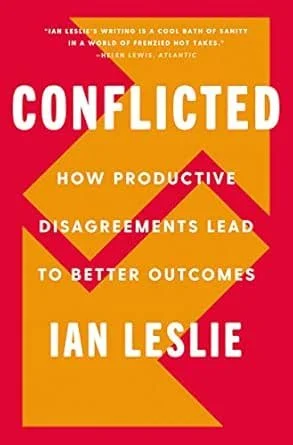
Conflicted
How Productive Disagreements Lead To Better Outcomes
by Ian Leslie
The 60-Second Take
In Conflicted, journalist Ian Leslie explores the lost art of productive disagreement. Drawing on insights from hostage negotiators, divorce mediators, and elite innovators, he reveals why healthy conflict is essential for progress. By learning to separate our egos from our ideas, letting go of the need to control others, and prioritizing connection over winning, we can transform destructive arguments into powerful engines for creativity and better decision-making.
Why Harmony Is the Enemy of Innovation
When a disagreement breaks out in a boardroom, you can usually feel the physical shift in the room. Heart rates spike. People shift uncomfortably in their chairs. The instinct is almost always to shut the conflict down immediately, smooth things over, and return to a state of polite consensus. We are socially conditioned to believe that a quiet, agreeable team is a highly functional team.
Ian Leslie thinks this is a profound mistake. In Conflicted: How Productive Disagreements Lead to Better Outcomes, he argues that human beings need friction to generate heat. A team that never argues is a team that never truly tests its own assumptions. The problem is not that we argue too much; the problem is that we are exceptionally bad at it. We either avoid conflict entirely to protect our relationships, or we engage in toxic, ego-driven battles to destroy our opponents. Leslie provides a much-needed manual for the middle ground. By studying people who manage high-stakes disputes for a living, he distills a framework for arguing well, ensuring that the inevitable friction of business leads to clarity rather than resentment.
What You'll Learn
The danger of artificial harmony and why groupthink destroys companies
The critical distinction between task conflict and relationship conflict
Why the Wright brothers' constant arguing was their greatest competitive advantage
How the "drop the bone" method bypasses a person's defensive reflexes
Why curiosity and surprise are your best tools for changing someone's mind
The Trap of Artificial Harmony
Humans are highly social creatures, and our evolutionary programming tells us that being excluded from the tribe is dangerous. This biological desire to belong is why we are so prone to conflict avoidance. We bite our tongues. We nod along with a manager's flawed strategy because pointing out the flaw feels like an act of aggression.
Leslie warns that this creates a culture of artificial harmony. On the surface, the company looks perfectly aligned. Everyone is polite. But underneath, resentment ferments and bad ideas move forward without proper stress testing. When a team prioritizes politeness over truth, they fall victim to groupthink. The desire for consensus overrides the realistic appraisal of alternatives.
To build a high-performing organization, leaders have to explicitly change this social contract. You have to normalize disagreement. People must understand that challenging an idea is not an act of disloyalty; it is a requirement of the job. If your meetings consist entirely of people agreeing with you, your team is not actually adding value. They are just echoing your blind spots.
Task Conflict Versus Relationship Conflict
If conflict is necessary, why does it so frequently end in disaster? Leslie relies on organizational psychology to explain the difference between two very different types of friction.
Task conflict is an argument about the work. It is a debate over a marketing strategy, a software bug, or a financial projection. Relationship conflict is an argument about the people. It involves ego, disrespect, and personal animosity. Task conflict is incredibly healthy and drives innovation. Relationship conflict is toxic and destroys teams.
The danger is that task conflict can instantly mutate into relationship conflict if you are not careful. When you criticize a colleague's idea, their brain often interprets it as a criticism of their intelligence. To prevent this mutation, you must establish a foundation of deep, unconditional respect before the argument ever begins.
Leslie uses the Wright brothers as the ultimate example of this dynamic. Wilbur and Orville argued constantly. They would yell at each other for hours over the aerodynamics of their flying machine. Yet, their arguments never became toxic. They possessed absolute mutual respect, which allowed them to attack each other's ideas mercilessly without ever attacking each other's character. They recognized that the argument was not a battle for dominance; it was a collaborative attempt to solve a puzzle. When you detach a person's ego from the problem at hand, you free them to actually think clearly.
Drop the Bone and Connect First
When we want to change someone's mind, our default strategy is to overwhelm them with facts. We build a logical argument, present our data, and expect the other person to immediately concede. When they refuse, we push harder. Leslie draws on the expertise of hostage negotiators and police interrogators to show why this approach almost always fails.
Human beings have an intense, innate need for autonomy. When you push facts onto someone and tell them they are wrong, their brain perceives a threat to their independence. They raise their shields and push back. Leslie compares this to a dog with a bone. If you grab the bone and pull, the dog will clamp down harder. The only way to get the dog to drop the bone is to stop pulling.
In an argument, letting go of the bone means releasing your need to control the other person. You have to signal that you respect their autonomy and that you are not trying to force them into submission. Before you introduce a single fact, you must establish a human connection. Hostage negotiators do this by employing intense active listening. They summarize the hostage taker's grievances without judgment, validating their emotional state. Once a person feels heard and realizes their autonomy is not under attack, their defensive barriers lower. Only then can rational persuasion begin.
Break the Script and Stay Curious
Arguments usually follow a highly predictable script. One person attacks, the other defends, and then counter-attacks. Both parties fall into familiar, polarized roles, and the conversation goes in circles. If you want to make an argument productive, you have to intentionally break the script.
Leslie advises doing this by "being weird." Introduce an element into the conversation that the other person does not expect. This could mean actively acknowledging a valid point they just made, admitting that you are unsure about one of your own assumptions, or simply lowering the volume of your voice. When you behave unpredictably, you force the other person to pause their automatic defensive routine and actually pay attention to the present moment.
The most effective way to break the script is to replace statements with genuine curiosity. When we are arguing, we tend to make broad declarations. Instead, ask the other person to explain the mechanics of their belief. Ask "how" instead of "why." When people are forced to patiently explain how their proposed solution would actually work step-by-step, they often recognize the gaps in their own logic without you ever having to point them out. Curiosity diffuses anger. It transforms a confrontational standoff into an exploratory conversation.
Conflicted at a Glance
Artificial harmony. Politeness is often cowardice in disguise; avoiding conflict to keep the peace allows terrible ideas to survive.
Task vs. relationship conflict. Healthy teams fight aggressively about the problem (task), but they never let it become a fight about the person (relationship).
The autonomy threat. Pushing facts aggressively makes people dig in their heels because they feel their intellectual independence is being attacked.
First connect. You cannot logically persuade someone until you have made them feel completely heard and respected.
Drop the bone. Stop trying to force the other person to concede. When you stop pulling, they will naturally lower their defenses.
Break the script. Defuse repetitive arguments by acting unexpectedly—admit you might be wrong or ask a genuine, curious question to reset the dynamic.
A Quick Start Guide to Productive Disagreement
Establish the rules of engagement. Before a high-stakes project begins, explicitly agree as a team that challenging ideas is required and that no critique is personal.
Validate before you counter. When someone presents a point you disagree with, summarize their point back to them perfectly to prove you are actually listening before you state your case.
Ask "how" questions. Instead of telling a colleague their plan will fail, ask them to walk you through exactly how they envision the plan functioning in reality.
Monitor the mutation. Pay close attention to the tone of the room. If a debate over a strategy begins to feel tense or personal, pause the meeting and re-establish mutual respect.
Surrender the need to win. Approach the disagreement as a shared puzzle that you are both trying to solve, rather than a debate tournament where one of you has to lose.
Who Should Read Conflicted (and Who Can Skip It)
Read it if you lead a team that suffers from groupthink, where everyone constantly agrees with you and rarely offers dissenting opinions.
Read it if you are naturally conflict-averse and tend to stay quiet during important meetings to avoid rocking the boat.
Read it if you are highly aggressive in debates and often succeed in winning the argument but fail to notice that you are damaging your professional relationships in the process.
Skip it if you are looking for specific, mathematically driven negotiation tactics for closing vendor contracts or real estate deals.
Skip it if you prefer dense academic texts. This book relies heavily on psychological anecdotes and storytelling rather than hard corporate data models.
Final Reflections
Conflicted provides a desperately needed reframe for how we view friction in the workplace. Ian Leslie successfully demystifies the mechanics of a good argument, proving that conflict itself is entirely neutral. The outcome depends solely on how the participants manage their egos. By drawing on the extreme examples of interrogators and hostage negotiators, he highlights a universal truth of human psychology: people will not listen to your logic until you validate their humanity. The book is an essential read for anyone who wants to stop dreading difficult conversations. It proves that when handled with curiosity, respect, and a willingness to let go of control, a disagreement is the fastest route to mutual understanding and breakthrough innovation.
The Bottom Line
To build stronger teams and solve complex problems, you must stop treating disagreements as personal battles to be won and start treating them as collaborative puzzles to be solved.
Frequently Asked Questions
What is the main idea of Conflicted?
The main idea is that our modern tendency to avoid conflict is destroying our ability to innovate and connect. By learning the rules of productive disagreement—separating our egos from the task, prioritizing curiosity, and making others feel heard—we can use healthy arguments to drive better decisions.
What is the difference between task and relationship conflict?
Task conflict focuses purely on the work or the problem at hand, which drives innovation. Relationship conflict focuses on personalities, ego, and disrespect, which destroys trust. The goal is to encourage robust task conflict while absolutely preventing it from mutating into relationship conflict.
How do you keep an argument productive?
You keep an argument productive by making the other person feel heard before you introduce contradictory facts. You must respect their autonomy, ask curious questions instead of making aggressive statements, and consciously break the repetitive script of attack-and-defend by showing vulnerability.
Business Floss is reader-supported. When you use our links we may earn an affiliate commission that helps us keep the site running. Thank you for your support!


