
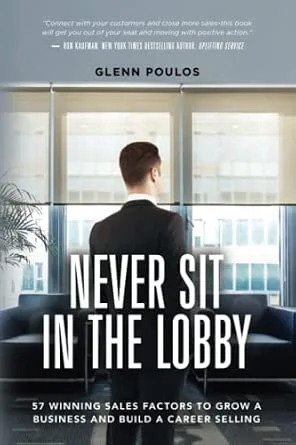
Never Sit in the Lobby
57 Winning Sales Factors to Grow a Business and Build a Career Selling
by Glenn Poulos
The 60-Second Take
In Never Sit in the Lobby, veteran executive Glenn Poulos distills three decades of frontline experience into fifty-seven practical rules for sales success. He abandons theoretical dogma in favor of gritty, real-world tactics. By mastering physical presence, ruthless time management, and the art of the perfect pitch, professionals can avoid costly interpersonal mistakes, command respect, and consistently close more high-value deals.
Stop Casting Pearls Before Uninterested Prospects
Sales training is heavily saturated with idealistic dogma. Managers tell new recruits that the customer is always right. They insist that every email requires an immediate response, every prospect deserves a free lunch, and persistence eventually wins every account. After three decades in the trenches, Glenn Poulos realized that these theoretical best practices were actually exhausting his teams and actively killing their closing rates. In Never Sit in the Lobby, Poulos dismantles the polite fiction of corporate sales.
He argues that exceptional selling is rarely about executing a flawless, cinematic presentation. It is usually about avoiding the dozens of subtle, interpersonal mistakes that destroy your credibility before the pitch even begins. Through fifty-seven highly specific "winning sales factors," Poulos provides a gritty, street-level manual for modern professionals. The book focuses intensely on physical posture, protecting your calendar, and identifying which clients actually warrant your energy. This summary covers the core mechanics of his approach, showing you how to command respect and close deals without sacrificing your dignity or your schedule.
What You'll Learn
Why your physical posture in a waiting room dictates the entire dynamic of a meeting
How to use a "mini-tour" to gather critical competitive intelligence
The mechanics of the "Punch Perfect Pitch" and the rule of three
Why treating every prospect equally is a massive waste of your time
How to apply "greed-based learning" to master product knowledge
The Literal Lobby and the Posture of Readiness
The title of the book stems from a very specific, physical rule that governs how Poulos approaches client interactions. When you arrive at a prospect's office and check in with the receptionist, the natural instinct is to find the most comfortable leather chair, sit down, and start scrolling through your phone. Poulos views this as a fatal tactical error. When you sit, you immediately adopt a subordinate posture. When the decision-maker eventually walks in, you are caught off guard. You have to awkwardly put your phone away, scramble out of a deep chair, and gather your belongings just to shake their hand.
Instead, you must stand. You should position yourself near the door or the hallway where the client is most likely to enter. You must be attentive, completely off your devices, and physically ready. When the client walks through the door, you greet them at eye level. This establishes an immediate dynamic of mutual respect and professionalism. You are signaling that you value their time and that you are entirely focused on the present moment.
This state of readiness extends to what you carry. Poulos insists that you must never walk into a client's building empty-handed. You should always have something tangible in your hand and a specific question in your mind. The physical item could be the specific price quote they requested, a new product sample, or even a box of pastries for the staff. The mental item is a premeditated icebreaker designed to bypass awkward small talk. Arming yourself physically and mentally ensures that the transition from the lobby to the boardroom is completely seamless. It prevents stilted conversation and immediately positions you as a prepared expert who is there to deliver value.
Getting Behind the Veil: The Mini-Tour
Most salespeople treat the client's lobby and the assigned meeting room as the only acceptable spaces to exist. They walk in, deliver their presentation, and walk out. Poulos teaches his teams to actively break this boundary by asking for a "mini-tour". Before settling into a conference room, you simply ask the client if you can take a quick look at their new warehouse, their engineering lab, or their production floor.
People love to show off their facilities, and they will almost always agree. This strategy provides massive advantages. The lobby is a heavily curated, sterile environment designed for public consumption. The production floor is where the actual reality of the business happens. Getting behind the veil allows you to observe exactly how your products, or your competitors' products, are currently being used.
During the tour, you can spot inefficiencies that your prospect never thought to mention. You might notice pallets of a competitor's product sitting unused, signaling a point of friction you can exploit. You might also spot completely unrelated departments that could benefit from other services your company offers. A brief walk through a warehouse provides infinitely more actionable intelligence than an hour of polite conversation across a boardroom table. It also humanizes the interaction, moving you from the role of a vendor giving a formal pitch to a collaborative partner exploring their operational reality.
The Punch Perfect Pitch and Winning Sales Presence
When it is finally time to present your solution, Poulos warns against starting with a slow, rambling introduction. He utilizes a framework called the "Punch Perfect Pitch and Close". The absolute most critical moment of a presentation is the opening seconds. You have to start with a "punch" or a "bang". This is a highly calculated hook that immediately positions you as a messenger of good news. You do not open by reciting your company's corporate history. You open by directly addressing the client's most urgent problem and confidently stating that you have the solution.
Once you have hooked their attention, you must deploy what Poulos calls a Winning Sales Presence (WSP). This involves active listening, confident body language, and mastering the subtleties of rapport. It is the ability to read the room and adjust your energy to match the client's state. When explaining the actual product, Poulos relies on the rule of three. Breaking down features and benefits into three distinct points is optimal for human retention. Two points feel insubstantial, and four points overwhelm the listener.
If the pitch is delivered effectively, the transition to the close should be completely organic. A successful presentation naturally prompts the client to start asking logistical questions. They will ask about pricing, delivery schedules, or trial periods. Poulos notes that if the client is not asking these buying questions by the end of your pitch, you have not actually convinced them. You must pause, step back, and re-engage their core pain points before attempting to force a close.
Ruthless Qualification and the 80/20 Flip
Perhaps the most contrarian advice in the book revolves around time management and customer qualification. Many organizations promote the idea that every lead is sacred. Poulos completely rejects this. He argues that salespeople exhaust themselves by treating low-probability prospects with the same reverence as high-probability targets. If you are dealing with a massive corporation that is deeply entrenched with a competitor, and you know there is a 99 percent chance they will never switch vendors, you should not waste your afternoon buying them lunch.
You must separate the wheat from the chaff. Your time and energy are strictly finite resources. Poulos advises sales professionals to ruthlessly qualify their prospects early in the process. You have to stop casting pearls before swine. If a prospect is continually rude, unresponsive, or blatantly using you to get a cheaper quote from their current vendor, you must abandon the account and redirect your energy.
This requires a strategic application of the 80/20 rule. Instead of fighting a brutal, low-margin battle against massive corporations for the top 20 percent of elite enterprise clients, small and medium-sized businesses should flip the script. The bottom 20 percent of clients who are currently being ignored or underserved by massive corporate vendors can become the highly profitable 80 percent of your portfolio. By targeting the exact customers that the industry giants consider too small to care about, you face less resistance, build deeper loyalty, and close deals significantly faster.
Winning Sales Factors at a Glance
Never sit. Standing in the lobby prevents you from being caught distracted or in a physically subordinate position when the client enters.
Bring a prop and a prompt. Never show up empty-handed. Always carry a physical item and have a specific conversation starter ready to go.
Ask for the mini-tour. Get out of the conference room and walk the production floor to gather raw competitive intelligence.
The Punch Perfect Pitch. Start every presentation with an aggressive hook that directly addresses the client's most urgent pain point.
The Rule of Three. Always break your product demonstrations and key benefits into three distinct points to maximize memory retention.
Stop pleasing everyone. Ruthlessly protect your calendar by abandoning prospects who show a near-zero probability of converting.
A Quick Start Guide to Commanding the Room
Change your waiting habits. The next time you visit a client's office, do not look at your phone. Stand near the doorway, review your notes mentally, and prepare for a firm handshake.
Never email the proposal. If a client asks for a quote or literature, do not just send a PDF if they are within driving distance. Use the request as an excuse to hand-deliver the document and secure face time.
Draft your opening punch. Review your standard sales deck and delete the slide about your company's history. Replace it with a single, bold statement about the client's problem.
Group features in threes. Audit your product demonstrations. If you are listing a dozen different technical features, consolidate them into three clear, overarching benefits.
Fire a bad prospect. Look at your current pipeline and identify the one client who consumes the most energy while offering the lowest probability of a sale. Stop following up with them today.
Who Should Read Never Sit in the Lobby (and Who Can Skip It)
Read it if you are a B2B sales professional looking for gritty, practical tactics to gain an edge over aggressive competitors.
Read it if you manage a sales team and want a straightforward playbook to train junior reps on physical presence and boardroom dynamics.
Read it if you struggle with time management and find yourself exhausted by prospects who constantly demand attention but never actually buy.
Skip it if you are looking for highly technical advice on digital marketing, SEO, or automated inbound funnels. This book is focused intensely on interpersonal, face-to-face selling.
Skip it if you want academic theories on consumer psychology. Poulos provides street-level anecdotes and rules built from direct experience rather than clinical studies.
Final Reflections
Never Sit in the Lobby is a highly effective, deeply pragmatic book because it focuses on the unglamorous mechanics of selling. Glenn Poulos completely ignores the motivational fluff that pads most sales literature. Instead, he treats sales as a physical and tactical discipline. The advice to literally stand up, protect your time, and push for a tour of the client's facility are simple actions that yield disproportionate results. While some readers might find the direct, almost cutthroat approach to qualifying customers harsh, it is an essential corrective for professionals who are burning out trying to please everyone. The book serves as a fantastic reminder that success in business is rarely about a single stroke of genius; it is about consistently executing the small, interpersonal fundamentals that your competitors are too lazy to do.
The Bottom Line
Winning high-value deals requires you to abandon idealistic sales dogma and focus relentlessly on physical readiness, aggressive time management, and protecting your calendar from uninterested prospects.
Frequently Asked Questions
What is the main idea of Never Sit in the Lobby?
The main idea is that closing deals and building a successful sales career relies heavily on mastering interpersonal dynamics and avoiding subtle, fatal mistakes. Author Glenn Poulos provides 57 practical factors focused on physical presence, strict time management, and direct communication to help salespeople command respect and win more business.
Why does the author say you should never sit in the lobby?
Sitting in a lobby puts you in a relaxed, physically subordinate position, and usually leads to distraction (like checking your phone). By standing attentively, you are physically ready to greet the decision-maker at eye level the moment they walk in, immediately establishing mutual respect and professionalism.
What is a mini-tour?
A mini-tour is a tactical request made by a salesperson to briefly walk through a client's facility, such as their warehouse or production floor, before sitting in a conference room. It allows the seller to observe how operations actually run, spot competitors' products, and identify unstated problems they can solve.
Business Floss is reader-supported. When you use our links we may earn an affiliate commission that helps us keep the site running. Thank you for your support!


