
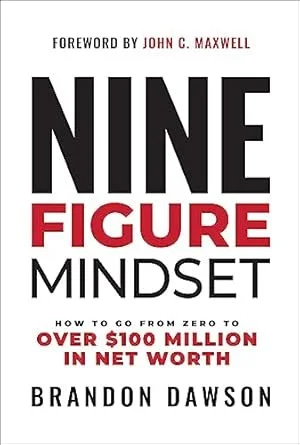
Nine-Figure Mindset
How to Go from Zero to Over $100 Million in Net Worth
by Brandon Dawson
The 60-Second Take
In Nine-Figure Mindset, entrepreneur Brandon Dawson maps the difficult psychological transition from exhausted business owner to elite enterprise leader. He argues that scaling past your current revenue ceiling requires abandoning the gritty, do-it-all approach that initially made you successful. By discarding limiting beliefs, building scalable systems, and obsessively developing human capital, founders can break through stagnation and build a deeply resilient, massively profitable organization.
Your Work Ethic Is the Bottleneck
The modern business landscape aggressively glorifies the hustle. Founders are taught that relentless effort, sleepless nights, and absolute control over every detail are the ultimate badges of honor. This philosophy works exceptionally well during the initial startup phase. Sheer willpower will frequently push a new company to its first million dollars in revenue. However, as Brandon Dawson explains in Nine-Figure Mindset, that exact same willpower eventually becomes a suffocating liability.
Dawson is a veteran entrepreneur and growth expert who has successfully built and scaled enterprises to astonishing valuations. His central thesis is that the primary barrier preventing a company from scaling from seven figures to nine figures is not a lack of capital, a poor market, or bad marketing. The primary barrier is the founder's psychology. To build a massive enterprise, leaders must undergo a radical shift in how they view their role. They must transition from an operational focus—where they are the smartest person in the room solving every daily emergency—to a strategic growth mindset. This summary explores Dawson’s framework for dismantling your internal barriers, leveraging human capital, and rethinking the mechanics of extreme business growth.
What You'll Learn
The definition of an "entrepreholic" and why the addiction to starting businesses destroys long-term wealth
How unconscious limiting beliefs dictate your company's revenue ceiling
Why transitioning from an operator to a strategic leader is required to scale
How to transform a severe economic crisis into a springboard for market dominance
The critical importance of proximity and seeking guidance from mentors who have already won
The Entrepreholic and the Addiction to Starting
Many entrepreneurs suffer from a specific behavioral loop that actively prevents them from achieving massive scale. Dawson refers to these individuals as "entrepreholics." An entrepreholic is someone who is fundamentally addicted to the adrenaline of the startup phase. They love the excitement of a blank whiteboard, the initial thrill of finding product-market fit, and the fast-paced chaos of building something from nothing.
However, every business eventually hits a plateau. Usually around the one-million or five-million-dollar revenue mark, the company encounters severe operational friction. Systems break down, hiring becomes difficult, and the daily reality of running the business becomes tedious. Instead of doing the difficult, unglamorous work of fixing the structural issues and pushing through the plateau, the entrepreholic abandons ship. They convince themselves that the market is bad or the idea is flawed, and they immediately start a brand-new business to chase that initial high again.
Dawson argues that this cycle traps brilliant individuals in a perpetual state of mediocrity. They spend their entire lives building a portfolio of small, chaotic businesses that rely entirely on their personal energy to survive. Breaking out of this trap requires recognizing that the boredom and friction of scaling are not signs of failure. They are standard operational hurdles. A nine-figure mindset demands the discipline to stay with one vehicle, fix the underlying systems, and endure the discomfort of transition rather than running toward the distraction of a new idea.
Shattering the Invisible Revenue Ceiling
Before you can fix the mechanics of your business, you have to fix the mechanics of your self-perception. Dawson points out that an organization rarely outgrows the internal beliefs of its leader. If a founder subconsciously believes that managing a team of fifty people is impossibly stressful, their behavior will ensure the company never grows beyond twenty employees. They will unconsciously sabotage large deals, alienate talented managers, and create bottlenecks to keep the business within their psychological comfort zone.
To illustrate this, Dawson shares a powerful micro-story from his own career. Early on, he struggled to push his personal income past a quarter of a million dollars a year. He would work furiously, reach that specific threshold, and then inevitably experience a setback that knocked him back down. He eventually realized that the market was not holding him back. He was holding himself back. He had internalized a limiting belief that $250,000 was the absolute maximum amount of money a person of his background and education could reasonably earn. That belief became a strict self-fulfilling prophecy.
Overcoming these barriers requires a brutal, honest inventory of your internal narrative. You have to acknowledge your past failures, accept full accountability for them without blaming the economy or your employees, and systematically rewrite your expectations. Dawson insists that you must shift your perspective from a state of apprehension and scarcity to a state of absolute abundance. The moment you genuinely believe your enterprise is capable of doing a hundred million dollars in revenue, your brain will begin looking for the strategic levers to make it a reality.
Scaling Through Authentic Leadership
The hardest transition for a successful founder is stepping back from the daily operations. When you built the company, your technical skills and operational grit were your greatest assets. As you scale toward nine figures, those exact traits become irrelevant. You can no longer inspect every product, manage every client relationship, or write every piece of marketing copy. You have to scale through people.
Dawson emphasizes that this requires a profound evolution in leadership style. You must become an authentic leader whose primary focus is developing the human capital within the organization. Scaling a business means you are no longer managing tasks; you are managing the environment in which tasks get done. You have to build a corporate culture that actively supports continuous learning, rewards innovation, and allows employees to safely make mistakes.
If your team does not grow, your business cannot grow. A nine-figure CEO views their top employees as appreciable assets, investing heavily in their training and personal development. This involves creating structural systems that align the employees' personal ambitions with the professional goals of the company. When you build a framework where a talented manager can achieve their own financial and career dreams exclusively by driving your company's revenue forward, you create an unstoppable organizational engine.
Crisis as a Strategic Accelerator
In business, periods of extreme economic volatility are guaranteed. Most leaders view these periods with terror, immediately adopting a defensive posture. They freeze hiring, slash marketing budgets, and retreat into survival mode. Dawson argues that a nine-figure mindset views adversity through an entirely different lens. A crisis is not a time to retreat; it is a rare, highly lucrative opportunity for advancement.
When an entire industry panics, the competitive landscape clears. Dawson recounts his own strategic maneuvering during the 2008 financial crisis. While his competitors were pulling back and hoarding cash, he recognized that the cost of acquiring market share had suddenly plummeted. He leaned into the uncertainty, made aggressive strategic choices, and positioned his enterprise to capture the clients and territory that retreating competitors were leaving behind.
Embracing change and uncertainty is the hallmark of exponential growth. Economic downturns, supply chain disruptions, and technological shifts are the exact forces that drive progress. If you possess a resilient, growth-oriented mindset, you can use these disruptions as a springboard to acquire distressed assets, hire exceptional talent that was recently laid off, and dominate the market while everyone else is hiding.
The Necessity of Proximity and Mentorship
You cannot solve a hundred-million-dollar problem using the exact same thinking that created a one-million-dollar business. Dawson closes his philosophy by highlighting the absolute necessity of continuous education and proximity to success.
Many founders allow their egos to isolate them. They feel they have to project an image of infallible expertise to their team and the market. This isolation is dangerous. To reach the next tier of success, you must actively seek out individuals who have already conquered the terrain you are trying to navigate. Finding a mentor who has built a massive enterprise provides you with a shortcut past the most common scaling mistakes. It forces you to challenge your existing beliefs and drastically expands your perception of what is possible. Committing to a lifetime of being a student is the only way to ensure you never become the ceiling of your own organization.
Nine-Figure Mindset at a Glance
The entrepreholic trap. Starting businesses is exciting; scaling them is tedious. Do not abandon a viable company just to chase the initial thrill of a new launch.
Internal ceilings. Your company's revenue will rarely exceed your own subconscious beliefs about what you are capable of managing.
Operational to strategic. You cannot outwork a scaling problem. You must shift from completing daily tasks to designing systems and guiding leaders.
Human capital is everything. True scale is achieved by building an environment where talented employees can achieve their personal goals by driving the company's growth.
Crisis is an accelerator. When competitors retreat during economic downturns, brave leaders step forward to acquire cheap market share and exceptional talent.
Seek proximity. Eliminate your ego and seek mentorship from executives who have already achieved the exact level of success you are striving for.
A Quick Start Guide to Scaling Your Mindset
Audit your limiting beliefs. Write down the specific revenue number or employee headcount that currently makes you feel deeply anxious, and actively define why that fear is irrational.
Stop doing the daily work. Identify three critical operational tasks you perform every single day, and systematically delegate them to your team this week.
Invest in talent development. Schedule a meeting with your top three performers not to discuss current projects, but to explicitly ask how you can support their five-year career goals.
Reframe the next setback. The next time a major client leaves or an initiative fails, force yourself and your team to identify two specific strategic advantages created by the failure.
Find a superior mentor. Reach out to a business leader in your broader network who operates a company at least ten times the size of yours and ask for a fifteen-minute conversation.
Who Should Read Nine-Figure Mindset (and Who Can Skip It)
Read it if you are a founder or CEO whose company has plateaued, and you feel completely exhausted trying to force growth through sheer personal willpower.
Read it if you struggle with the transition from being a scrappy, independent operator to acting as the strategic leader of a growing management team.
Read it if you have a habit of starting multiple side projects and new ventures whenever your primary business encounters difficult operational friction.
Skip it if you are perfectly content running a solo, highly specialized lifestyle business and have zero desire to manage employees or build a massive corporate structure.
Skip it if you are searching for granular, highly technical accounting formulas or specific marketing tactics. This book is heavily focused on organizational psychology and high-level leadership theory.
Final Reflections
Nine-Figure Mindset is an empowering, confrontational examination of what it actually takes to build extreme wealth and enduring enterprise value. Brandon Dawson successfully bridges the gap between abstract motivational psychology and the hard operational realities of running a business. The book's greatest strength lies in its blunt diagnosis of self-sabotage. By highlighting how founders unwittingly limit their own success through the "entrepreholic" cycle and an inability to delegate, Dawson provides a mirror that many leaders desperately need. While the leap from managing a small team to architecting a nine-figure empire is undeniably daunting, the frameworks provided in this book make the transition logical and methodical. It is a vital read for any ambitious professional willing to dismantle their own ego in pursuit of exponential growth.
The Bottom Line
Scaling a massive business requires you to stop trying to outwork your problems and instead redesign your psychology to build systems, empower people, and lead strategically.
Frequently Asked Questions
What is the main idea of Nine-Figure Mindset?
The core message is that the gritty, do-it-all operational work ethic required to start a business becomes the exact bottleneck that prevents it from scaling. To grow a company to $100 million and beyond, founders must overcome their own limiting beliefs, shift to a strategic leadership role, and relentlessly develop their human capital.
What is an "entrepreholic"?
An entrepreholic is a founder who is addicted to the adrenaline rush of starting new ventures. When their current business hits the inevitable friction and boredom of the scaling phase, instead of fixing the broken systems, they abandon the effort and start a brand new company to chase the initial high again.
How do limiting beliefs affect business growth?
Dawson argues that a company's revenue ceiling is directly tied to the founder's psychology. If a leader subconsciously believes they are incapable of managing a large team or earning past a specific financial threshold, they will unknowingly sabotage deals, reject top talent, and keep the business small enough to fit within their psychological comfort zone.
Business Floss is reader-supported. When you use our links we may earn an affiliate commission that helps us keep the site running. Thank you for your support!


