
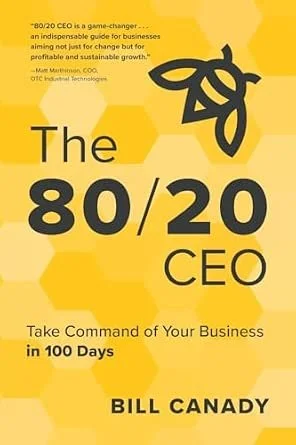
The 80/20 CEO
Take Command of Your Business in 100 Days
by Bill Canady
The 60-Second Take
In The 80/20 CEO, global executive Bill Canady provides a 100-day playbook for leaders who need to rapidly take command of their organizations. By applying the Pareto Principle to executive strategy, he introduces the Profitable Growth Operating System (PGOS). Learn how to eliminate complexity, focus exclusively on the 20 percent of efforts that drive 80 percent of results, and establish a high-performance culture built on strategic subtraction.
Stop Doing Everything and Start Doing What Works
When a new CEO takes the helm of a struggling or stagnant company, the immediate instinct is usually to add. They want to add new products, launch new marketing initiatives, and pursue new customer segments to force growth. In The 80/20 CEO: Take Command of Your Business in 100 Days, global executive Bill Canady argues that this instinct is completely backward. Growth is not found by adding complexity; it is found by ruthlessly subtracting the noise.
Drawing on decades of experience turning around manufacturing and industrial companies, Canady applies the Pareto Principle—the famous economic observation that 80 percent of results come from 20 percent of causes—directly to executive leadership. He outlines a comprehensive framework called the Profitable Growth Operating System (PGOS). By utilizing this system over a strict 100-day period, leaders can rapidly identify their true profit engines, cut the bloated legacy processes, and align their teams around the few things that actually matter.
What You'll Learn
How the Pareto Principle applies to customers, products, and executive time
The mechanics of the Profitable Growth Operating System (PGOS)
How to use "Zero-Up" thinking to simplify complex business operations
Why you need a 100-day action plan to build momentum and establish authority
The roles of the "Leadership Triad" in executing an 80/20 strategy
The Profitable Growth Operating System (PGOS)
The foundational premise of the book is that businesses naturally tend toward complexity, and complexity destroys margins. Over time, companies acquire disparate product lines, chase low-value customers to hit top-line revenue targets, and create layers of bureaucratic management. Canady’s Profitable Growth Operating System (PGOS) is designed to act as a machete against this overgrowth.
To implement PGOS, leadership must first look at hard data to find their "vital 20 percent." In almost every business, 20 percent of the customers are generating 80 percent of the profits. Similarly, 20 percent of the products or services are carrying the financial weight of the entire organization. Canady argues that once you identify these top performers, your strategy becomes obvious: you must aggressively reallocate your time, capital, and top talent to serve that 20 percent. The remaining 80 percent of your portfolio—the low-margin clients, the outdated legacy products, the administrative busywork—must be automated, outsourced, aggressively repriced, or eliminated entirely.
Zero-Up Thinking and Confronting Reality
Cutting 80 percent of your distractions is painful. It requires confronting hard truths about the business, a concept Canady connects to the "Stockdale Paradox"—the ability to confront the brutal facts of your current reality while maintaining absolute faith that you will prevail in the end.
To help leaders make these difficult cuts, Canady advocates for "Zero-Up" thinking. Instead of looking at an existing budget or organizational chart and asking what can be trimmed (which usually results in defensive posturing and minor tweaks), you start from zero. You ask: "If we were building this company from scratch today to serve only our most profitable customers, what would we include?"
This framework forces radical simplification. It leads to segmenting unrelated business units, merging redundant departments, and stripping out outdated standard operating procedures. By designing the business from the ground up to exclusively support the high-yield 20 percent, you build a lean, aggressive organization capable of scaling without bloat.
The Leadership Triad
A CEO cannot execute an 80/20 transformation alone. The sheer weight of daily operations will pull them back into the weeds. Canady explains that successful implementation of the PGOS framework relies on a specialized "Leadership Triad" consisting of a Visionary, a Prophet (or Innovator), and an Executor.
The CEO serves as the Visionary. Their primary role is to set the overarching strategic direction, define the specific markets the company will dominate, and establish an enduring mission. They must protect the 80/20 focus at the highest level.
The COO (or equivalent second-in-command) acts as the Prophet. This individual's job is to evangelize the 80/20 principle throughout the company. They translate the CEO's broad vision into actionable frameworks, designing training programs that teach mid-level managers how to identify their own high-value tasks. Finally, the Executor manages the day-to-day rhythm of the business, ensuring that the new, simplified processes are strictly adhered to and that the organization does not quietly slip back into its old, complex habits.
The 100-Day Action Plan
Why 100 days? Canady emphasizes that a new leader—or an existing leader attempting a massive turnaround—has a brief, critical window to establish momentum. A 100-day plan forces urgency and prevents analysis paralysis.
During this initial phase, the executive team must quickly take stock of the business using checklists and data analysis. They set clear, measurable objectives based on their 80/20 findings and demand immediate accountability. The 100-day timeframe is not about completing the entire transformation; it is about securing rapid, highly visible "quick wins" that prove the effectiveness of the new strategy to the rest of the organization. When employees see the immediate financial and operational benefits of dropping low-value tasks, they buy into the PGOS culture for the long term.
The 80/20 CEO at a Glance
The Pareto Principle applies to everything. 80 percent of your profits come from 20 percent of your customers, products, and efforts.
Complexity kills margins. Companies naturally drift toward bloat; leadership must constantly prune legacy systems and unprofitable clients.
The Profitable Growth Operating System (PGOS). A framework for redirecting all capital, talent, and time toward the vital 20 percent.
Zero-Up thinking. Do not try to trim your current operations by 10 percent. Start from zero and only add back what is strictly necessary to serve your top clients.
The 100-Day Window. Create extreme urgency by implementing data-driven, strategic shifts within the first three months to secure quick wins and organizational buy-in.
The Leadership Triad. Divide the heavy lifting between a Visionary (CEO), a Prophet who evangelizes the system, and an Executor who holds the line on daily operations.
A Quick Start Guide to Taking Command
Identify your vital few. Pull the data today and identify exactly which 20 percent of your customers and products are generating the vast majority of your profit.
Audit your calendar. Review your schedule for the past month and ruthlessly delete or delegate any recurring meeting or task that does not directly support your top 20 percent.
Practice Zero-Up thinking. Look at your current department or business unit and ask, "If we built this from scratch today to only serve our best clients, what would we eliminate?"
Draft a 100-day objective. Pick one specific, high-impact area of the business to simplify and set a hard, measurable goal to achieve within the next 100 days.
Establish your Triad. Ensure you have a clear second-in-command who is tasked with translating your strategic focus into operational training for the rest of the staff.
Who Should Read The 80/20 CEO (and Who Can Skip It)
Read it if you are a newly appointed executive or CEO tasked with turning around a stagnant, overly complex business.
Read it if you feel constantly overwhelmed by operational firefighting and need a mathematical framework for deciding what to ignore.
Read it if your business has grown rapidly through acquisitions and you are struggling to integrate disparate cultures and systems into a unified, profitable machine.
Skip it if you are a solo freelancer or early-stage startup founder searching for basic product-market fit; this book is designed for executives managing established, complex organizations.
Skip it if you are looking for soft-skills leadership coaching regarding emotional intelligence or team building; this is a highly strategic, data-driven operational playbook.
Final Reflections
The 80/20 CEO is a refreshingly pragmatic addition to the executive bookshelf. Bill Canady takes a well-known economic concept—the Pareto Principle—and operationalizes it into a highly specific corporate playbook. The book's greatest strength is its intolerance for busywork. By explicitly giving leaders permission to ignore, outsource, or eliminate 80 percent of their traditional responsibilities, Canady provides a path out of executive burnout. While the PGOS framework may feel rigid or overly systematic to leaders accustomed to creative, unstructured environments, the underlying logic is undeniable. In a business landscape obsessed with doing more, The 80/20 CEO proves that the fastest way to grow is to do significantly less, but with absolute precision.
The Bottom Line
To drive rapid, profitable growth, leaders must stop wasting resources on the bottom 80 percent of their operations and aggressively redesign their companies to serve only the vital 20 percent of customers and products that actually matter.
Frequently Asked Questions
What is the main idea of The 80/20 CEO?
The main idea is that the Pareto Principle (the 80/20 rule) should be the core operating system of any business. By implementing a 100-day action plan, CEOs can identify the 20 percent of efforts, customers, and products that drive 80 percent of the profits, and ruthlessly eliminate or redesign the rest.
What is the Profitable Growth Operating System (PGOS)?
PGOS is the author's strategic framework for simplifying business operations. It involves taking stock of current reality, segmenting businesses into clear focus areas, and allocating resources exclusively to the highest-yield opportunities to maximize margins and efficiency.
What does the author mean by a 100-day plan?
A 100-day plan is used to create immediate urgency and focus. It forces new (or existing) leaders to rapidly assess the company, implement the 80/20 rule, and secure quick operational wins that prove the strategy's value and secure buy-in from the rest of the team.
Business Floss is reader-supported. When you use our links we may earn an affiliate commission that helps us keep the site running. Thank you for your support!


