
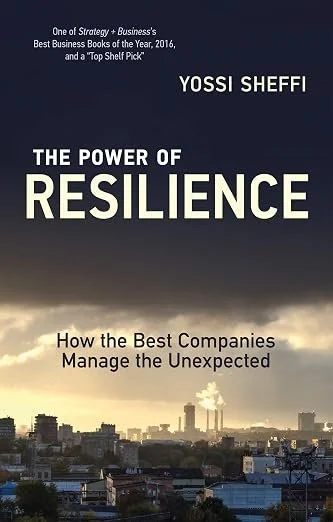
The Power of Resilience
How the Best Companies Manage the Unexpected
by Yossi Sheffi
The 60-Second Take
In The Power of Resilience, MIT supply chain expert Yossi Sheffi explores how globalization and lean manufacturing have made modern businesses dangerously fragile. Drawing on high-stakes corporate crises, Sheffi provides a comprehensive framework for managing risk. He argues that companies must move beyond costly redundancy and build inherent flexibility—mapping deep-tier suppliers, standardizing components, and fostering a culture of rapid detection—to survive and thrive during unexpected disruptions.
The Hidden Fragility of the Modern Economy
For decades, the undisputed holy grail of corporate operations was efficiency. Following the success of massive automotive and tech conglomerates, businesses worldwide adopted "Just-In-Time" manufacturing and lean inventory practices. They recognized that holding physical inventory in a warehouse tied up working capital. To cut costs, they stripped out the slack, outsourced everything that was not a core competency, and stretched their supply chains across the globe to chase the cheapest labor. It was a masterpiece of financial engineering.
It also created a deeply brittle global system. In The Power of Resilience: How the Best Companies Manage the Unexpected, MIT professor Yossi Sheffi explains that when an operational system is pulled perfectly taut, any vibration can snap the line. A localized flood, a sudden labor strike, or a subtle cybersecurity breach can cascade through a globally dispersed network, halting production continents away. Sheffi provides a comprehensive, mechanical manual for preparing for these "black swan" events. He proves that the organizations that win do not possess a magical ability to predict the future. Instead, they design their operations to absorb shocks, rapidly detect anomalies, and pivot faster than their competitors.
What You'll Learn
Why extreme supply chain efficiency actually increases your exposure to catastrophic risk
The critical difference between buying redundancy and building true flexibility
How to construct a vulnerability matrix to prioritize your operational threats
Why mapping your deep-tier suppliers is absolutely critical to long-term survival
How corporate culture dictates the speed and effectiveness of your crisis response
The Dark Side of Lean Operations
The modern supply chain is an invisible web of staggering complexity. A century ago, a company like Ford operated massive, vertically integrated plants where raw materials went in one door and a finished car came out the other. Today, a single consumer electronic device might consist of components manufactured by fifty different companies across twenty different countries, assembled by a contract manufacturer, and shipped by a third-party logistics provider.
This dispersion drastically lowers the cost of goods, but it obscures the risk. Sheffi argues that lean operations—specifically the elimination of buffer inventory—remove the shock absorbers from the system. If a company relies on daily shipments of a critical microchip to keep its assembly line running, a single delayed cargo ship causes immediate financial damage.
Furthermore, globalization exposes companies to geopolitical and environmental risks they never previously had to consider. An earthquake in Asia can suddenly bankrupt a manufacturer in the American Midwest. Sheffi does not argue that companies should abandon globalization or lean operations entirely, but he insists that leaders must recognize the hidden costs. Efficiency assumes a predictable world. When the world proves unpredictable, efficiency becomes a massive liability.
Mapping Your Vulnerabilities
You cannot manage a risk that you do not know exists. To regain control, Sheffi introduces the vulnerability matrix, a framework for categorizing threats based on two dimensions: the probability of the disruption occurring, and the severity of its impact on the business.
High-probability, low-impact events (like a minor weather delay or a routine machine breakdown) are easily managed by standard daily operations. Low-probability, low-impact events can be safely ignored. The true danger lies in low-probability, high-impact events. Because they are rare, management teams rarely want to spend money preparing for them. However, when these events strike, they can permanently destroy a brand.
To properly populate this matrix, a company has to solve the visibility problem. Most companies have a solid understanding of their tier-1 suppliers—the people who send them invoices directly. But they are completely blind to their tier-2 and tier-3 suppliers. Sheffi points to the 2011 Fukushima earthquake as a prime example. Following the disaster, global automakers realized that a single, damaged facility in Japan produced the vast majority of Xirallic, a specialized pigment used in metallic car paints worldwide. The automakers did not buy from this facility; their paint suppliers did. When the factory went offline, global auto production for certain colors ground to a halt. To build resilience, you must map your supply chain deep into the lower tiers to identify single points of failure.
Redundancy Versus Flexibility
When executives finally recognize their vulnerabilities, their first instinct is usually to buy redundancy. Redundancy means keeping extra inventory in a warehouse, paying for backup generators, or maintaining idle manufacturing capacity just in case something goes wrong. While redundancy works, Sheffi points out that it is essentially an expensive insurance policy. It ties up capital and sits unused 99 percent of the time.
The superior strategy is flexibility. Flexibility is structural agility. It means designing your products, your supplier contracts, and your workforce in a way that allows you to shift directions effortlessly. Sheffi outlines several ways to engineer this flexibility into a business.
One of the most powerful methods is standardization. If an automaker uses twenty different types of air conditioning dials across its product line, it is incredibly vulnerable if one specific dial supplier fails. If the automaker standardizes the design to use the exact same dial across all vehicles, they can utilize multiple suppliers. If one supplier burns down, the others can instantly ramp up production to cover the gap.
Flexibility also applies to the workforce. A factory where employees only know how to operate one specific machine is rigid. A factory that aggressively cross-trains its employees can seamlessly shift human capital to different parts of the line when a crisis alters the production schedule. Unlike redundancy, flexibility pays dividends every single day by making the company more agile, even when there is no crisis.
The Speed of Detection and Culture
A disruption does not officially begin when a factory catches fire or a server is hacked. The disruption begins when the company actually notices the problem. Sheffi emphasizes that the gap between the event and the detection is the battleground where competitors win or lose.
To illustrate this, he shares the famous story of a minor fire at a Philips semiconductor plant in New Mexico in 2000. The fire was extinguished in minutes, but smoke destroyed millions of microchips. The two primary customers for these chips were mobile phone rivals Nokia and Ericsson. Because Nokia closely monitored its incoming component flow daily, they noticed the disruption almost immediately. They pressured the supplier for answers, realized the severity of the shortage, and swiftly locked up all the alternative global manufacturing capacity for those chips.
Ericsson, on the other hand, relied on a corporate culture where lower-level managers were terrified of bringing bad news to their superiors. The delay in reporting the shortage meant that by the time Ericsson executives realized they had no chips, Nokia had already bought the market's remaining supply. Ericsson lost hundreds of millions of dollars and was severely crippled in the mobile phone race.
Resilience is ultimately a cultural issue. If your employees are punished for halting production or reporting anomalies, your detection speed will be dangerously slow. Sheffi praises the famous Toyota "Andon cord" culture, where any line worker is empowered to stop the entire assembly line the moment they notice a defect. By fostering a culture where bad news travels fast and frontline workers are trusted to act, companies dramatically shrink their response time, turning a potential catastrophe into a manageable hurdle.
Supply Chain Resilience at a Glance
The danger of lean operations. Removing all buffer inventory and relying entirely on "just-in-time" delivery creates brittle systems that shatter during sudden disruptions.
The Vulnerability Matrix. A strategic tool used to categorize risks by their probability of occurring and the severity of their financial impact.
Deep-tier blindness. Most companies are brought down by the failure of a tier-3 supplier they didn't even know they relied on.
Redundancy is insurance. Hoarding safety stock and backup capacity works, but it ties up massive amounts of working capital.
Flexibility is agility. Standardizing parts, cross-training employees, and utilizing concurrent routing allows a company to pivot instantly without holding excess inventory.
Culture dictates detection. If employees are afraid to report bad news, leadership will be the last to know about a crisis, effectively giving competitors a massive head start.
A Quick Start Guide to Securing Your Supply Chain
Map your deep-tier suppliers. Do not stop at the vendors who send you invoices. Force your primary suppliers to disclose where they source their critical raw materials to identify hidden chokepoints.
Standardize your components. Review your product lines and aggressively reduce the number of unique, proprietary parts. Use standardized components wherever possible to enable flexible sourcing.
Reward the reporting of bad news. Actively praise employees who bring operational anomalies to your attention quickly, ensuring that fear does not delay your crisis detection.
Identify your low-probability, high-impact risks. Gather your leadership team and explicitly list the "black swan" events that could bankrupt the company, then draft a specific contingency plan for each.
Cross-train your workforce. Invest the time to train your employees on multiple systems and processes so you can fluidly shift labor when an unexpected disruption alters your workflow.
Who Should Read The Power of Resilience (and Who Can Skip It)
Read it if you are an operations manager, supply chain director, or procurement specialist tasked with balancing cost-efficiency against operational risk.
Read it if you are a C-suite executive who wants to understand how geopolitical events, climate disruptions, and cyber threats actually translate into localized financial losses.
Read it if you want to understand the mechanical, logistical differences behind why some global brands survive massive crises while others declare bankruptcy.
Skip it if you are a solo entrepreneur selling digital-only products or consulting services. While risk management applies to everyone, this book is heavily focused on physical manufacturing, logistics, and global component sourcing.
Skip it if you want a quick, motivational leadership book. This is a dense, highly researched manual filled with complex corporate case studies and logistical frameworks.
Final Reflections
The Power of Resilience is a sobering, masterfully researched look at the fragile infrastructure of modern commerce. Yossi Sheffi does an exceptional job of explaining how the very strategies that made global corporations incredibly profitable—outsourcing, lean inventory, and just-in-time logistics—are the exact same strategies that leave them exposed to ruin. By shifting the conversation away from predicting disasters to building systems capable of absorbing them, he provides a highly pragmatic roadmap for leaders. While the sheer scale of the examples (global tsunamis, massive factory fires) can feel intimidating to smaller business owners, the underlying principles of standardizing parts, maintaining flexibility, and fostering a culture of rapid detection are universally applicable. It is an indispensable guide for anyone responsible for keeping a business running when the world falls apart.
The Bottom Line
Extreme supply chain efficiency is actually fragility in disguise, and to survive the inevitable chaos of a globalized economy, companies must stop hoarding expensive redundancy and start engineering deep, structural flexibility.
Frequently Asked Questions
What is the main idea of The Power of Resilience?
The main idea is that modern, lean supply chains are highly vulnerable to unexpected disruptions. To survive, companies must shift from simply buying expensive redundancy (like hoarding inventory) to building inherent flexibility through standardized parts, deep-tier supplier mapping, and a corporate culture that detects bad news instantly.
What is the difference between redundancy and flexibility?
Redundancy involves holding extra inventory, maintaining idle factory capacity, or paying for backup systems just in case a disruption occurs. It is an expensive form of insurance. Flexibility involves structural agility—cross-training workers, standardizing components, and using multiple suppliers—so the company can seamlessly change directions when a crisis hits without holding dead capital.
Why is deep-tier supplier mapping so important?
Most companies only track their tier-1 suppliers (the companies they buy from directly). However, catastrophic disruptions usually happen at the tier-2 or tier-3 level, when a raw materials provider goes offline. If multiple tier-1 suppliers all rely on the same invisible tier-3 factory, a single disruption can halt your entire production line.
Business Floss is reader-supported. When you use our links we may earn an affiliate commission that helps us keep the site running. Thank you for your support!


