
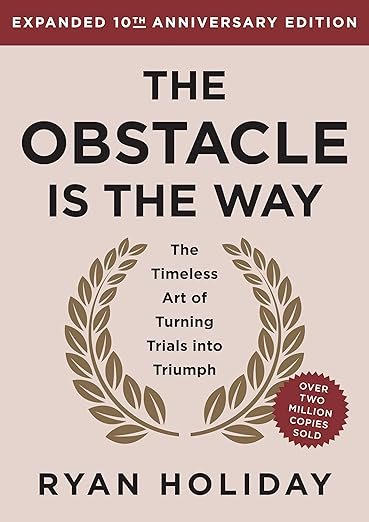
The Obstacle is the Way
The Timeless Art of Turning Trials into Triumph
by Ryan Holiday
The 60-Second Take
In The Obstacle Is the Way, Ryan Holiday translates the ancient philosophy of Stoicism into a pragmatic playbook for modern life. He argues that hardship is not a disruption to your goals, but the primary vehicle for achieving them. By mastering the three disciplines of perception, action, and will, professionals can learn to maintain emotional control and systematically flip their greatest challenges into unprecedented advantages.
Why the Barrier Is Actually the Blueprint
Nearly two thousand years ago, the Roman Emperor Marcus Aurelius wrote a private note to himself that would eventually become one of the most famous maxims in philosophical history: "The impediment to action advances action. What stands in the way becomes the way." Aurelius was not writing a motivational poster. He was trying to manage a collapsing economy, endless frontier wars, and a devastating plague. His insight was that the things blocking our path are actually the very things that teach us how to move forward.
In The Obstacle Is the Way, Ryan Holiday revives this core tenet of Stoicism and applies it directly to the modern professional world. He strips away the academic jargon of ancient philosophy to present a highly tactical, unsentimental framework for dealing with extreme difficulty. The book’s premise is radically simple. We cannot choose the roadblocks we face—a sudden economic downturn, a hostile competitor, a catastrophic failure—but we retain absolute power over how we interpret and respond to them. Holiday organizes this approach into three distinct disciplines: perception, action, and will.
What You'll Learn
The fundamental difference between an objective event and your emotional reaction to it
How to apply the three Stoic disciplines of perception, action, and will
Why focusing exclusively on what you can control eliminates anxiety
The concept of Amor Fati and the strategic value of embracing bad news
How to use negative visualization to prepare for inevitable failures
The Discipline of Perception: Seeing the World Objectively
The first step in overcoming any barrier is controlling how you look at it. Human beings are biologically wired to panic when things go wrong. When we lose a major client or face a lawsuit, we instantly attach negative emotional baggage to the event. We tell ourselves that the situation is unfair, disastrous, or insurmountable. Holiday points out that the event itself is totally objective. A lost client is just a lost client. The disaster only exists in your interpretation.
The discipline of perception requires separating the objective facts of a situation from your emotional reaction. To illustrate this, Holiday points to the story of Rubin "Hurricane" Carter, a top-ranked boxer falsely accused of murder and sentenced to life in prison. Carter experienced an unimaginably unjust obstacle. However, he refused to let the state control his perception. He decided that while they controlled his physical body, they could not touch his mind. He turned his prison cell into a laboratory, reading philosophy and law, entirely redirecting his energy into proving his innocence.
To master perception, you must ruthlessly filter your reality. When a crisis hits, you have to steady your nerves, refuse to be intimidated, and locate the hidden advantage. A bad boss is an excellent opportunity to learn how to manage difficult personalities. A slashed budget forces a team to innovate and eliminate bloated processes. The obstacle is never entirely bad unless you decide to view it that way.
The Discipline of Action: Dismantle the Problem
Perception alone is not enough. Once you have steadied your emotions and viewed the obstacle objectively, you have to move. However, the discipline of action does not mean frantic, panicked activity. It means directed, persistent, and iterative effort.
Holiday argues that we often freeze because we look at the totality of a problem and feel overwhelmed. The Stoic response is to break the obstacle down into its smallest component parts and attack the immediate next step. You do not have to solve the entire crisis today; you just have to take the next right action. He emphasizes the importance of process over outcome. When you focus entirely on the outcome, you are easily demoralized by setbacks. When you focus on the process—executing the task in front of you to the absolute best of your ability—you maintain your momentum.
This requires a willingness to fail fast and adapt. Holiday highlights the methodology of iterative startups and inventors. When Thomas Edison was searching for the right filament for the lightbulb, he did not view his thousands of failed materials as defeats. Each failure was an action that eliminated a wrong path, moving him closer to the right one. Action is the physical manifestation of your new perception. You dismantle the obstacle piece by piece, relying on discipline rather than sudden bursts of motivation.
The Discipline of the Will: Build Your Inner Citadel
The final discipline is the cultivation of the will. If perception is how the mind looks at the world, and action is how the body moves through it, the will is the internal strength that sustains you when the world breaks you down anyway. There will be obstacles that you cannot flip into an immediate advantage, and there will be problems you cannot immediately solve. In these moments, endurance is your only option.
The Stoics referred to this internal fortitude as the "inner citadel"—a fortress inside your mind that cannot be breached by external events, no matter how catastrophic. To build this citadel, Holiday recommends the practice of premeditatio malorum, or the premeditation of evils. Modern business calls this a pre-mortem. Before launching a project, you intentionally imagine every possible way it could fail. By anticipating disaster, you remove the shock value when things inevitably go wrong, allowing your will to remain intact.
The highest expression of the will is Amor Fati, a Latin phrase translating to "a love of fate." It is the ability to look at an agonizing setback and not merely tolerate it, but actively embrace it. You look at the failure, the rejection, or the loss, and you say, "This is exactly what I needed." It is the ultimate psychological armor. When you love whatever fate hands you, nothing can ever defeat you.
Applied Stoicism at a Glance
Perception. Strip away your emotional reactions and view problems objectively. The event is neutral; your judgment makes it good or bad.
Control. Draw a hard line between what you can control (your attitude, your effort) and what you cannot (the economy, other people). Ignore the latter.
Action. Break overwhelming problems down into immediate, actionable steps. Focus entirely on executing the process rather than agonizing over the outcome.
The Inner Citadel. Cultivate a mental fortress that remains calm and rational regardless of external chaos.
Amor Fati. Do not just accept hardship; love it. View every setback as the necessary fuel for your future success.
A Quick Start Guide to Turning Obstacles into Advantages
Audit your immediate reaction. When bad news hits, pause before responding. Acknowledge the panic or anger, then intentionally separate those feelings from the objective facts of the situation.
List what you control. Draw a line down a piece of paper. On one side, write down the elements of the problem you cannot change. On the other, write down the elements you can influence. Cross out the first side and never look at it again.
Find the hidden utility. Force yourself to answer this question: "If I had to find one strategic advantage in this disaster, what would it be?"
Define the next physical step. Stop worrying about how the problem will look six months from now. Identify the single smallest action you can take right now to improve the situation by one percent.
Conduct a pre-mortem. Before starting your next major initiative, hold a meeting where the team assumes the project has completely failed, and work backward to identify the likely causes.
Who Should Read The Obstacle Is the Way (and Who Can Skip It)
Read it if you are an entrepreneur or manager facing heavy market resistance and need a framework for maintaining your emotional equilibrium.
Read it if you have a tendency to freeze, panic, or get deeply frustrated when projects do not go according to your meticulously laid plans.
Read it if you are interested in philosophy but want something highly actionable, punchy, and grounded in real historical examples rather than dense academic theory.
Skip it if you already possess a deep, academic background in classical Stoicism; this is a modern, pop-philosophy primer designed for accessibility, not a scholarly translation.
Skip it if you are looking for a step-by-step operational playbook for scaling a business. This is a book about mindset and behavioral psychology, not corporate strategy.
Final Reflections
The Obstacle Is the Way has resonated deeply across Silicon Valley, professional sports, and the corporate world because it strips away the toxic positivity that plagues much of the self-help genre. Ryan Holiday does not tell you to smile and pretend that bad things are not happening. He tells you to look directly at the bad thing, analyze it coldly, and extract its utility. By packaging the robust, enduring wisdom of Marcus Aurelius, Seneca, and Epictetus into short, highly digestible chapters, Holiday provides a mental toolkit for an increasingly volatile world. The book is an essential reminder that a frictionless life is an illusion, and that true resilience comes from using the friction to move forward.
The Bottom Line
The things that block our progress are not actually in the way; they are the exact raw material we need to build our path forward.
Frequently Asked Questions
What is the main idea of The Obstacle Is the Way?
The main idea is that adversity should not be viewed as a barrier to success, but as the very mechanism that creates it. By controlling our perception, taking directed action, and maintaining our will, we can turn any professional or personal failure into a strategic advantage.
What does Amor Fati mean?
Amor Fati translates to "a love of fate." It is the Stoic practice of not just accepting everything that happens to you, including the terrible things, but actively embracing them and believing that they are necessary for your ultimate growth.
What are the three disciplines in the book?
The book is structured around the disciplines of Perception (how we view the problem), Action (how we dismantle the problem), and Will (how we endure the parts of the problem we cannot change).
Business Floss is reader-supported. When you use our links we may earn an affiliate commission that helps us keep the site running. Thank you for your support!


