
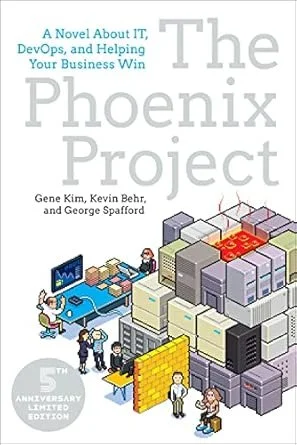
The Phoenix Project
A Novel About IT, DevOps, and Helping Your Business Win
by Gene Kim, Kevin Behr & George Spafford
The 60-Second Take
In The Phoenix Project, Gene Kim, Kevin Behr, and George Spafford use a fictional narrative to illustrate the core principles of DevOps. Following an overwhelmed IT manager tasked with saving a failing corporate initiative, the book demonstrates how applying lean manufacturing concepts to technology can eliminate silos, manage unplanned work, and align IT with broader business goals to transform a chaotic department into a competitive advantage.
IT Is Not a Department; It Is the Factory Floor
Most business literature treats technology as a black box—a necessary expense managed by people who speak a different language. The Phoenix Project shatters that illusion. Written as a business novel in the direct tradition of Eliyahu M. Goldratt’s manufacturing classic The Goal, this book by Gene Kim, Kevin Behr, and George Spafford tells the story of Bill Palmer. Bill is a competent IT manager suddenly thrust into the role of VP of IT Operations at Parts Unlimited, an auto parts retailer on the brink of collapse. His mission is to save "Project Phoenix," a massive, delayed software initiative that the entire company is banking on for its survival.
Through Bill’s daily struggles with catastrophic outages, warring departments, and endless corporate crises, the authors deliver a masterclass in modern systems thinking. The narrative captures the exact tension that plagues modern businesses: Development is incentivized to push new features as fast as possible, while Operations is incentivized to keep the system stable by resisting change. The book reveals that managing knowledge work is exactly like managing a physical manufacturing plant. It requires the same rigorous focus on flow, bottlenecks, and quality control. By reading about Bill's painful journey, professionals learn exactly how to dismantle toxic silos and build a high-performing culture.
What You'll Learn
The Four Types of Work that consume your team's time and energy
Why unplanned work is the most destructive force in any business
How to identify and protect the human bottlenecks in your organization
The Three Ways: the foundational principles of the DevOps movement
How to bridge the gap between Development, Operations, and Information Security
The Four Types of Work
Before you can improve a system, you have to know what is actually in the system. When Bill takes over IT Operations, he realizes his team is drowning, but nobody can articulate exactly what they are working on. Work is assigned via frantic emails, hallway conversations, and sticky notes. The authors emphasize that invisible work is impossible to manage. To regain control, you must categorize everything your team does into what they define as the Four Types of Work.
The first two are highly visible. Business Projects are the massive initiatives driven by the broader company, like the titular Project Phoenix. Internal IT Projects are the infrastructure upgrades, database migrations, and server replacements that the technology teams generate internally to keep the lights on.
The third type is Changes. These are the updates, patches, and modifications to existing systems. The fourth, and most dangerous, is Unplanned Work. This is the firefighting. It is the server crashes, the emergency rollbacks, and the urgent security breaches. Unplanned work is toxic because it does not just consume time; it actively steals time away from the other three categories. Furthermore, the authors show how these types are linked. A poorly executed Change almost always generates a massive wave of Unplanned Work. The very first step to fixing a broken department is visualizing all four types on a single board, making the invisible work visible, and ruthlessly prioritizing.
Identifying the Bottleneck
Every organization has a Brent. In the novel, Brent is the brilliant, indispensable senior engineer who knows how everything works. Because he is so uniquely capable, every team bypasses the official ticketing system and goes directly to him when they have a problem. As a result, Brent becomes the ultimate organizational bottleneck. No major project can move forward without his input, and because he is constantly interrupted with unplanned work, all the critical business projects stall.
The authors use Brent to practically illustrate the Theory of Constraints. In any value stream, there is only one true constraint holding back the entire system. If you optimize any other part of the process, you are wasting your resources because the bottleneck dictates the maximum throughput of the entire factory.
Once Bill identifies Brent as the constraint, his job is not to ask Brent to work harder or put in more weekend hours. His job is to protect Brent's time at all costs. Bill shields him from direct requests, standardizes his repetitive tasks so junior staff can execute them, and ensures Brent only works on the single most critical task at a time. A hero engineer is not a competitive advantage. A hero engineer is a systemic risk that must be managed, documented, and eventually engineered out of the critical path.
The Three Ways
The conceptual heart of The Phoenix Project is a framework called The Three Ways. This is the underlying philosophy of DevOps, designed to harmonize the conflicting goals of the business, the developers, and the operations team.
The First Way: Flow
This principle is about maximizing the speed of work moving from left to right—from Development, through IT Operations, and out to the customer. To achieve flow, you have to limit your Work in Progress (WIP). Starting tasks is easy; finishing them is hard. By artificially restricting how many projects can be open at once, you force the team to finish old work before starting new work. It also requires reducing batch sizes. Instead of deploying massive, risky software updates every six months, teams should deploy small, easily manageable updates frequently. This requires building automated testing and deployment pipelines so code can move swiftly without manual friction.
The Second Way: Feedback
While Flow moves left to right, feedback must constantly move from right to left. The goal is to catch errors as quickly as possible. If a developer writes a piece of code that breaks the server environment, they need to know immediately, not six months later during a massive midnight deployment. The Second Way is about amplifying feedback loops so that quality is built in at the source, rather than inspected in at the end. This means utilizing pervasive telemetry and monitoring so that any degradation in system performance is immediately visible to the people who wrote the code.
The Third Way: Continual Learning and Experimentation
The final step is cultural. A high-performing organization must carve out time for the improvement of daily work. If teams are too busy firefighting to improve their systems, they will be firefighting forever. The Third Way requires a culture that rewards risk-taking and learns from failures without assigning blame. The authors argue that companies should routinely conduct blameless post-mortems after an outage. Furthermore, mature organizations will actively inject tension into the system—such as randomly turning off servers during business hours—to practice their responses and build systemic resilience.
The Phoenix Project at a Glance
Work must be visible. You cannot manage what you cannot see. Force all tasks, favors, and emergencies onto a visual tracking system.
The Four Types of Work. Everything an IT department does falls into Business Projects, Internal IT Projects, Changes, or Unplanned Work.
Unplanned work kills flow. Firefighting is not a badge of honor; it is a failure of process that steals time from value creation.
Find the constraint. Identify the specific person or process holding up the system and subordinate everything else to maximizing their throughput.
Limit Work in Progress. Stop starting and start finishing. Having ninety projects 10% complete is worse than having one project 100% complete.
The Three Ways. True DevOps relies on fast flow from left to right, rapid feedback from right to left, and a culture of continuous learning and mastery.
A Quick Start Guide to DevOps Thinking
Visualize the work. Force every single task, request, and project onto a physical or digital Kanban board. Stop accepting work via email or informal hallway chats.
Limit your WIP. Set a hard numerical cap on how many items can be in the "doing" column at once to force the completion of existing tasks.
Protect your bottlenecks. Identify the key individuals who are required for every project and build a system that shields them from unplanned interruptions.
Automate the repetitive. Find the manual, error-prone steps in your deployment or testing process and invest the upfront time to automate them.
Schedule time to improve. Dedicate a specific percentage of your team's weekly hours to paying down technical debt and improving existing systems, even if the business begs for new features.
Who Should Read The Phoenix Project (and Who Can Skip It)
Read it if you are an IT manager, developer, or operations professional who feels constantly overwhelmed by emergency fixes and missed deadlines.
Read it if you are a business executive who wants to understand why your technology initiatives always seem to run late, go over budget, and cause friction between departments.
Read it if you enjoyed Eliyahu M. Goldratt’s The Goal and want to see how manufacturing physics map perfectly onto modern software development.
Skip it if you prefer traditional, academic business books; the fictional narrative format is engaging but requires you to follow a character-driven storyline to get to the core frameworks.
Skip it if you are looking for highly technical, code-level instructions on configuring deployment pipelines. This is a book about management philosophy and process, not specific software tools.
Final Reflections
The Phoenix Project succeeds brilliantly because it does not feel like an abstract theory; it feels like workplace therapy. Anyone who has ever worked in or adjacent to a corporate technology department will immediately recognize the warring factions, the impossible deadlines, and the sheer panic of a catastrophic outage that the characters endure. By wrapping deep lean manufacturing and DevOps principles inside a compelling, often funny fictional narrative, the authors make complex systems thinking accessible to everyone.
Its primary achievement is proving that technology is not a mystical art form exempt from the laws of physics. It is a production line. Technical debt is a very real tax that compounds over time, and relying on heroics to save projects is a recipe for employee burnout. When you stop treating code like magic and start treating it like inventory, the path to a sane, profitable, and highly functional business becomes entirely clear.
The Bottom Line
Your technology department is a factory floor, and if you do not actively visualize the work, protect your human bottlenecks, and eradicate unplanned firefighting, your entire business will eventually grind to a halt.
Frequently Asked Questions
What is the main idea of The Phoenix Project?
The main idea is that the principles of lean manufacturing can and must be applied to IT operations. Through a fictional story, the book illustrates how visualizing work, eliminating bottlenecks, and adopting DevOps practices can transform a chaotic technology department into a strategic business asset.
What are The Three Ways?
They are the foundational principles of DevOps introduced in the book. The First Way is Flow (moving work quickly from development to operations). The Second Way is Feedback (creating rapid loops to catch errors early). The Third Way is Continual Learning (fostering a culture of experimentation and mastery).
What are the Four Types of Work?
The authors categorize all IT tasks into Business Projects, Internal IT Projects, Changes, and Unplanned Work. The book emphasizes that Unplanned Work (firefighting) is the most destructive type because it prevents teams from executing the other three.
Business Floss is reader-supported. When you use our links we may earn an affiliate commission that helps us keep the site running. Thank you for your support!


