
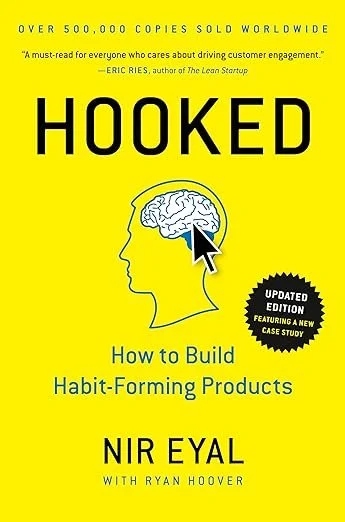
Hooked
How to Build Habit-Forming Products
by Nir Eyal
The 60-Second Take
In Hooked, Nir Eyal decodes the psychological mechanics behind the world's most engaging technologies. He introduces the Hook Model, a four-step framework—Trigger, Action, Variable Reward, and Investment—that companies use to manufacture desire and turn casual users into daily devotees. Master these principles, and you can build ethical, habit-forming products that solve real problems and keep users coming back without relying on expensive marketing.
Why We Can't Stop Scrolling
It is not an accident that you check your phone the moment you feel a pang of boredom. It is also not an accident that certain applications feel impossible to put down, while others are abandoned days after downloading. In Hooked, Nir Eyal argues that the most successful digital products are not necessarily the ones with the best features; they are the ones that have successfully engineered human habits.
Instead of relying on expensive marketing campaigns to buy growth, habit-forming companies build unprompted user engagement directly into their product design. They create environments where users naturally cue themselves to take action. Eyal breaks down exactly how these companies operate, providing a highly practical manual for product managers, designers, and entrepreneurs. By understanding the underlying psychology of habit formation, creators can build software that genuinely solves problems and keeps users coming back.
What You'll Learn
The four interconnected phases of the Hook Model
The difference between external marketing and internal psychological triggers
How unpredictable outcomes create desire and hold human attention
Why forcing a user to put effort into a product actually makes them stay
The strict biological frequency limit required to build any habit
The Hook Model: Manufacturing Desire
The core of the book is the Hook Model, a four-step framework designed to seamlessly move a user from an initial prompt to a solidified routine. The goal is to cycle a user through these four steps enough times that they no longer need an external reminder to use the service.
The model consists of a Trigger, an Action, a Variable Reward, and an Investment. Each time a consumer passes through this cycle, their habit is reinforced, and the product effectively becomes more valuable to them. The genius of the model is that it does not rely on coercion. Instead, it leverages our natural psychological tendencies, gently guiding users toward a behavior that eventually becomes automatic.
Triggers and Context
Every habit begins with a trigger, which acts as the spark plug for behavior. Products initially rely on external triggers, such as push notifications, emails, or advertisements. However, Eyal warns that these often fail because companies send them on their own schedule rather than considering the user's context. He shares a story of a flight attendant repeatedly yelling at a sleeping passenger just to ask if he wanted a drink. While this is terrible customer service, companies do the exact same thing when they blast users with irrelevant notifications. The difference between a trigger that feels like magic and one that feels like spam is simply context.
The ultimate goal is to move past external prompts entirely and attach the product to an internal trigger. Internal triggers are stored in the user's memory and are almost always tied to an emotion, particularly a negative one. When a user automatically opens a social media app the moment they feel lonely or uncertain, the internal trigger has successfully taken hold.
Once triggered, the user must take action. Eyal emphasizes that behavior is a function of motivation, ability, and a trigger. Because motivation is highly fluctuating and difficult to control, designers should focus relentlessly on ability. This means reducing the time, money, and cognitive effort required to perform the action. When friction is eliminated, the intended behavior becomes effortless.
Variable Rewards and Stored Value
If you open your refrigerator and the light turns on, you do not feel a sudden urge to keep opening the door because the outcome is entirely predictable. However, if the fridge gave you a different, surprising treat every time, you would open it constantly. Predictable feedback loops do not create desire. Unpredictability, on the other hand, spikes dopamine and activates the areas of the brain associated with craving.
Eyal categorizes these variable rewards into three distinct types. The reward of the tribe is driven by social validation, such as likes, comments, and community connection. The reward of the hunt involves the pursuit of information or resources, such as scrolling through a newsfeed to find an interesting article. Finally, the reward of the self is driven by mastery and completion, like clearing your inbox or maintaining a daily streak.
The cycle concludes with the investment phase, where the user is asked to do a bit of work. This might involve uploading content, inviting friends, or stating preferences. Crucially, this effort creates stored value. The more a user invests in the platform, the better and more personalized the service becomes, which naturally loads the next trigger and starts the cycle all over again.
The Hard Limit of Frequency
Not every product can or should be habit-forming. Eyal points out a strict biological cutoff: for a habit to form, the key behavior must occur within a week's time or less.
He illustrates this reality with an anecdote about speaking at a real estate conference. The event organizer enthusiastically asked him to teach the agents how to make buying and selling homes into a habit. Eyal had to explain that it is an impossible request. Because people do not buy houses on a weekly basis, a habit can never form. If your product is bought infrequently, you cannot rely on the Hook Model; instead, you must focus on delivering extremely high perceived utility to ensure the customer returns when the rare need finally arises.
Habit-Forming Design at a Glance
The Hook Model. A four-phase loop consisting of a trigger, an action, a variable reward, and an investment.
Internal triggers. Habit-forming products successfully attach their use to an existing emotion or routine, eliminating the need for paid marketing.
Ease over motivation. Friction kills action, so designers must make the intended behavior as simple and effortless as possible.
The power of unpredictability. Variable rewards spike dopamine and keep users engaged through a sense of hunting and discovery.
Stored value. Asking users to invest time or data makes the product more personalized and increases the likelihood they will return.
The frequency rule. To build a true habit, the user must engage with the product at least once a week.
A Quick Start Guide to Building Hooks
Identify the internal trigger. Clearly define the specific pain point, emotion, or moment of uncertainty your product immediately relieves.
Audit your friction. Map out the exact steps a user must take to get the job done, and relentlessly remove any elements that require unnecessary time or brainpower.
Add meaningful variability. Ensure your product delivers rewards that are slightly unpredictable in timing or size to sustain user attention.
Ask for a small investment. Prompt the user to save a preference, follow a topic, or input data to improve their next experience.
Check your frequency. Honestly assess if your target user naturally encounters the problem your product solves at least once a week.
Who Should Read Hooked (and Who Can Skip It)
Read it if you are a product manager, UX designer, or software founder trying to improve your platform's long-term retention rates.
Read it if you are a marketer shifting your focus from acquiring top-of-funnel leads to building deep, unprompted customer engagement.
Read it if you are simply curious about the behavioral psychology behind your own technology use and want to understand how your attention is captured.
Skip it if you sell infrequent, high-ticket items like enterprise hardware, consulting, or real estate; the frequency rule makes this model irrelevant to your business.
Skip it if you are looking for technical coding advice. This is a behavioral design framework, not a software development manual.
Final Reflections
Hooked is an indispensable guide for anyone building products in the digital age. Nir Eyal successfully translates complex behavioral psychology into a clear, actionable framework that explains exactly why we use the technology we do. While the book primarily focuses on the mechanics of engagement, it also raises important questions about the morality of manipulation. Eyal argues that creating habits is a superpower, and with it comes the responsibility to build products that genuinely improve users' lives rather than merely exploiting their dopamine systems. For those willing to use these tools ethically, the Hook Model is a brilliant blueprint for creating lasting value.
The Bottom Line
Habits are not formed by accident; they are engineered through a continuous cycle of triggers, simple actions, unpredictable rewards, and user investments that organically make a product harder to leave.
Frequently Asked Questions
What is the main idea of Hooked?
The main idea is that successful companies do not just rely on great marketing to retain users; they engineer their products to form habits. By utilizing a four-step psychological loop called the Hook Model, companies can attach their products to users' daily routines and internal emotions.
What are the four steps of the Hook Model?
The four steps are the Trigger (which prompts the behavior), the Action (the simplest behavior done in anticipation of a reward), the Variable Reward (the unpredictable payoff that satisfies the craving), and the Investment (the effort the user puts in that improves the product for next time).
Can any product become a habit?
No. According to the book, a strict requirement for habit formation is frequency. If a user does not engage with the behavior at least once a week, it is nearly impossible for a true habit to form.
Bonus Content
Business Floss is reader-supported. When you use our links we may earn an affiliate commission that helps us keep the site running. Thank you for your support!