
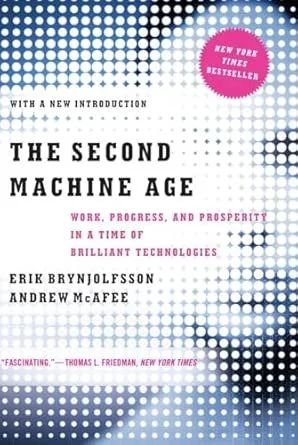
The Second Machine Age
Work, Progress, and Prosperity in a Time of Brilliant Technologies
by Erik Brynjolfsson & Andrew McAfee
The 60-Second Take
In The Second Machine Age, MIT researchers Erik Brynjolfsson and Andrew McAfee explain how digital technologies are doing for human brainpower what the steam engine did for muscle power. While this era promises unprecedented abundance, it also creates severe economic inequality by hollowing out routine jobs. To thrive, professionals must stop competing against computers and learn to race alongside them by mastering ideation, complex communication, and large-frame pattern recognition.
The Chessboard Is Half Full
There is an old fable about the inventor of chess who presented his game to a powerful emperor. The emperor was so delighted that he offered the inventor any reward he wished. The inventor asked for a simple mathematical favor: place one grain of rice on the first square of the chessboard, two on the second, four on the third, and keep doubling it until the board is full. The emperor readily agreed, thinking it was a cheap price. He did not realize that while the first half of the chessboard yields a manageable pile of rice, the continuous doubling on the second half produces a mountain of rice larger than Mount Everest, bankrupting the empire.
In The Second Machine Age, MIT researchers Erik Brynjolfsson and Andrew McAfee use this fable to illustrate a profound economic reality. We have spent the last few decades on the first half of the technological chessboard. The growth of computing power was impressive, but manageable. Now, we have entered the second half of the board. The doubling of computing power is producing results so massive and disruptive that they defy human intuition.
The authors argue that just as the steam engine initiated the first machine age by multiplying human physical power, the digital revolution has initiated a second machine age by multiplying human cognitive power. This transition is not a smooth, linear progression. It is a violent economic restructuring that creates staggering wealth alongside severe inequality. This summary breaks down the architecture of this new era and provides a framework for ensuring your career is not automated into obsolescence.
What You'll Learn
The three defining characteristics of the digital revolution: exponential, digital, and combinatorial
The difference between "bounty" (technological abundance) and "spread" (widening inequality)
Why technology disproportionately favors capital over labor, and superstars over average workers
Moravec's paradox, and why a computer can do calculus but cannot easily clean a messy room
How to adapt your skills to focus on ideation and complex communication
The Three Pillars of the New Era
To understand why the global economy feels so unpredictable right now, you have to understand the three distinct characteristics driving modern innovation. Brynjolfsson and McAfee define the second machine age as exponential, digital, and combinatorial.
First, the era is exponential. This is driven by Moore's Law, the observation that computing power roughly doubles every eighteen to twenty-four months. When things improve exponentially, they look deceptively flat for a long time before suddenly going vertical. This is why artificial intelligence felt like a fringe science fiction concept for decades, only to suddenly become capable of driving cars, diagnosing diseases, and writing coherent essays in what felt like overnight. The math simply caught up.
Second, the era is digital. When information is digitized, it becomes a "non-rival" good. If you own a physical hammer, and someone else takes it, you no longer have a hammer. If you own a digital song or a piece of software, you can copy it and send it to a million people at a marginal cost of zero. You do not lose your copy, and the million copies are perfect replicas. This digital nature allows new technologies to scale globally at speeds that physical manufacturing could never achieve.
Third, and perhaps most importantly, the era is combinatorial. Innovation is rarely about inventing something entirely new from scratch. It is usually about combining existing building blocks in novel ways. The smartphone combined a camera, a GPS tracker, a phone, and an internet connection. Then, software developers combined those features with mapping data to create Waze, and others combined them with payment processing to create Uber. Because there are now millions of digital building blocks available globally, the potential combinations are practically infinite. Innovation is no longer bottlenecked by physical materials; it is only bottlenecked by human imagination.
The Twin Forces: Bounty and Spread
The collision of these three pillars creates massive economic consequences. The authors categorize these consequences into two opposing forces: bounty and spread.
Bounty is the incredible abundance generated by digital technology. It is the consumer surplus that makes our lives materially better. You have access to a free global encyclopedia in your pocket. You can communicate with anyone on earth through free video software. You can navigate any city without a paper map. Much of this bounty does not even register in traditional Gross Domestic Product (GDP) metrics because the products are entirely free, yet they drastically improve the human condition.
Spread, however, is the dark side of the equation. Spread refers to the widening inequality caused by digital disruption. Technology is not neutral. It heavily favors specific types of economic actors. The authors identify three types of "biased" technical change driving this spread.
The first is skill-biased technical change. Routine manual work (like assembly line sorting) and routine cognitive work (like basic bookkeeping or data entry) are easily automated. Non-routine work is highly rewarded. The second is capital-biased technical change. Software can replace labor, which means a larger share of corporate profit flows to the people who own the software and the capital, rather than the people who do the physical work.
The final and most aggressive force is superstar-biased technical change. Because digital goods can be perfectly replicated at zero marginal cost, the absolute best creator in a specific field can capture the entire global market. Before digitization, a moderately talented local accountant or software developer could make a great living serving their immediate town. Today, a user can simply purchase the world's best accounting software for a fraction of the price. The best product takes 90 percent of the market, leaving almost nothing for the second or third best.
Racing With the Machines, Not Against Them
If routine cognitive work is being outsourced to silicon, what is left for humans? The solution is not to fight the machines or try to out-calculate them. The solution is to race with them.
To figure out where humans still hold the advantage, the authors point to Moravec's paradox. This is the discovery by artificial intelligence researchers that high-level reasoning requires very little computation, but low-level sensorimotor skills require enormous computational resources. It is relatively easy to program a computer to beat a grandmaster at chess, but it is incredibly difficult to program a robot to walk up a flight of stairs, open a door, and comfort a crying child.
In the professional world, computers are excellent at pattern recognition when the rules are fixed and the data is clean. Humans excel at broad-pattern recognition, ideation, and complex communication. Ideation is the ability to generate new, out-of-the-box concepts. A computer can perfectly execute a digital marketing campaign, but a human must decide what emotion the campaign is trying to evoke. A computer can read a medical scan and spot a tumor faster than a radiologist, but a human doctor is required to sit down with the patient, deliver the diagnosis with empathy, and guide them through a complex, deeply personal treatment decision.
To future-proof your career, you must audit your daily responsibilities. If you spend your days pulling numbers from one spreadsheet, formatting them, and pasting them into another document, you are highly vulnerable. You need to aggressively pivot your skillset toward tasks that require emotional intelligence, leadership, creative problem solving, and the ability to combine disparate ideas. Let the machines handle the data processing. You must handle the strategy.
The Second Machine Age at a Glance
Exponential compounding. Computing power is growing so rapidly that it defies human intuition, making highly advanced AI practically inevitable.
Combinatorial innovation. Modern growth relies on treating digital technologies like Lego bricks, snapping existing software and hardware together to create entirely new industries.
The Bounty. Digital technology creates massive consumer abundance, providing free, perfect access to information, navigation, and communication globally.
The Spread. Technology accelerates inequality by replacing routine labor with software, ensuring that the owners of capital and superstar creators capture the vast majority of new wealth.
Moravec's Paradox. Hard things are easy for computers, and easy things are hard. Math is simple for a machine; emotional nuance and physical dexterity are incredibly difficult.
The human advantage. To survive, professionals must focus on ideation, broad-pattern recognition, and complex interpersonal communication.
A Quick Start Guide to Future-Proofing Your Career
Audit your routine. Look at your calendar from the past week. Highlight every task that involved routine data transfer, basic calculation, or following a strict, unvarying checklist. Accept that software will soon do those tasks.
Lean into complex communication. Actively seek out projects that require negotiation, conflict resolution, or pitching ideas to a live audience. Empathy and persuasion are highly resistant to automation.
Become a combinatorial thinker. Look at adjacent industries. Ask yourself how a software tool or business model used in agriculture or healthcare could be combined with your current operations to create something novel.
Leverage the machine. Stop viewing artificial intelligence as a competitor. Start actively using generative AI, data scraping tools, and automation software to accelerate your own output, effectively making yourself a human-machine hybrid.
Prioritize ideation over execution. Shift your professional brand away from being the person who simply executes instructions faster than others. Become the person who figures out which instructions are actually worth executing.
Who Should Read The Second Machine Age (and Who Can Skip It)
Read it if you are an executive trying to understand the macroeconomic forces driving your industry's sudden, violent shifts in profitability.
Read it if you are a professional in a highly routine cognitive field (like accounting, paralegal work, or basic coding) and need a framework for pivoting your career before you are automated out of a job.
Read it if you are interested in the intersection of technology and public policy, specifically regarding wealth inequality and the future of education.
Skip it if you are looking for a tactical, step-by-step coding tutorial or a guide to implementing specific enterprise software systems in your business.
Skip it if you are already deeply familiar with the concepts of Moore's Law and skill-biased technical change. The book serves as a masterful synthesis of these ideas rather than an esoteric academic thesis.
Final Reflections
The Second Machine Age is a defining text of modern economic literature. What makes Brynjolfsson and McAfee's work so compelling is their ability to hold two conflicting ideas in tension: they are relentlessly optimistic about the technological miracles humanity is producing, while remaining deeply sober about the economic carnage those miracles will inflict on the middle class. While the book was written prior to the massive explosion of generative AI models like ChatGPT, its foundational frameworks remain startlingly accurate. The authors successfully predicted that cognitive tasks would be hollowed out next. The transition into the second half of the chessboard is messy, uncomfortable, and unavoidable. The professionals and businesses that read the board correctly will capture unprecedented wealth, while those who cling to routine processes will simply be swept off the table.
The Bottom Line
Digital technology is compounding so rapidly that it is hollowing out routine cognitive labor, meaning the only way to secure your economic future is to stop competing on calculation and start competing on human ideation and complex communication.
Frequently Asked Questions
What is the main idea of The Second Machine Age? The main idea is that humanity has entered a new era driven by digital technology that multiplies our cognitive power, much like the steam engine multiplied physical power. This exponential, digital, and combinatorial growth creates massive abundance ("bounty") but also severe economic inequality ("spread"), rewarding those who can leverage technology while replacing routine workers.
What is the difference between bounty and spread? Bounty refers to the incredible surplus of cheap or free digital goods—like GPS, massive online libraries, and communication tools—that improve the quality of human life. Spread refers to the widening economic gap caused by technology, as wealth concentrates among the owners of capital and superstar creators, while routine jobs are automated and middle-class wages stagnate.
What does combinatorial innovation mean? Combinatorial innovation is the concept that new breakthroughs rarely come from inventing something entirely unprecedented. Instead, they come from combining existing technologies in new ways. Because digital building blocks are easily accessible globally, innovators can mix and match software, hardware, and data (like combining mobile phones, cameras, and GPS to create ride-sharing apps) to generate endless new solutions.
Business Floss is reader-supported. When you use our links we may earn an affiliate commission that helps us keep the site running. Thank you for your support!


