
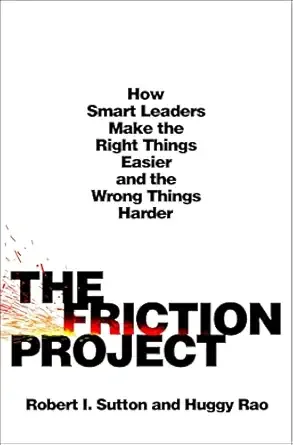
The Friction Project
How Smart Leaders Make the Right Things Easier and the Wrong Things Harder
by Robert I. Sutton & Huggy Rao
The 60-Second Take
In The Friction Project, Stanford professors Robert I. Sutton and Huggy Rao provide a practical guide to identifying and managing organizational drag. They argue that skilled leaders act as "friction fixers," aggressively eliminating the bad friction that wastes time, while intentionally introducing good friction to prevent reckless decisions. Master these principles to cure addition sickness, protect your team's time, and build a highly productive workplace.
Why Doing Simple Things at Work Has Become So Hard
Have you ever tried to hire a new employee or approve a minor software purchase, only to find yourself trapped in a labyrinth of fifty manual requests and endless committee approvals? You are not alone. In organizations around the world, employees are drowning in "bad friction"—the convoluted processes, pointless meetings, and bloated administrative forms that make it incredibly difficult to get actual work done.
In The Friction Project, Stanford professors Robert I. Sutton and Huggy Rao examine the invisible forces that slow down productivity and burn out teams. Drawing on seven years of research, they argue that leaders must stop focusing solely on adding new initiatives and start acting as "friction fixers". This summary breaks down how smart managers diagnose organizational drag, cure their companies of "addition sickness," and master the delicate balance of making the right behaviors effortless and the wrong behaviors difficult.
What You'll Learn
The fundamental difference between "good friction" and "bad friction"
Why human beings naturally suffer from "addition bias" and how it ruins productivity
How friction fixers act as fierce trustees of their employees' time
The "rule of halves" technique for subtracting corporate waste
Why introducing intentional friction can improve creativity and decision-making
Good Friction Versus Bad Friction
When we hear the word "friction" in a business context, we immediately assume it is something that needs to be eliminated. Silicon Valley culture has spent decades worshipping speed, efficiency, and seamless user experiences. However, Sutton and Rao clarify that some forms of friction are incredibly useful. The core premise of the book relies on distinguishing between the friction that helps us and the friction that harms us.
Bad friction is the sludge that prevents employees from doing meaningful work. It is the 42-page benefits application form in Michigan that asks a thousand questions. It is the weekly executive committee meeting that secretly costs a major consulting client 300,000 hours a year in preparation time. Bad friction drains energy, stifles creativity, and frustrates customers because it provides absolutely no value in exchange for the massive effort it demands.
Good friction, on the other hand, is completely intentional. Sometimes, leaders need to slow people down to prevent catastrophic mistakes or to foster deeper human connection. For instance, Sutton and Rao highlight how creative work requires struggle; teams need to wade through bad ideas to find rare good ones, and rushing that process ruins the output. Similarly, friction can be a feature for customers. When Jumbo, a massive Dutch supermarket chain, noticed that older customers were feeling lonely as checkout lanes became overly automated, they introduced a "slow checkout lane". This allowed seniors to linger and chat with the cashiers. By intentionally rejecting hyper-efficiency, the company created a wildly successful customer experience. Good friction protects us from impulsive decisions and preserves our humanity.
The Epidemic of Addition Sickness
If bad friction is so universally despised, why do companies keep creating more of it? The authors point to a psychological phenomenon known as "addition sickness," which is driven by a cognitive blind spot called "addition bias". Human beings are hardwired to build. When we are presented with a problem, our immediate, instinctual reaction is to ask, "What can I add here to fix this?"
If cross-departmental communication is poor, a manager schedules a new mandatory weekly sync. If a major project fails, leadership creates a brand-new oversight committee to review all future projects. If an internal process is mildly flawed, the IT department buys a massive new software platform instead of tweaking the old one. Research from the University of Virginia proves that additive ideas come to mind quickly and effortlessly, while subtractive ideas—thinking about what we can remove—require significantly more cognitive effort. Because we are usually moving fast and working with the first ideas that pop into our heads, companies pile new procedures on top of old ones without ever auditing whether the old ones are still necessary.
Addition sickness eventually leads to "Jargon Monoxide"—the corporate gobbledygook that pollutes communications and drastically slows down decision-making. When organizations layer complex matrices and overlapping roles onto their staff, they invent convoluted language to justify the bloat. To cure addition sickness, leaders must fundamentally shift their mindset from building to editing. Just as a film editor ruthlessly cuts footage to make a better movie, a "friction fixer" must ruthlessly cut rules, tools, and meetings to make a better, more agile workplace.
Becoming a Trustee of Others' Time
The most effective friction fixers view themselves as the ultimate protectors of their team's time and attention. Their primary job focuses on clearing the path so tasks can be accomplished easily.
Sutton illustrates this with a surprisingly simple example from a California DMV. A line of fifty people was waiting outside the building, anticipating hours of frustrating delays. An employee stepped outside, walked down the line, and handed out the necessary forms and pens before the doors even opened. By solving the paperwork problem while people were already waiting, this frontline friction fixer allowed several people to finish their business on the spot, cutting Sutton's own wait time to just thirty minutes.
To replicate this at scale, companies need systemic campaigns. The authors showcase Hawaii Pacific Health, which launched a "Getting Rid of Stupid Stuff" (GROSS) campaign. Initiated by a chief medical officer, the campaign empowered nurses and doctors to flag administrative burdens that cut into patient care. By identifying and eliminating just a few unnecessary mouse clicks in their software system, the hospital saved its nurses 1,700 hours of wasted effort every single month. Being a trustee of time means giving the frontline workers the power to point out the friction they face daily.
The Friction Project at a Glance
Addition bias. The human tendency to solve problems by adding new elements (rules, software, meetings) rather than subtracting unnecessary ones.
Good friction. Intentional obstacles that prevent impulsive decisions, force critical thinking, and protect human connection.
Bad friction. Convoluted processes, jargon, and administrative bloat that waste resources and drain employee energy.
Trustee of time. A leadership philosophy where managers view their primary role as protecting their employees' focus and removing workflow obstacles.
Jargon monoxide. Overly complex, confusing corporate language that obscures meaning and slows down execution.
Pre-mortems. An exercise in good friction where teams slow down before launching a project to imagine all the ways it could fail, helping them avoid future disasters.
A Quick Start Guide to Fixing Friction
Apply the Rule of Halves. Challenge yourself to reduce a burden by 50 percent immediately. Cut the length of your meetings in half, or reduce your direct reports by half, and only add elements back if they prove absolutely necessary.
Launch a "Stupid Stuff" audit. Ask your employees to identify one specific administrative task, form, or approval process that wastes their time without adding value, then kill it.
Use the reversibility test. When making a decision, ask if the outcome is easily reversible. If it is, eliminate the friction and move fast. If it is irreversible, apply good friction and slow the decision down.
Kill Jargon Monoxide. Force your team to speak and write in concrete, sensory terms. Reject complex acronyms and convoluted corporate speak that confuse the actual work.
Slow down for creativity. Do not rush brainstorming or product development. Run "previctorems" to imagine success and "premortems" to imagine failure so your team fully processes the risks.
Who Should Read The Friction Project (and Who Can Skip It)
Read it if you are an executive or middle manager who suspects your team is burning out from administrative bloat rather than actual workload.
Read it if you are in operations, HR, or IT and are responsible for designing the internal processes that the rest of the company has to live with.
Read it if you are leading a massive organizational transformation and need a framework for determining which legacy processes to kill.
Skip it if you are a solo entrepreneur with zero employees. The core challenges addressed here relate to managing people and complex corporate structures.
Skip it if you are looking for highly technical lean manufacturing or Six Sigma mathematical formulas. This book is deeply focused on the human and psychological elements of organizational design.
Final Reflections
The Friction Project offers a profoundly humane approach to business management. Robert I. Sutton and Huggy Rao do not just complain about red tape; they dissect the psychology behind why we create it. By naming the problem "addition sickness," they give leaders a vocabulary to challenge the natural instinct to constantly build and acquire. The book's most valuable insight is its nuance regarding "good friction". In a business culture that blindly worships speed, the authors make a compelling, research-backed case that slowing down is often the key to better decision-making and happier customers. While large corporate examples dominate the text, the core message is universal: true leadership is the art of editing, ensuring that the path is clear for the work that actually matters.
The Bottom Line
To build a highly productive organization, leaders must cure their "addition sickness" by ruthlessly eliminating the bad friction that wastes employees' time, while intentionally injecting good friction to protect them from rushing catastrophic decisions.
Frequently Asked Questions
What is the main idea of The Friction Project?
The main idea is that organizations naturally accumulate "bad friction"—wasteful processes, pointless meetings, and complex rules—because of a human tendency to solve problems by adding things. Smart leaders combat this by acting as friction fixers, actively removing obstacles while selectively maintaining "good friction" to ensure thoughtful decision-making.
What is addition sickness?
Addition sickness is the organizational habit of constantly adding new tools, layers of management, and procedures without ever subtracting the outdated ones. It is driven by "addition bias," the psychological instinct to fix a problem by introducing a new element rather than removing a broken one.
What is the difference between good friction and bad friction?
Bad friction is unintentional and wasteful, like confusing software forms or unnecessary approval chains that drain employee energy. Good friction is intentional and protective; it involves deliberately slowing down a process to encourage creative thinking, foster human connection, or prevent irreversible mistakes.
Business Floss is reader-supported. When you use our links we may earn an affiliate commission that helps us keep the site running. Thank you for your support!