
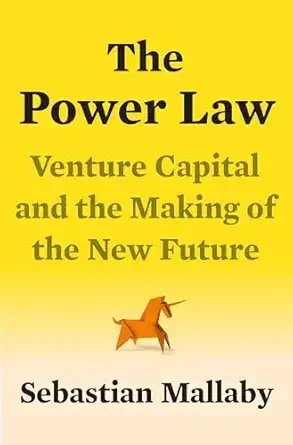
The Power Law
Venture Capital and the Making of the New Future
by Sebastian Mallaby
The 60-Second Take
In The Power Law, Sebastian Mallaby traces venture capital from Arthur Rock's 1957 bet on the "traitorous eight" to SoftBank's excesses at WeWork. His argument: VC returns follow a power law, where a handful of grand slams pay for everything else, and that math shapes how the industry thinks, invests, and occasionally blows up. Part history, part defense of a frequently caricatured business.
Why Most Venture Investments Fail, and Why That Is the Point
Sebastian Mallaby is a financial historian, a two-time Pulitzer finalist, and the author of More Money Than God, which did for hedge funds roughly what this book does for venture capital. For The Power Law he got extraordinary access: the partners at Sequoia, Kleiner Perkins, Accel, Benchmark, and Andreessen Horowitz, plus the Chinese firms Qiming and Capital Today. The result is a character-driven history of an industry that is written about constantly and understood poorly.
The organizing idea sits in the title. Venture returns do not follow a normal distribution, where most outcomes cluster near an average. They follow a power law, where a tiny number of extreme winners account for nearly all the value created. That is not a quirk of the asset class. It is the fact from which every strange behavior in venture capital follows.
What You'll Learn
What a power law distribution is, and the specific numbers that prove venture runs on one
How Arthur Rock invented "liberation capital" and why equity ownership was the real innovation
Why stage-by-stage financing is a risk-management tool, not just a funding schedule
Mallaby's answer to the hardest question about VCs: do they create value or just show up for it
How growth-stage megafunds broke the model in the 2010s, with Uber and WeWork as exhibits
Where the book's optimism about venture capital deserves pushback
The Power Law: Why 5 Percent of the Capital Makes 60 Percent of the Money
Mallaby opens with data rather than anecdote. Horsley Bridge, an investor in venture funds, held stakes in funds that backed roughly 7,000 startups between 1985 and 2014. Deals accounting for just 5 percent of the capital deployed generated 60 percent of all returns over that stretch. For contrast, in 2018 the top-performing 5 percent of subindustries in the S&P 500 accounted for only 9 percent of the index's performance. Y Combinator ran the same arithmetic on itself in 2012 and found that three quarters of its gains came from 2 of the 280 companies it had backed.
Those numbers do more than describe an asset class. They dictate a decision rule. When the distribution has a long tail, expected value is dominated by the extreme cases, which means the cost of a miss and the cost of a loss are wildly asymmetric. Losing your money in a failed startup costs you one unit of capital. Passing on the startup that returns 200x costs you the fund.
This is why venture capitalists behave in ways that look reckless from the outside. They fund founders with no revenue. They tolerate a portfolio where most companies fail outright. They chase ideas that sound absurd, because an idea that sounds sensible to everyone is already priced in and cannot become an outlier. The screening question is not "will this work?" but "if this works, how large does it get?"
The generalization is where the book earns its keep for readers outside venture. Plenty of business domains are power-law shaped: drug discovery, publishing, films, enterprise sales pipelines, R&D portfolios, even hiring. Most corporate planning tools assume normal distributions and reward high hit rates. Applied to a power-law domain, that machinery systematically kills the only projects capable of paying for the whole portfolio. Diagnosing which distribution you are in is the first move, and most organizations never make it.
Liberation Capital: How Arthur Rock Invented the Model
In 1957, eight researchers at Shockley Semiconductor Laboratory had reached their limit with William Shockley, a Nobel laureate and an intolerable boss whose management practices included lie detector tests. They wanted out. Arthur Rock, then a young financier in New York, told them not to look for new jobs individually but to leave together and start a company, and he found the money to make it possible. Fairchild Semiconductor was the result, and it seeded a generation of Silicon Valley firms.
Rock called it liberation capital, and Mallaby treats it as the industry's founding act. The critical innovation was not the money. It was the ownership. Traditional corporate research labs paid salaries; the institution captured the value. Rock's structure handed meaningful equity to the people doing the work, which changed the calculus for every talented technologist who was tired of their employer. Rock later co-founded Davis & Rock, whose bets included Intel, and returned many multiples of the fund to a small group of limited partners.
What Mallaby draws from this is a claim about geography and structure rather than genius. Silicon Valley's advantage was never that smarter people happened to live there. It was that a legal and financial template existed for smart people to defect, take ownership, and try again, plus a dense network of people who had already done it. Each defection created new nodes in that network. When the East Coast tried to replicate the outcome, it kept supplying capital to businesses that already had products and customers, which is a fundamentally different and much less generative activity.
Do Venture Capitalists Create Value, or Just Show Up for It?
This is the book's most contested argument, and Mallaby knows it. The skeptical case says VCs are essentially lottery ticket buyers who take credit for founders' work, that returns are luck, and that the best firms simply get first look at the best deals because they are already famous.
His counterevidence is largely historical and specific. Tom Perkins, at Kleiner Perkins, treated early-stage money as a device for eliminating technical uncertainty as cheaply as possible. He held the view that market risk and technology risk move inversely, so the job of the first check is to spend as little as possible retiring the science question. At Genentech he pushed the company to contract research out to existing laboratories rather than building its own, which meant the venture was testing the core hypothesis without carrying a lab's overhead. Don Valentine at Sequoia pushed Atari toward the home version of Pong and engineered the Sears distribution relationship, then arranged the eventual sale to Warner. Neither was a passive check-writer. Both stamped their judgment onto the companies.
Stage-by-stage financing is the structural version of the same instinct. Rather than funding a company to completion, the VC funds it to the next milestone, at which point the risk profile has changed and the price should change with it. It looks like a funding schedule. It functions as a series of forced checkpoints that either kill the project cheaply or justify the next tranche.
Mallaby also lays out the industry's internal disagreement about how to find deals. Accel built the "prepared mind" model: pick sectors, study them the way a consulting firm would, and be ready when the right company appears. The opposing school says the future gets discovered by founders and the investor's job is to follow them into places no research memo would have identified. Mallaby does not fully resolve this, which is honest. Both approaches have produced enormous winners, and the tension between them is still live.
When the Money Got Too Big
Growth capital and the founder king
The last third of the book covers what happened when the amounts stopped being venture-sized. Yuri Milner's DST arrived with enormous checks and terms that were friendly to founders in unusual ways, and SoftBank's Vision Fund later took that logic to its extreme. Capital that once arrived in disciplined tranches, each buying down a specific risk, started arriving in floods.
The consequence was governance. Mallaby's account of the era is unsparising about the industry's own role: the search for grand slams produced a cult of the visionary founder, and companies flagged as potential outliers were handed extraordinary control, often through super-voting shares. Uber and WeWork are the case studies. The exception he highlights is Bill Gurley of Benchmark, who did eventually move against Travis Kalanick at Uber, at real cost and real risk. That episode reads as the counterexample proving the rule, since it was notable precisely because so few investors did anything comparable.
The model goes global
Mallaby also tracks venture capital's export, particularly to China, where firms like Qiming and Capital Today built on the Valley's template and adapted it. He notes, pointedly, that Chinese venture has produced more prominent women investors than American venture ever has. The closing material turns geopolitical, framing venture capital as a competitive national asset, and this is where the book's structure strains most. It sits somewhere between history and policy argument, and reads a bit bolted on.
Venture Capital at a Glance
The power law. A distribution where a small number of extreme outcomes account for most of the total value, unlike a normal distribution clustered around an average.
Liberation capital. Arthur Rock's term for funding that frees talent from an existing employer by giving it ownership of what it builds.
Stage-by-stage financing. Releasing money in tranches tied to milestones, so each round buys down a specific risk before more capital is committed.
The prepared mind. Accel's approach of researching sectors in advance so the firm recognizes the right company on first contact.
Grand slam thinking. Screening for maximum potential upside rather than probability of success, because one outlier funds the portfolio.
Founder king problem. The governance failure that follows when outlier-hunting hands unchecked control to a single visionary.
A Quick Start Guide to Thinking in Power Laws
Diagnose the distribution first. Before choosing a strategy, establish whether outcomes in your domain cluster around an average or run to extremes. The answer changes everything downstream.
Price the miss, not just the loss. In a long-tailed domain, the opportunity you declined can cost far more than the one that failed. Track both.
Fund in tranches tied to milestones. Structure commitments so each release retires a specific, named uncertainty rather than buying general progress.
Kill your hit-rate metric. A high success rate in a power-law domain usually means you screened out everything with real upside.
Protect governance early. Concentrated bets create concentrated power. Decide what oversight looks like before the company is winning, because nobody can impose it afterward.
Who Should Read The Power Law (and Who Can Skip It)
Read it if you allocate capital under deep uncertainty, whether in corporate innovation, R&D, or investing, and want a rigorous account of how long-tailed math should change your process.
Read it if you are raising venture money and want to understand your investors' incentives from the inside, including why they push for scale you may not want.
Read it if you like well-told business history. Mallaby is a superb narrative writer, and the Rock, Perkins, and Valentine chapters stand on their own.
Skip it if you want tactical guidance on running a startup. This is a history of the money, not a founder's manual.
Skip it if you want a hard-edged critique of venture capital's social effects. Mallaby is broadly sympathetic to his subject, and the labor, inequality, and concentration arguments get comparatively little space.
Final Reflections
The reporting is exceptional and the history is the most complete account of the industry available in one volume. Mallaby writes finance narrative as well as anyone working, and the book was shortlisted for the Financial Times Business Book of the Year.
Two caveats matter. The first is the access question. Mallaby is a Council on Foreign Relations fellow rather than an industry participant, so he has no fund to sell, but the book depends on cooperation from the people it evaluates, and the verdict lands consistently favorable. His central claim that VCs genuinely add value is well argued, though the evidence leans on hand-picked historical cases where the investor's contribution is visible, and the sample of firms he was granted access to is by definition the sample that survived. The failures are less thoroughly examined than the wins.
The second is timing. The book was published in January 2022, at very nearly the top of the cycle it describes. Its confidence about venture capital as an engine of national prosperity is a product of that moment, and the rate-driven reckoning that followed is not in the text. That does not invalidate the history or the math. It does mean the concluding argument should be read as a position taken at a specific point rather than a settled conclusion.
The Bottom Line
In a normal distribution you win by being right often. In a power law you win by being right enormously, once. Confusing the two is how careful organizations reliably fund the wrong things.
Frequently Asked Questions
What is the power law in venture capital?
It describes the extreme skew in venture returns: a very small share of investments produces nearly all the profit. Mallaby cites Horsley Bridge data showing that 5 percent of capital deployed across roughly 7,000 startups generated 60 percent of returns between 1985 and 2014. Because one winner can pay for an entire fund, investors optimize for maximum upside rather than probability of success.
Is The Power Law worth reading if I am not in venture capital?
Yes, if you make bets under real uncertainty. The useful transfer is the distinction between normal and power-law domains, and the recognition that standard planning tools, built around hit rates and averages, actively harm you in the second kind. If you only want operating advice for a business, look elsewhere.
Is The Power Law biased in favor of venture capital?
It leans favorable. Mallaby argues venture capital deserves recognition as a genuine engine of innovation and pushes back on the view that VCs are lucky bystanders. He does cover the governance failures at Uber and WeWork and the industry's poor record on diversity, but critics of venture's broader social costs will find the treatment light.
Business Floss is reader-supported. When you use our links we may earn an affiliate commission that helps us keep the site running. Thank you for your support!


