
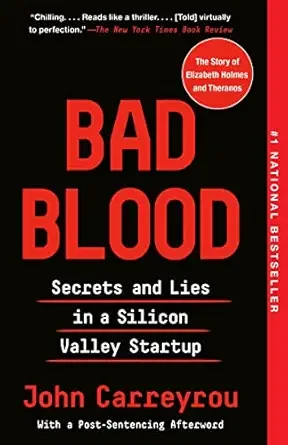
Bad Blood
Secrets and lies in a Silicon Valley Startup
by John Carreyrou
The 60-Second Take
In Bad Blood, Pulitzer-winning reporter John Carreyrou tells how Theranos, a $9 billion startup built on a blood-testing device that never worked, deceived investors, retailers, and patients for over a decade. Elizabeth Holmes raised hundreds of millions on a promise her own scientists knew was false, then silenced anyone who said so. It is the definitive anatomy of a corporate fraud, and a warning about what belief can hide.
How a $9 Billion Startup Sold a Machine That Never Worked
Elizabeth Holmes left Stanford at nineteen with an idea almost anyone would want to be true. A single drop of blood from a finger prick, run through a small device sitting in your local drugstore, could deliver the panel of results that normally requires vials drawn from a vein. Faster, cheaper, no needle. She raised more than $700 million on that promise. At the peak, Theranos was valued at $9 billion and Holmes was on magazine covers as the youngest self-made female billionaire in America.
The machine never worked. Bad Blood is John Carreyrou's account of how that fact stayed buried for more than a decade, written by the Wall Street Journal reporter whose October 2015 investigation forced it into the open. It reads like a thriller. But the part worth studying is quieter than the scandal: this was not a con that slipped past one careless person. It got past a national pharmacy chain, a national grocery chain, several billionaires, and a board of former cabinet secretaries, every one of whom had the resources to check and did not.
What You'll Learn
How the Theranos device actually worked, and why it could never do what Holmes promised
Why "fake it till you make it" carries a different price in medicine than in software
How secrecy, siloed teams, and legal intimidation kept the fraud alive for years
What Walgreens, Safeway, and Theranos's investors failed to verify before writing checks
The warning signs visible from outside the company the entire time
How two junior employees and one reporter brought down a $9 billion company
The Vision That Outran the Science
Holmes founded the company in 2003 after briefly attending Stanford. Her original concept was a patch that would draw blood, analyze it, and administer medication. That gave way to a cartridge-and-reader system built on microfluidics, the machine known internally as Theranos 1.0. Elegant on paper, unreliable in practice.
By 2007 the company had quietly lowered its ambitions and built something cruder. The Edison was assembled around a repurposed robot originally designed to dispense glue, shuttling samples between stations inside a sleek box. It sort of worked. It could run only immunoassays, a single family of blood test, and could not perform general chemistry, hematology, or DNA amplification. That left Theranos able to run roughly a dozen of the more than two hundred tests on its published menu using its own technology.
The gap had to be filled with something, so Theranos bought commercial analyzers, most notably the Siemens ADVIA, and modified them to accept the tiny finger-stick volumes the company had advertised. The modification amounted to diluting the sample. Dilution is not free: it drops the concentration of whatever you are measuring, often below the range the analyzer was validated to detect, which is exactly how you get results that drift. Patient reports listed the Theranos lab in Newark, California as the testing site, so no doctor could tell which machine had produced a number, or whether it should be trusted.
This is the mechanical heart of the fraud and it is worth sitting with. Theranos did not fail because a hard engineering problem defeated a talented team. Plenty of companies fail that way, and there is no shame in it. Theranos failed because the launch date was fixed by commercial deals and the science was expected to catch up. When it didn't, the company shipped anyway.
"Fake It Till You Make It" Doesn't Work in Medicine
Silicon Valley tolerates the polished demo that runs slightly ahead of the product. Vaporware, pre-announcements, roadmaps sold as features. The implicit bargain is that the cost of being early is embarrassment, and the software eventually catches up.
Theranos ran that playbook exactly. Demonstrations were staged for investors and partners on devices that were not doing what the room believed, and when a demo failed the failure was concealed rather than disclosed. At a pitch to Safeway's board, one director volunteered his own blood for a prostate screening test. The Edison whirred and clicked and never produced a result. Holmes suggested the number would come later.
By the time the Walgreens launch went live in September 2013, the Edison was not ready and the miniLab, the more capable successor under development, was further away still. The company launched regardless, running most tests on modified commercial machines with diluted blood.
Here is what separates this from every other startup cautionary tale. These were not beta users. They were patients. Real people received results for thyroid function, potassium, and cancer screening, and made real decisions on them. In 2016 Theranos voided two years of results from its Edison devices. Somewhere in that pile are people who were told they were sick and were not, and people who were told they were fine and were not.
The transferable lesson is about domain, not ethics. A market's tolerance for overpromising is not a universal constant. It depends entirely on who absorbs the cost when the promise turns out to be wrong. In consumer software, the customer absorbs an inconvenience. In diagnostics, aviation, or construction, somebody absorbs a much larger loss, and the norms have to be different. Carrying software habits into a regulated field is not boldness. It is a category error with victims.
A Board of Statesmen and a Culture of Fear
The Theranos board became one of the most impressive in American business: former secretaries of state George Shultz and Henry Kissinger, former defense secretary William Perry, former senators Sam Nunn and Bill Frist, and General James Mattis. It also became a study in what a board is actually for.
These were serious people. But oversight of a clinical laboratory requires someone both willing and equipped to ask whether the assays validate. What the roster supplied instead was credibility, and that credibility flowed outward to investors and partners as a substitute for the evidence nobody demanded. Holmes also held super-voting shares, so control never really sat with the board or with the investors funding her. The most decorated board in the country cannot govern a founder it cannot outvote.
Inside, the machinery ran on fear. Ramesh "Sunny" Balwani, the company's president and chief operating officer and, secretly, Holmes's romantic partner, enforced a culture in which raising a problem was treated as disloyalty. Teams were compartmentalized so chemists could not compare notes with engineers. Nondisclosure agreements were sweeping. Employees who voiced doubts were shouted down, sidelined, or fired the same day, and turnover was brutal. Ian Gibbons, the company's chief scientist and one of the few people who fully understood the technical shortfall, died by suicide in 2013 under the weight of the pressure and litigation surrounding him.
The pattern generalizes well past this one company. An organization that punishes bad news does not stop generating bad news. It stops hearing it. Leadership then decides from a picture that has been sanded smooth on the way up. Every mechanism Theranos used to protect the story (the silos, the NDAs, the firings, the lawyers) worked exactly as designed, and each one removed another chance to correct course while correction was still cheap.
The Diligence That Nobody Did
For anyone who evaluates deals, this is the most useful section of the book and the most uncomfortable.
Walgreens signed a partnership that included a $100 million "innovation fee" and a $40 million loan. It hired an outside laboratory consultant, Kevin Hunter, to assess the technology. He asked to see the lab and was refused. He asked to watch the device run a comparison against a standard analyzer and was stonewalled. He told Walgreens executives what that pattern meant. They proceeded anyway, driven substantially by the fear that if they walked, CVS would sign instead.
Safeway went further. Chief executive Steve Burd bet the chain's retail footprint on the partnership, spending hundreds of millions to build out clinic space in stores for a service that never launched. When Theranos ran tests for Safeway employees, results came back slowly, samples were mishandled, and numbers made no sense. The deal collapsed and Burd's tenure ended.
The investor list has the same shape: Rupert Murdoch, the Walton family, the DeVos family, the Cox family. What is conspicuous is who is absent. The specialist life-science venture firms, the investors who would have insisted on peer-reviewed validation and audited data, largely passed. Theranos raised instead from wealthy individuals and family offices for whom this was one position among many, and who read the board's presence as the diligence.
That is the mechanism worth naming: circular validation. The retailers trusted the board. The investors trusted the retail contracts and each other. The board trusted Holmes. Every participant felt covered because someone else, apparently better qualified, had already looked. Nobody had. A chain of people each deferring to the next produces enormous confidence and zero information.
How It Unraveled: Two Junior Employees and a Reporter
Tyler Shultz was a recent Stanford graduate working in the Theranos lab, and the grandson of board member George Shultz. Erika Cheung was a young lab associate. Both watched quality-control failures get waved through, and both tried internal channels first. Tyler emailed Holmes directly; the reply came from Balwani, and it was contemptuous. Tyler brought the matter to his grandfather over dinner, with Cheung there to corroborate. George Shultz did not believe them.
Both eventually went outside. Cheung reported to the Centers for Medicare and Medicaid Services, and both spoke to Carreyrou, whose first article ran in October 2015. What followed was not a graceful corporate reckoning. Theranos dismissed its sources as inexperienced and disgruntled. Its lawyer, David Boies, threatened the Journal and pursued the whistleblowers personally. Cheung was handed a threatening letter outside her workplace by a man who stepped out of an SUV, at an address almost nobody knew she was living at. Tyler Shultz's family spent enormous sums on legal fees, and his relationship with his grandfather was badly damaged.
Regulators finished what the reporting started. CMS inspected the Newark lab and found deficiencies serious enough to threaten patient safety. Theranos voided two years of results. Walgreens ended the partnership. By mid-2016 Forbes had revised Holmes's paper net worth from $4.5 billion to nothing, and in September 2018 the company dissolved.
The book was published in May 2018, before any criminal trial. For readers who want the ending: Holmes was convicted in January 2022 on four counts of defrauding investors, acquitted on the charges relating to patients, and sentenced to eleven years and three months. Balwani was convicted on all twelve counts against him and sentenced to nearly thirteen years.
The Theranos Playbook at a Glance
The Edison. Theranos's proprietary analyzer, capable of only one family of test and roughly a dozen of the 200+ tests the company advertised.
Dilution. Stretching a finger-stick sample to fit commercial analyzers, pushing readings below the range those machines were validated to measure.
The staged demo. Presentations engineered so the device appeared to work, with failures concealed rather than disclosed.
Compartmentalization. Deliberate siloing of teams so no single employee could assemble a full picture of the technology.
Legal intimidation. Sweeping NDAs, surveillance, and aggressive outside counsel used to convert doubt into personal risk.
Prestige as proxy. A board of statesmen and generals supplying outside credibility in place of technical oversight.
A Quick Start Guide to Pressure-Testing an Extraordinary Claim
Watch the thing run. Insist on seeing the core technology perform live, on your sample, under conditions you set.
Find out who has actually validated it. Peer review, independent labs, and regulatory clearance are not the same as press coverage and awards.
Treat secrecy as data. Trade secrets justify protecting how something works. They never justify refusing to show that it works.
Ask whether dissent survives. Heavy turnover among technical staff and a founder who fires skeptics tell you exactly what internal review is worth.
Discount the roster. Famous directors and marquee investors are evidence that other people were impressed, not that anyone checked.
Who Should Read Bad Blood (and Who Can Skip It)
Read it if you invest, sit on a board, or sign partnership agreements, and want the most vivid case study available of how diligence fails in a room full of capable people.
Read it if you work in a regulated industry and need a concrete answer for why startup norms about shipping early do not transfer.
Read it if you have ever wondered what it actually costs to be the person who speaks up. The chapters on Tyler Shultz and Erika Cheung are the most instructive in the book.
Read it if you simply want superb investigative journalism that moves like a thriller.
Skip it if you want a framework. This is reported narrative, not a management model, and you extract the lessons yourself.
Skip it if you already know the story from the documentary or the miniseries and only want the outcome. The book's value is in the granular detail, and it ends in 2018 before the trials.
Final Reflections
Bad Blood is, first, an exceptional piece of reporting. Carreyrou interviewed roughly 150 people, including some sixty former employees, most bound by nondisclosure agreements and some under surveillance. That sourcing is what gives the book its authority, and it won the Financial Times and McKinsey Business Book of the Year Award on the strength of it.
It has limits worth knowing. The final third shifts into first person as Carreyrou becomes a participant in his own story, and readers who liked the cool investigative distance of the opening may find the change jarring. The book is description rather than analysis: it shows you precisely what happened and leaves the diagnosis largely to you. It is also comparatively incurious about Holmes herself. We learn what she did and very little about how she squared it internally, which leaves the central character somewhat opaque. Some readers will find that restraint admirable, others will find it a gap.
The fair verdict is that the book does the hard job perfectly and declines the speculative one. What it leaves behind is a set of conditions rather than a villain: a founder with unchecked control, a board chosen for prestige, partners racing a competitor, investors outside their competence, and a culture where the person who raised a hand got fired. Assemble those in any industry and you get some version of the same result.
The Bottom Line
Every party who could have stopped Theranos assumed a more qualified party already had. Fraud on that scale does not require a criminal mastermind, only a chain of capable people who each decide that verification is somebody else's job.
Frequently Asked Questions
Is Bad Blood a true story?
Yes. It is investigative nonfiction by John Carreyrou, the Wall Street Journal reporter who broke the Theranos story in October 2015, built on interviews with roughly 150 people including about sixty former employees. Its central claims were later tested in federal court, where Elizabeth Holmes was convicted of defrauding investors in January 2022.
What was actually wrong with the Theranos technology?
The company's Edison analyzer could run only one family of blood test and covered about a dozen of the more than two hundred tests Theranos offered. For everything else the company used commercial analyzers modified to accept tiny samples by diluting them, which pushed readings outside the range those machines were validated to measure. Patients received results the company had reason to know were unreliable.
Is Bad Blood worth reading if I already watched the miniseries?
Probably, if you care about the mechanics rather than the personalities. Dramatizations compress the technical detail and the diligence failures, which is exactly where the book's practical value sits. If you only wanted the plot, you already have it.
Business Floss is reader-supported. When you use our links we may earn an affiliate commission that helps us keep the site running. Thank you for your support!


