
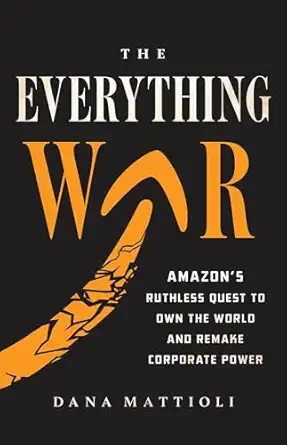
The Everything War
Amazon’s Quest to Own the World and Remake Corporate Power
by Dana Mattioli
The 60-Second Take
In The Everything War, Wall Street Journal reporter Dana Mattioli investigates Amazon's transformation from an online bookstore into an aggressive corporate titan. Drawing on hundreds of insider interviews, she exposes how the company leverages its massive data advantage, secret algorithms like Project Nessie, and espionage tactics through the Alexa Fund to crush competitors and copy third-party sellers. It is a sobering look at how monopolistic power reshapes global retail.
The Dark Side of Customer Obsession
Jeff Bezos built a massive empire on a single, compelling leadership principle: Customer Obsession. On the surface, this philosophy sounds perfect. It suggests a company entirely devoted to delivering exactly what the buyer wants, as quickly and cheaply as possible. But in The Everything War, Wall Street Journal reporter Dana Mattioli argues that this obsession often serves as a convenient smokescreen for brutal, anti-competitive behavior.
Mattioli spent years covering corporate mergers and acquisitions, where she noticed a disturbing trend: CEOs across every industry—from retail to healthcare—were making desperate, sometimes illogical strategic decisions simply out of fear of Amazon. After interviewing more than 600 current and former employees, executives, and partners, she paints a picture of a corporation that operates more like a sovereign nation than a traditional retailer. Amazon does not just want to lead the market; it wants to own the infrastructure that the entire market relies upon. This summary explores the specific, aggressive tactics Amazon uses to crush its rivals, exploit its partners, and maintain its stranglehold on global commerce.
What You'll Learn
How Amazon uses third-party seller data to build and advantage its own private label brands
The role of the Alexa Fund in conducting corporate espionage on emerging startups
How the secret "Project Nessie" algorithm manipulated pricing across the internet
Why the FTC is suing Amazon for illegal anti-competitive behaviors
How Amazon forces aggressive equity warrants onto its vendors and partners
The Espionage of the Alexa Fund
Venture capital is traditionally designed to foster innovation. A large tech company creates an investment arm to fund promising startups, taking a minority stake in exchange for providing capital and mentorship. Amazon launched the Alexa Fund in 2015 with this stated purpose, ostensibly aiming to support new companies working in voice technology. However, Mattioli reveals that the fund often operated as a corporate espionage unit.
Startups seeking investment were required to open their books and share their most sensitive, proprietary data. Because Amazon was simultaneously developing its own competing products, this created a massive conflict of interest. Mattioli recounts an incident where a founder placed her proprietary information in a secure data room for the Alexa Fund team, only to discover that Amazon employees entirely unaffiliated with the investment fund were accessing and reviewing her trade secrets.
Instead of acquiring these startups at fair market value or paying licensing fees for their technology, Amazon repeatedly used the information gathered during the due diligence process to build competing products. Doppler Labs is highlighted as one of the promising companies that fell victim to this strategy. By exploiting the very startups it claimed to support, Amazon maintained its technological dominance without having to pay for true innovation, effectively growing on the backs of its competitors.
Project Nessie and Algorithmic Price Manipulation
A core component of Amazon's public identity is its commitment to offering the lowest prices on the internet. But Mattioli details how the company deployed secret algorithms to manipulate market pricing to its advantage, most notably through a program called Project Nessie. This algorithm was specifically designed to test the elasticity of online pricing and extract maximum profit without losing the sale.
Project Nessie monitored how competitors priced their goods and artificially raised Amazon’s prices in tandem when those competitors followed suit. This allowed the company to quietly inflate the cost of goods for consumers across the entire e-commerce ecosystem, padding its margins while maintaining the illusion of competitive pricing.
These aggressive pricing tactics are central to the Federal Trade Commission’s sweeping antitrust lawsuit against the tech giant. The FTC, led by Chair Lina Khan, accuses Amazon of operating an illegal monopoly and engaging in behaviors that ultimately harm the very consumers it claims to be obsessed with. Project Nessie stands as a prime example of how immense data superiority allows a single platform to dictate the economic realities for buyers everywhere.
Cannibalizing the Third-Party Marketplace
Amazon's third-party marketplace is a massive driver of its profitability. Independent sellers use the platform to reach millions of customers, paying Amazon a fee for the privilege. In theory, this is a symbiotic relationship. In practice, Mattioli shows that Amazon treats its third-party sellers as unpaid research and development teams.
The company closely monitors the vast amounts of sales data generated on its platform to identify which niche products from smaller entrepreneurs are performing exceptionally well. Once a lucrative product is identified, Amazon's private label team copies the item down to its specific details. The company then manufactures an Amazon-branded version—often using insights gleaned from the original supplier—and sells it at a lower price.
Crucially, Amazon also controls the search algorithms that determine what customers see. The company routinely adjusted its search results to prioritize its newly minted proprietary products, burying the original creators several pages deep. This practice erodes the market share of independent businesses and ensures that the platform owner always wins, stacking the deck against the merchants who helped build the marketplace.
Equity Warrants and Predatory Partnerships
The imbalance of power extends beyond third-party sellers to the massive vendors and suppliers that stock Amazon's warehouses. Mattioli exposes the aggressive tactics Amazon uses to integrate its acquisitions and extract value from its corporate partners. To secure lucrative contracts or gain placement on the platform, suppliers were frequently strong-armed into providing Amazon with shares of equity in their businesses.
These equity warrants allowed Amazon to secure stakes in different companies at rates well below the prevailing market value. The strategy served a dual purpose: it generated massive financial upside for Amazon if the vendor succeeded, and it acted as a protective measure to block other companies from acquiring a controlling interest in a key supplier.
Amazon consistently demanded these warrants regardless of the partner’s actual financial health or the mutual benefit of the deal. Mattioli describes a corporate culture that resembled a brutal competition—likened by some to "The Hunger Games"—where executives were constantly pressured to perform and extract maximum concessions from partners. This ruthless approach alienated allies and fueled the growing regulatory scrutiny that now threatens to dismantle parts of the empire.
The Everything War at a Glance
Customer obsession vs. monopoly. Amazon uses its public commitment to consumers as a shield for aggressive, anti-competitive market domination.
The Alexa Fund. A venture capital arm that audited startup data rooms to extract proprietary information, later using it to build competing Amazon products.
Project Nessie. A secret algorithmic pricing tool that manipulated online prices to inflate margins, drawing intense scrutiny from the FTC.
Third-party cannibalization. Amazon tracks successful products from independent sellers, creates cheaper private-label clones, and alters search results to favor its own brands.
Predatory equity warrants. Amazon forces suppliers to hand over equity stakes at below-market value simply to secure distribution contracts.
A Quick Start Guide to Protecting Your Business from Monopolies
Compartmentalize your data. If you are partnering with a massive platform, tightly control access to your proprietary information and never put all your trade secrets in a shared data room.
Diversify your sales channels. Relying entirely on a single marketplace makes you vulnerable to sudden algorithm changes or private-label cloning. Build direct relationships with your customers.
Guard your equity. Be extremely wary of distribution deals that require you to hand over stock warrants below market value.
Monitor your IP. Use social listening tools and brand registries to quickly identify if a larger platform or competitor is ripping off your specific product designs.
Assume your partner is your competitor. Treat massive tech conglomerates as potential rivals, even when they present themselves as benevolent investors or vendors.
Who Should Read The Everything War (and Who Can Skip It)
Read it if you are an e-commerce entrepreneur or third-party seller trying to understand the invisible forces governing your product rankings.
Read it if you are a startup founder considering taking venture capital from the investment arm of a massive technology conglomerate.
Read it if you follow antitrust law, corporate governance, and the Federal Trade Commission's ongoing efforts to regulate big tech.
Skip it if you are looking for a highly technical guide on how to optimize your Amazon listings or master AWS cloud architecture.
Skip it if you only want a glowing, inspirational biography of Jeff Bezos; this is a deeply critical investigative report.
Final Reflections
The Everything War is a meticulously researched expose that shatters the carefully constructed mythology of corporate benevolence. Dana Mattioli does not simply recount Amazon's growth; she dissects the structural advantages that make that growth almost impossible to challenge. By exposing the reality of Project Nessie, the Alexa Fund, and the ruthless exploitation of third-party merchants, the book reframes Amazon's success. It becomes clear that the company did not just build a better mousetrap; it bought the factory, squeezed the suppliers, and actively broke the traps of anyone trying to compete. While the sheer scale of the antitrust violations presented can feel overwhelming, Mattioli provides an essential public service. She gives readers the vocabulary and the evidence needed to recognize monopolistic behavior, proving that unchecked corporate power ultimately harms the very customers it claims to serve.
The Bottom Line
Amazon’s unprecedented dominance was not built solely on innovation and efficiency, but on a systematic, ruthless strategy of exploiting its partners, manipulating market pricing, and copying the products of the independent sellers who built its marketplace.
Frequently Asked Questions
What is the main idea of The Everything War?
The main idea is that Amazon has leveraged illegal, anti-competitive behaviors to establish a market stranglehold across multiple industries. Through extreme corporate secrecy, predatory pricing algorithms, and the exploitation of third-party seller data, the company has grown into a monopoly that stifles competition.
What is the Alexa Fund controversy?
Amazon's Alexa Fund was introduced as a venture capital arm to invest in voice technology startups. In practice, it operated as a corporate espionage tool, gaining access to the proprietary data rooms of emerging companies only for Amazon to use that information to build competing products.
What is Project Nessie?
Project Nessie was a secret algorithm used by Amazon to manipulate online prices. It artificially inflated prices to test how much competitors would follow suit, allowing Amazon to quietly pad its profit margins without officially losing its status as the cheapest option.
Business Floss is reader-supported. When you use our links we may earn an affiliate commission that helps us keep the site running. Thank you for your support!


