
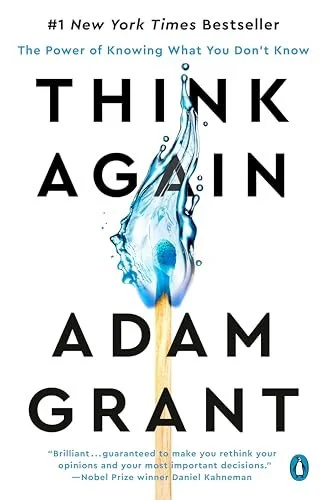
Think Again
The Power of Knowing What You Don’t Know
by Adam Grant
“THIS. This is the right book for right now. Yes, learning requires focus. But, unlearning and relearning requires much more—it requires choosing courage over comfort. In Think Again, Adam Grant weaves together research and storytelling to help us build the intellectual and emotional muscle we need to stay curious enough about the world to actually change it. I’ve never felt so hopeful about what I don’t know.
”
The Art of Being Wrong: Why Rethinking Is Your Most Valuable Skill
We live in a culture that worships conviction. From the politician who refuses to flip-flop to the CEO who sticks to their "vision" despite sinking profits, we often mistake steadfastness for strength and changing one’s mind for weakness. But ask yourself this: When was the last time you heard someone say, "I was wrong, and here is how my thinking has evolved"? It’s rare, isn’t it?
We treat our ideas like possessions to be guarded rather than hypotheses to be tested. The problem is that in a rapidly changing world, holding too tightly to your old tools and old beliefs doesn't make you principled; it makes you obsolete. In Think Again, organizational psychologist Adam Grant challenges us to embrace the joy of being wrong. He argues that intelligence is usually seen as the ability to think and learn, but in a turbulent world, there's another set of cognitive skills that might matter more: the ability to rethink and unlearn.
What You'll Learn
The Four Mindsets: How to spot when you are preaching, prosecuting, or politicking, and how to shift into "Scientist" mode.
The Power of Confident Humility: Why the sweet spot of success lies between arrogance and insecurity.
Persuasion Techniques: How to open other people’s minds not by overpowering them, but by listening.
Challenge Networks: Why you need friends who criticize you more than friends who cheerlead for you.
Escape the Three Professions of the Mind
Most of us, without realizing it, slip into one of three distinct mental modes when we talk, think, or argue. Grant categorizes these as the Preacher, the Prosecutor, and the Politician.
When our sacred beliefs are in jeopardy, we become Preachers, delivering sermons to protect and promote our ideals. When we see flaws in someone else's reasoning, we become Prosecutors, marshaling arguments to prove them wrong and win the case. And when we are seeking approval from an audience, we become Politicians, campaigning and lobbying for their support.
The danger is that in all three modes, the truth is secondary. The goal is to be right, to win, or to be liked. You are already convinced you know the answer before you start.
Grant suggests a fourth mode: The Scientist.
Thinking like a scientist doesn't mean you need a lab coat. It means you don't let your ideas become your identity. When a scientist sees data that contradicts their hypothesis, they don't get offended; they get curious. They treat an opinion as a hunch, not a truth. Shifting into this mode allows you to say, "That's a fascinating counterpoint; I hadn't thought of that," rather than digging in your heels.
Consider the cautionary tale of Mike Lazaridis, the genius behind BlackBerry. For a decade, his device dominated the world. But when the iPhone launched, Lazaridis slipped into Preacher mode. He preached the virtues of the keyboard. He prosecuted the idea of typing on glass. He believed people wanted a communication tool, not a toy. He failed to rethink his assumptions until it was too late. By the time he accepted the touchscreen, the market had moved on. His intelligence and past success actually blinded him to the future.
The Sweet Spot: Confident Humility
Many of us fear that if we admit we don't know something, we'll look incompetent. We often confuse confidence with competence. Grant introduces the concept of "Confident Humility" as the antidote to this fear.
Confidence is believing in yourself. Humility is knowing you don't have all the answers. They are not opposites; they are partners. You can have faith in your capability to learn a solution while acknowledging that you don't possess the solution right now.
This is the exact opposite of the "Armchair Quarterback" syndrome (or the Dunning-Kruger effect), where people with low competence possess high confidence. They are stranded on "Mount Stupid," unable to see their own ignorance. On the other end of the spectrum is Imposter Syndrome—high competence but low confidence.
Confident humility sits in the ideal middle ground. It sounds like this: "I am not sure if we can pull this off yet, but I am confident we have the team to figure it out." This mindset keeps you hungry for data and open to feedback. It prevents you from becoming a BlackBerry in an iPhone world.
Key Terms at a Glance
The Preacher: A mindset focused on defending sacred beliefs and proselytizing to others.
The Prosecutor: A mindset focused on attacking the flaws in others' reasoning to "win" the argument.
The Politician: A mindset focused on winning the approval of an audience rather than finding the truth.
The Scientist: The ideal mindset. You treat opinions as hypotheses, data as a guide, and are willing to abandon old ideas when evidence suggests they are wrong.
Confident Humility: The ability to have faith in your capacity to learn while acknowledging your current ignorance.
Binary Bias: The tendency to seek clarity by simplifying complex continuums into two mutually exclusive categories (e.g., Good vs. Bad).
The Art of Persuasion: Don't Bully, Dance
We often think that to win an argument, we need to overwhelm the other person with facts, logic, and superior reasoning. We act like logic bullies. But Grant points out that this usually backfires. When you push, people push back. They put their defenses up.
Effective rethinking in interpersonal situations looks less like a tug-of-war and more like a dance.
One of the most powerful tools Grant explores is Motivational Interviewing. Originally developed for addiction counseling, this technique helps people find their own motivation to change. Instead of telling someone why they are wrong, you ask open-ended questions that help them examine their own thinking.
For example, instead of telling a resistant employee, "You need to adopt this new software because it’s more efficient," a manager using this approach might ask, "On a scale of 1 to 10, how happy are you with our current workflow?" If they say "Six," you follow up with, "Why a six and not a ten?" This invites them to articulate the problems themselves. Once they say the current system is flawed, they are much more open to a solution.
Another counterintuitive finding Grant shares regarding persuasion is the "dilution effect." We tend to think that the more reasons we give to support our case, the better. But weak arguments dilute strong ones. If you give five reasons to invest in a project, and two are shaky, the skeptic will latch onto the two shaky ones and dismiss your entire proposal. It is often better to present your two strongest arguments and stop there.
Building a Challenge Network
We all have a support network—the people who bring us soup when we’re sick and cheer us on when we get a promotion. We love these people. But for professional growth and cognitive flexibility, Grant argues we also need a Challenge Network.
These are the people who trust you enough to tell you the truth. They are the critics who tear apart your presentation before you give it to the board. They are the skeptical colleagues who ask, "Have you considered why this might fail?"
Grant shares the story of the Wright brothers, who argued constantly. To an outsider, it looked like hostility. But they were engaging in "task conflict," not "relationship conflict." They weren't attacking each other personally; they were attacking the ideas. Because they respected one another, the friction polished their thinking and led to the airplane.
If everyone in your circle agrees with you, you aren't learning; you're just being reinforced. You need to actively invite people to poke holes in your logic. When someone challenges you, the knee-jerk reaction is to defend. The "Scientist" reaction is to say, "Tell me more. What am I missing?"
Rethinking Your Career and Life
Finally, Grant asks us to apply these principles to our biggest life decisions. We are often taught to "have a plan" at a young age. We ask children, "What do you want to be when you grow up?" as if they should lock in a career path at age ten.
This leads to Identity Foreclosure—settling on a path before we've explored enough options. We get a degree in law because we decided to be a lawyer at 17, only to find at 30 that we hate the daily reality of legal work. Yet, because of the "sunk cost fallacy" (the time and money already invested), we refuse to rethink the plan.
Grant encourages us to schedule "life checkups." Just as you go to the doctor twice a year to check your physical health, you should sit down once or twice a year to check your career health. Are you still learning? Is this path still aligned with your values? It is perfectly acceptable—even necessary—to abandon a plan that no longer serves the person you have evolved into.
Quick Start Guide: How to Practice Rethinking
Conduct a "Rethinking Audit": Look at your calendar and budget. Do you spend money and time on things simply because "that's how we've always done it"? Identify one recurring meeting or expense to question this week.
Ban the Phrase "That's Not How We Do It Here": Replace it with, "Let’s experiment with that for a month and see what happens."
Argue Like a Scientist: Next time you are in a debate, acknowledge the valid points the other person makes. Say, "You're right about X, and that makes me think..." It disarms them and signals you are listening.
Seek Out Disconfirming Info: If you think a project is a good idea, spend one hour specifically searching for reasons why it might be a bad idea. If you can't find any, you aren't looking hard enough.
Create a "Mistake Log": Keep a notebook where you write down times you were wrong. Review it monthly. If the log is empty, you aren't taking enough risks or you aren't being honest with yourself.
Final Reflections
Think Again serves as a crucial reminder that in a knowledge economy, the ability to change your mind is a superpower. Adam Grant illustrates that holding onto old beliefs doesn't make us consistent; it makes us complacent. By identifying our own tendencies to preach, prosecute, or politick, and instead choosing to think like scientists, we open ourselves up to growth. Whether it is rethinking a business strategy, a political view, or a career path, the goal is not to be right, but to get it right. Embrace the joy of being wrong, surround yourself with a challenge network, and remember: if you don't look back at your old self and wonder how you could have been so naive, you probably haven't learned enough.
Business Floss is reader-supported. When you use our links we may earn an affiliate commission that helps us keep the site running. Thank you for your support!


